


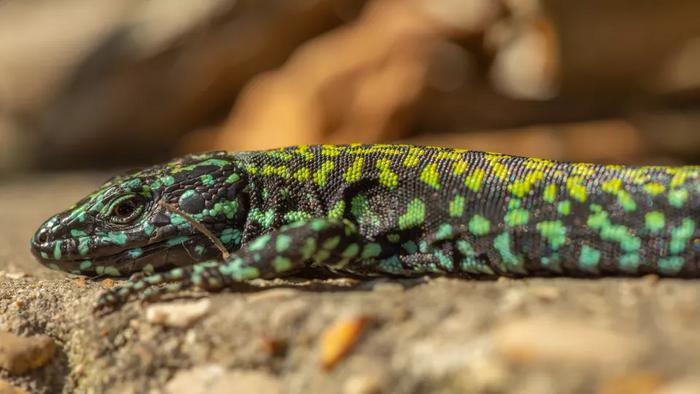
Body shape, colour and behaviour often evolve together as species adapt to their environment. Researchers from Lund University in Sweden have studied this phenomenon in a specific type of large, bright green and aggressive common wall lizard found near the Mediterranean. They discovered that a unique cell type might have played a key role in this joint evolution.

Credit: Javier Abalos
Body shape, colour and behaviour often evolve together as species adapt to their environment. Researchers from Lund University in Sweden have studied this phenomenon in a specific type of large, bright green and aggressive common wall lizard found near the Mediterranean. They discovered that a unique cell type might have played a key role in this joint evolution.
Adaptation is a genetic change that results in increased viability in the surrounding environment. It may affect colour, shape and behaviour. However, the basis for how this works genetically has remained shrouded in mystery.
In a new study, evolutionary biologists have combined field work and DNA analysis to study large, green, aggressive and sexually prominent wall lizards in the Mediterranean region. They discovered a number of genes responsible for the lizard’s Hulk-like appearance.
“All tissues and organs that are behind the Hulk-like appearance develop from cells called neural crest cells that form in the early embryo. We believe that the cells that underlie changes in shape, colour and behaviour are regulated together, and that the traits therefore evolve together,” says Nathalie Feiner, evolutionary biologist at Lund University.
The research group investigated a common wall lizard with green and black colouring, impressive body size and aggressive behaviour. Males with this appearance emerged many thousands of years ago, close to present-day Rome, and have shown themselves to be dominant over males with other colour combinations. This has resulted in the Hulk lizards spreading throughout Italy.
“Our knowledge of neural crest cells comes almost entirely from a few model organisms, such as mice. We are now charting this type of cell in lizard embryos in order to understand how phenomena such as the Hulk lizard can evolve,” says Nathalie Feiner.
Over the next few years, Feiner and her team will conduct more field studies, set up breeding groups and undertake advanced genetic analyses, including using the CrispR-Cas9 gene-editing technique. All with the aim of establishing what role neural crest cells play in the intertwined evolution of colour, shape and behaviour.
“Our focus is on lizards, but our discoveries can probably be applied to all animals with neural crest cells, which would cover around 70,000 species of vertebrate. Although our work provides a possible explanation to how evolution works, it is also the beginning of many new areas of research,” she says.
In addition to Lund University, the following higher education institutions and organisations participated in the study: Chengdu Institute of Biology, University of Tasmania, Uppsala Genome Centre.
Journal
Science Advances
Article Title
Adaptive introgression reveals the genetic basis of a sexually selected syndrome in wall lizards
Article Publication Date
3-Apr-2024
Cite Scienmag News
Gavin Prescott. (April 29, 2024). “Incredible Hulk” lizard provides clues to understanding evolution. Scienmag. https://scienmag.com/incredible-hulk-lizard-provides-clues-to-understanding-evolution/
Gavin Prescott. "“Incredible Hulk” lizard provides clues to understanding evolution." Scienmag, 29 April 2024, https://scienmag.com/incredible-hulk-lizard-provides-clues-to-understanding-evolution/. Accessed 7 September 2026.
Gavin Prescott. "“Incredible Hulk” lizard provides clues to understanding evolution." Scienmag. April 29, 2024. https://scienmag.com/incredible-hulk-lizard-provides-clues-to-understanding-evolution/

