


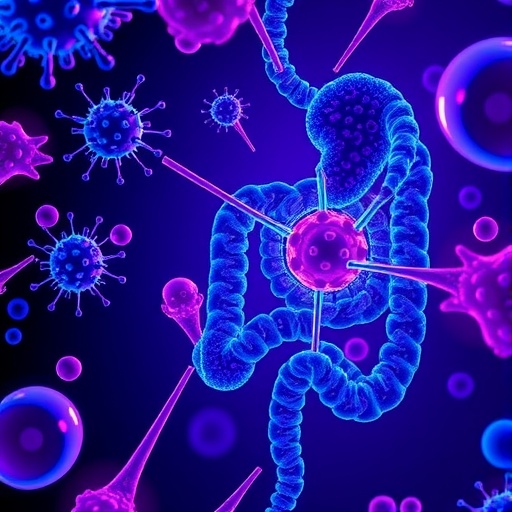
In a groundbreaking study that redefines our understanding of the gut microbiome’s influence on systemic diseases, researchers have unveiled a novel microbial metabolite that plays a critical role in the progression and potential treatment of paediatric sepsis. The intricate interplay between gut microbes and bile acid chemistry, long suspected but poorly understood, has been elucidated through comprehensive metabolomics and metagenomic analyses, offering fresh insights into the mechanisms underlying sepsis—a life-threatening condition that disproportionately affects children worldwide.
This study, published in Nature Microbiology, pivots on the discovery of deoxycholic acid 3-sulfate (DCA-3S), a sulfated bile acid variant whose levels correlate strongly with the severity and progression of sepsis in paediatric patients. Using state-of-the-art bile acid-targeted metabolomics combined with deep gut metagenomic sequencing, the researchers identified DCA-3S as a robust biomarker associated with sepsis stages, suggesting it could serve both diagnostic and prognostic purposes.
One of the most surprising revelations of this investigation is the identification of Enterococcus raffinosus, a commensal bacterial species within the human gut flora, as the primary producer of DCA-3S. This discovery challenges the long-established dogma that bile acid sulfation—a detoxification process—occurs exclusively in the liver via hepatocytes. Instead, the research highlights a previously unrecognized microbial pathway of bile acid modification occurring directly in the gut lumen, contributing over 80% of DCA-3S production.
Sepsis, characterized by an overwhelming immune response to infection leading to organ dysfunction, has long been associated with disruptions in the gut microbiota and bile acid profiles. However, the causative links and therapeutic targets have remained elusive. Through rigorous in vitro culture experiments and in vivo mouse models, the study rigorously demonstrated that E. raffinosus synthesizes DCA-3S via sulfotransferase enzymes encoded within its genome—enzymes traditionally thought to be exclusive to liver tissues in mammalian hosts.
Further functional assays employing murine models of sepsis showed that administration of purified or synthetic DCA-3S markedly improved survival rates. Mechanistically, DCA-3S enhances intestinal barrier integrity by upregulating tight junction proteins and reducing epithelial permeability, which is critical in preventing bacterial translocation and systemic inflammation—hallmarks of sepsis pathology.
Interestingly, beyond fortifying epithelial barriers, DCA-3S also exhibited potent anti-inflammatory effects. Its presence dampened systemic cytokine storms by modulating key signaling pathways in immune cells, including NF-κB and MAP kinase pathways, which are central to inflammatory amplification in sepsis. This dual action—barrier protection coupled with immunomodulation—positions DCA-3S as a multifaceted therapeutic agent.
The translational potential of these findings is profound. Current sepsis management relies heavily on broad-spectrum antibiotics and supportive care, often with limited specificity and significant side effects such as microbiome dysbiosis. The prospect of harnessing a microbial metabolite to restore gut homeostasis and mitigate inflammatory injury opens new avenues for precision medicine in critical care settings, especially for vulnerable paediatric populations.
Complementing animal studies, experiments utilizing human intestinal organoids recapitulated DCA-3S’s beneficial effects in vitro, underscoring its potential applicability in human therapeutics. These organoid models confirmed enhancement of epithelial barrier function and attenuated inflammatory signaling upon DCA-3S treatment, validating its role as a bioactive metabolite directly influencing gut mucosal health.
The researchers also explored the dynamics of E. raffinosus colonization in sepsis patients, discovering that abundances of this bacterium—and consequently levels of DCA-3S—were inversely correlated with disease severity. This suggests a protective microbiota signature that could be harnessed prognostically or through microbiota-targeted therapies such as probiotics or fecal microbiota transplantation.
Moreover, the sulfation process mediated by E. raffinosus represents a paradigm shift in bile acid biology, expanding the concept of microbial co-metabolism in the gut-liver axis. It highlights microbes as active contributors, not just passive recipients, in host xenobiotic metabolism. This insight may prompt a reevaluation of bile acid biochemistry, with implications extending beyond sepsis to other inflammatory and metabolic disorders influenced by bile acid signaling.
This study exemplifies the power of integrative omics approaches, combining metabolomic profiling with high-resolution metagenomics to unravel complex host-microbe interactions. It underscores the importance of microbial functional capacity—not merely microbial presence—in dictating health outcomes, thereby refining our approach to microbiome research from descriptive to mechanistic.
The discovery of DCA-3S and its microbial origin adds a new dimension to sepsis biology, bridging gaps in our knowledge about how gut microbial metabolites modulate systemic immunity and organ function. It invites future exploration into microbial enzymes mediating bile acid transformations and their regulation by diet, antibiotics, and other environmental factors.
Future clinical translation will require careful assessments of dosing, safety, and delivery mechanisms for DCA-3S-based therapies. Moreover, longitudinal studies in diverse populations are needed to consolidate the role of E. raffinosus and DCA-3S as biomarkers, potentially leading to tailored microbiome-informed interventions that improve patient outcomes.
This innovative research not only enriches our understanding of gut microbiota’s contributions to sepsis but also epitomizes the emergent field of microbial metabolite therapeutics. It paves the way for exploiting naturally occurring molecules synthesized by commensal bacteria to modulate human disease, heralding a new era where microbiome-derived compounds transition from bench to bedside.
As paediatric sepsis continues to challenge healthcare systems globally, discoveries like DCA-3S offer hope for more effective and less invasive treatments. By elucidating how a single bacterial species can profoundly influence host bile acid metabolism and immune responses, this work elevates the human microbiome from a mysterious entity to a tangible partner in combating critical illnesses.
In summary, the identification of Enterococcus raffinosus as the microbial architect of the sulfated bile acid DCA-3S ushers in a novel conceptual framework for sepsis diagnosis and treatment. This microbial metabolite emerges as a promising biomarker and therapeutic agent, capable of restoring gut barrier function and modulating the immune landscape in pediatric sepsis—a breakthrough that could reshape future strategies to tackle this devastating condition.
Cite Scienmag News
Morgan Morrow. (May 1, 2026). Gut Microbe’s Sulfated Bile Acid Eases Pediatric Sepsis. Scienmag. https://scienmag.com/gut-microbes-sulfated-bile-acid-eases-pediatric-sepsis/
Morgan Morrow. "Gut Microbe’s Sulfated Bile Acid Eases Pediatric Sepsis." Scienmag, 1 May 2026, https://scienmag.com/gut-microbes-sulfated-bile-acid-eases-pediatric-sepsis/. Accessed 5 September 2026.
Morgan Morrow. "Gut Microbe’s Sulfated Bile Acid Eases Pediatric Sepsis." Scienmag. May 1, 2026. https://scienmag.com/gut-microbes-sulfated-bile-acid-eases-pediatric-sepsis/


