


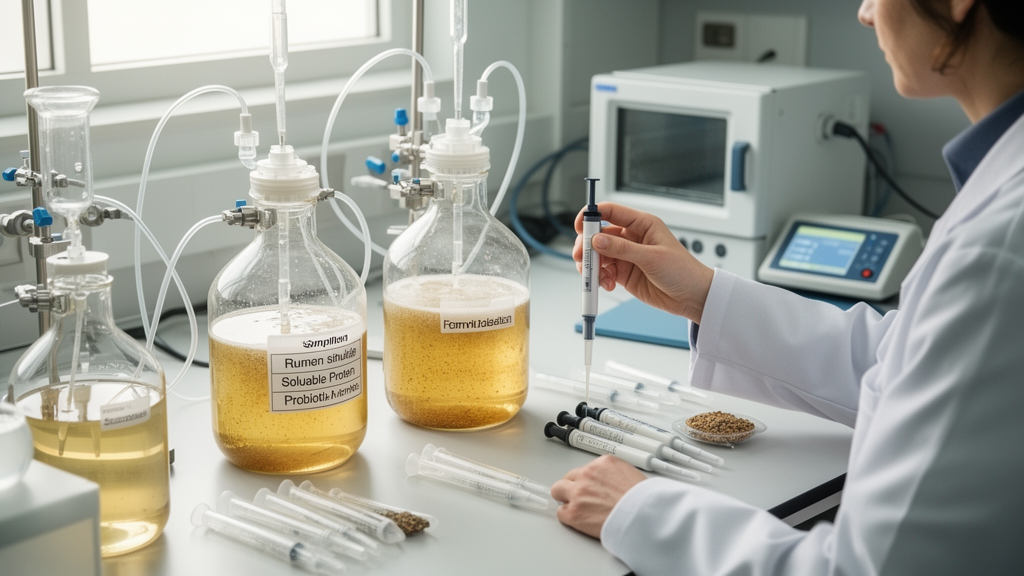
An in vitro study of cattle rumen fermentation found that a compound probiotic containing Candida tropicalis and Enterococcus faecalis increased the soluble-protein fraction of a cottonseed-meal-based feed, while the most pronounced fermentation response occurred when the fermented substrate had a soluble-protein to insoluble-protein ratio of 1:2.5. At that ratio, the researchers measured higher total volatile fatty acids, acetate, propionate and valerate, together with greater crude-protein degradation and a rumen microbial community containing relatively more Streptococcus and Ruminobacter . The experiment used rumen fluid from three adult female Huaxi cattle and provides preliminary laboratory evidence rather than proof of benefits in living animals.
The researchers at Shihezi University in China first screened seven probiotic strains for their effects on a feed substrate containing cottonseed meal, corn flour and wheat bran. Cottonseed meal served as the main protein source, corn flour supplied fermentable carbohydrate and wheat bran provided a porous fibrous structure. The mixture was fermented for 48 hours at 40% moisture with individual strains or without inoculation, after which soluble protein, crude protein, microbial crude protein, ammonia nitrogen and pH were assessed.
All seven strains increased soluble-protein content relative to the uninoculated control, but C. tropicalis , Saccharomyces cerevisiae and E. faecalis produced the strongest overall results when the indicators were ranked together. The ranking used soluble protein, crude protein and microbial crude protein as positive indicators, ammonia nitrogen as a negative indicator and pH as a range-based indicator. The three best-performing strains were then tested in combinations using an orthogonal experimental design.
Four combinations were evaluated, each with or without each organism. The combination containing C. tropicalis and E. faecalis , without S. cerevisiae , had the highest measured soluble protein, at 34.28% of crude protein, the highest crude protein, at 19.4% of dry matter, and the highest microbial crude protein, at 43.29% of dry matter. It also had the lowest ammonia nitrogen, at 1.26 g/kg total nitrogen, and the lowest pH, at 4.19, among the four combinations tested.
These findings selected the two-organism culture for the subsequent rumen incubation experiment; they did not establish a molecular mechanism for its performance or demonstrate benefits in animals. The selected culture was used to ferment three substrates with different protein structures. S1 had a soluble-protein to insoluble-protein ratio of 1:2, with soluble protein representing 33.5% of crude protein; S2 used a ratio of 1:2.5 and 28.7% soluble protein; and S3 used 1:3 and 25.0% soluble protein.
Before fermentation, the formulations contained 18.2%, 17.1% and 24.3% crude protein on a dry-matter basis, respectively. The experiment therefore compared the targeted protein ratios together with the ingredient adjustments used to create them, rather than changing only the ratio in an otherwise chemically identical feed. S2 delivered the highest total volatile fatty acid concentration, 144.08 mmol/L, compared with 116.15 mmol/L for S3 and 103.08 mmol/L for S1.
The individual volatile fatty acids followed the same overall pattern. S2 contained 62.85 mmol/L acetate, 25.78 mmol/L propionate and 11.57 mmol/L valerate, all significantly higher than the corresponding values in S1 and S3 at the study’s statistical threshold. S3 produced intermediate values for total volatile fatty acids, acetate, propionate and valerate, while S1 had the lowest concentrations of these measures.
Butyrate and isobutyrate did not differ significantly among the three groups, and the acetate-to-propionate molar ratio was also similar, ranging from 2.40 to 2.49. Substrate degradation showed a somewhat different pattern. Crude-protein disappearance was significantly higher in S1 and S2 than in S3, although S1 and S2 did not differ significantly from one another.
Dry-matter disappearance increased over the 48-hour incubation and was numerically highest in S2 at the endpoint, followed by S3 and S1. Sampling time and the interaction between time and treatment were significant for dry-matter disappearance, but the treatment main effect was not. Culture pH declined gradually, with values fluctuating within 6.47–7.64, and treatment did not significantly affect pH.
Ammonia nitrogen differed with both time and treatment, while the time-by-treatment interaction was not significant. S1 and S3 maintained higher ammonia-nitrogen concentrations during part of the incubation, showing that nitrogen accumulation and the strongest overall endpoint response cannot be equated in a simple way. For the microbial analysis, the researchers amplified and sequenced the V3–V4 region of the 16S rRNA gene from the incubated communities, using six biological replicates per treatment.
Richness estimates, including the Chao, Ace and Simpson indices, did not differ significantly among S1, S2 and S3, although the Shannon index differed between S1 and S3. Principal-coordinate analysis showed distinct community structures among the three treatments, with a significant difference in beta diversity. At genus level, Streptococcus and Ruminobacter were relatively more abundant in S2, while Rikenellaceae_RC9_gut_group was less abundant in S2 and S3 than in S1.
Bacteroidetes and Bacillota together accounted for more than 83% of the sequences, and the groups contained 233, 159 and 217 unique operational taxonomic units, respectively. The microbial findings are consistent with the better fermentation measured in S2, but they do not demonstrate that Streptococcus or Ruminobacter caused the increase in volatile fatty acids or protein disappearance. The study did not measure functional gene expression, metagenomic functions or the activities of enzymes involved in nitrogen metabolism.
Its authors therefore describe the enrichment of these genera as a potentially important association. The selection of soluble and insoluble protein fractions followed the CNCPS protein-fractionation system: soluble protein comprised non-protein nitrogen plus soluble true protein, while insoluble protein was calculated as crude protein minus those two components. These analytical definitions helped quantify the protein structures that the probiotics fermented before the rumen incubation.
Several limitations constrain the conclusions. Fermentation can alter carbohydrate fractions as well as protein, but the researchers did not perform a comprehensive post-fermentation analysis of neutral-detergent fiber, acid-detergent fiber, starch or water-soluble carbohydrates. Consequently, differences in volatile fatty acid production, dry-matter disappearance, crude-protein disappearance and microbial composition cannot be attributed solely to the initial soluble-to-insoluble protein ratio.
The in vitro system also omits host immune responses, ruminal absorption and feed passage kinetics. Rumen fluid came from only three donor animals, only a limited set of strains was tested, and no animal growth, milk-production or feed-intake outcomes were measured. As a result, the findings support further in vivo testing but do not establish improved animal performance, reduced nitrogen excretion or a practical feeding recommendation.
Overall, the experiments show that probiotic fermentation can alter the protein structure of a cottonseed-meal-based substrate and that an intermediate soluble-protein proportion of 28.7% of crude protein corresponded to the most favorable measured rumen-fermentation outcomes. The C. tropicalis – E. faecalis combination also outperformed the screened single strains and the other tested combination in the feed-fermentation indicators. Yet the experiment demonstrates a laboratory association, not a causal mechanism or a proven benefit for cattle.
Validating whether the two organisms and the 1:2.5 ratio can improve nitrogen-use efficiency in vivo will require controlled animal studies, full compositional measurements of the fermented feeds and functional or omics-based analysis of the rumen microbiome.
Subject of Research: In vitro testing of probiotic-fermented feed protein structure and rumen fermentation in cattle
Article Title: In vitro investigation of probiotic-mediated enhancement of soluble protein utilization and rumen fermentation efficiency
Article References: Yang, X., Ma, X., Chen, N., Qi, Y., Li, S., Wu, Y., & Zhang, W. (2026). In vitro investigation of probiotic-mediated enhancement of soluble protein utilization and rumen fermentation efficiency. Frontiers in Veterinary Science, 13, Article 1899102. https://doi.org/10.3389/fvets.2026.1899102
Image Credits: AI Generated
DOI: 10.3389/fvets.2026.1899102
Keywords: probiotics, rumen fermentation, soluble protein, nitrogen utilization, cattle nutrition, cottonseed meal, volatile fatty acids, rumen microbiome, feed fermentation, in vitro study, vitro, investigation
Cite Scienmag News
William Thompson. (October 20, 2026). In vitro investigation of probiotic-mediated enhancement of soluble protein utilization and rumen fermentation efficiency. Scienmag. https://scienmag.com/in-vitro-investigation-of-probiotic-mediated-enhancement-of-soluble-protein-utilization-and-rumen-fermentation-efficiency/
William Thompson. "In vitro investigation of probiotic-mediated enhancement of soluble protein utilization and rumen fermentation efficiency." Scienmag, 20 October 2026, https://scienmag.com/in-vitro-investigation-of-probiotic-mediated-enhancement-of-soluble-protein-utilization-and-rumen-fermentation-efficiency/. Accessed 20 October 2026.
William Thompson. "In vitro investigation of probiotic-mediated enhancement of soluble protein utilization and rumen fermentation efficiency." Scienmag. October 20, 2026. https://scienmag.com/in-vitro-investigation-of-probiotic-mediated-enhancement-of-soluble-protein-utilization-and-rumen-fermentation-efficiency/


