


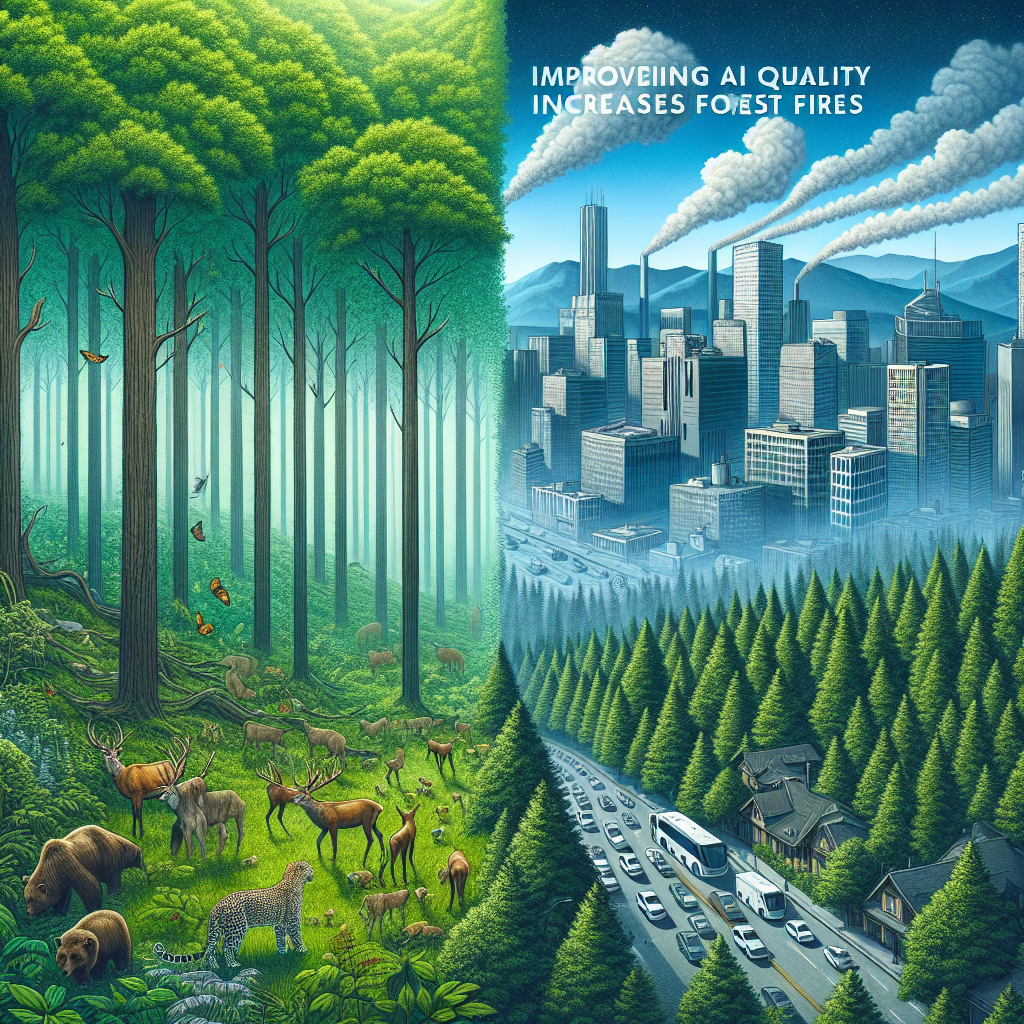
If we want cleaner air, fewer forest fires, and less severe climate change, a new UC Riverside study shows we must reduce aerosol pollution and greenhouse gases like carbon dioxide at the same time.
If we want cleaner air, fewer forest fires, and less severe climate change, a new UC Riverside study shows we must reduce aerosol pollution and greenhouse gases like carbon dioxide at the same time.
The study found that boreal forests in the northern hemisphere are particularly vulnerable to negative effects of cleaning up aerosol pollution. This includes forests in Canada, Alaska, northern Europe, and northern Russia.
Aerosols are small particles like dust and sea salt as well as airborne chemicals produced by fossil fuel combustion. They are responsible for poor air quality. The UCR study, published in the journal Science Advances, showed that reducing levels of human-made aerosols causes an increase in wildfires, especially in northern hemisphere forests.
Because aerosol particles like sulfate and their precursors like sulfur dioxide reflect sunlight and help make clouds brighter, removing them means more of the sun’s heat hits the ground.
“Cleaning up the air, which is something we all want to do, will accelerate global warming and also impact wildfires unless we also reduce emissions of greenhouse gases like methane and carbon dioxide,” said Robert Allen, UCR climatology professor and lead study author.
The warming effect of atmospheric carbon dioxide levels is well known. Burning fossil fuels for heat, electricity, and transportation is adding increasing levels of CO2 into the atmosphere. The CO2 acts like a blanket, preventing heat from leaving Earth.
Heat waves and drought occur more frequently in today’s climate than they did 50 years ago. These conditions cause plants to die and become kindling for wildfires.
“When you dry out the soil, that also dries out plants, which makes them more combustible,” Allen said. “Warming contributes to wildfires.”
Both CO2 and aerosol reductions cause warming and create large increases in forest fires. However, reducing aerosol emissions creates more fire.
“We usually associate fire activity with increasing heat — drier conditions, enhanced combustibility, and so on,” Allen said. “But in our experiments, we saw that even though increases in CO2 cause a bigger increase in temperatures, there is actually a bigger increase in fire activity with aerosol mitigation.”
As plants convert light into food in a process called photosynthesis, they use CO2. With more CO2 in the atmosphere, plants don’t have to keep the pores in their leaves open for as long to get the CO2 they need. Keeping their pores closed allows them to retain more water. It also means the plants don’t need to draw as much water from the soil.
This implies that under aerosol mitigation, plants dry out more. As fewer cooling aerosols make conditions warmer, water evaporates more from plant pores. As the plants lose water, they have to draw more of it from the soil, which also leads to drier soil.
Of note is that human-made aerosols have a short lifespan. “If you stopped aerosol emissions today, they’d fall out of the atmosphere in a week,” Allen said.
Globally, there has been progress on reducing sulfate aerosols resulting from sulfur dioxide emissions. The U.S. and Europe have significantly decreased coal combustion. Remaining coal-fired power plants now use “scrubber” technology that prevents these chemicals from forming. “This is good for air quality but potentially bad for the climate,” Allen said.
One faster way to offset the warming induced by aerosol mitigation would be to make significant reductions in methane emissions from agriculture, fossil fuels, and landfill waste.
Methane warms the planet 86 times more powerfully than carbon dioxide but has a much shorter half-life. Methane only lasts about a decade, compared to CO2 which can potentially last for thousands of years.
“The warming you’d get from reducing aerosols could be offset by reducing enough methane,” Allen said.
More than 150 countries have signed a pledge to reduce methane emissions by at least 30 percent from 2020 levels by 2030. The participants represent more than half of all human-made methane emissions, so it is an achievable goal.
“We are on the right trajectory with regards to aerosols and methane. I still have hope, but there is a narrow window of time to make this happen and avoid the worst projected climate impacts,” Allen said. “This decade is the important one.”
Journal
Science Advances
Article Title
Are Northern Hemisphere boreal forest fires more sensitive to future aerosol mitigation than to greenhouse gas–driven warming?
Article Publication Date
29-Mar-2024
Cite Scienmag News
Russell Cooper. (May 29, 2024). Improving air quality increases forest fires. Scienmag. https://scienmag.com/improving-air-quality-increases-forest-fires/
Russell Cooper. "Improving air quality increases forest fires." Scienmag, 29 May 2024, https://scienmag.com/improving-air-quality-increases-forest-fires/. Accessed 3 September 2026.
Russell Cooper. "Improving air quality increases forest fires." Scienmag. May 29, 2024. https://scienmag.com/improving-air-quality-increases-forest-fires/


