

Friday, October 30, 2026
Science
No Result
View All Result
  • Login
  • HOME
  • SCIENCE NEWS
  • CONTACT US
  • HOME
  • SCIENCE NEWS
  • CONTACT US
No Result
View All Result
Scienmag
No Result
View All Result
Home Science News Biology

Implants Track Activity Changes in Rabies-Infected Foxes Before Death

October 29, 2026
in Biology, Technology and Engineering
Drew Townsend
By Drew Townsend Scienmag Editorial Profile - Cell Biology
Reading Time: 3 mins read
0
Implants Track Activity Changes in Rabies-Infected Foxes Before Death

Implants Track Activity Changes in Rabies-Infected Foxes Before Death

65
SHARES
587
VIEWS
Share on FacebookShare on Twitter
ADVERTISEMENT

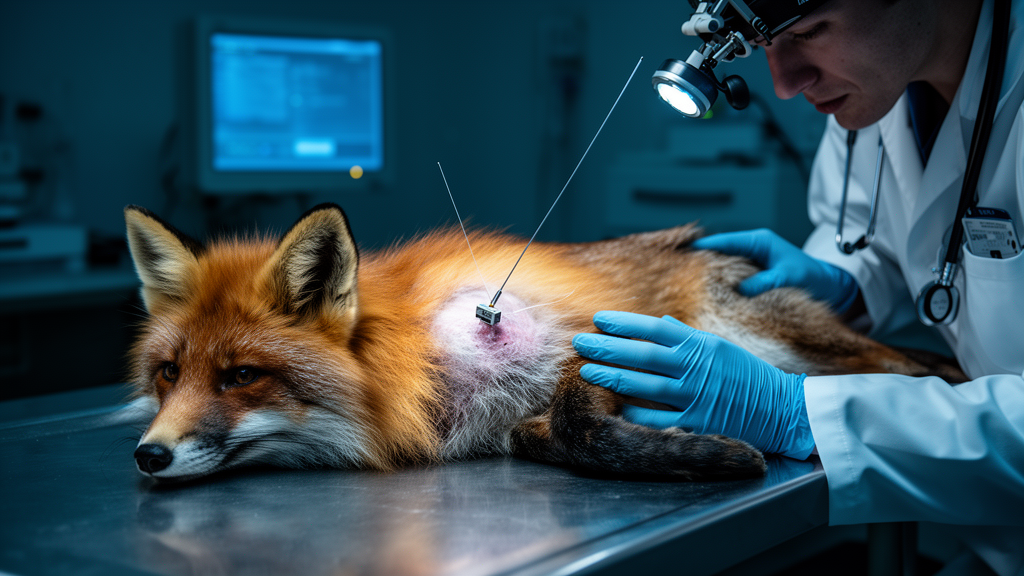
In a proof-of-concept study published in the journal Animal Biotelemetry, four foxes fitted with devices that logged body temperature and activity levels showed measurable changes in behavior during rabies infection, in some cases triggering alerts up to two weeks before the animals died.

The work addresses a practical gap. Technological advances now allow continuous health and welfare monitoring in many settings, but such tools remain little used for less common laboratory animals. ANSES maintains a colony of red foxes (Vulpes vulpes) for regulatory and research purposes, chiefly because the agency serves as a reference laboratory for rabies and Echinococcus parasites for France and the European Union. Both are serious zoonotic diseases, making fox health monitoring a matter of institutional as well as animal welfare interest.

In 2022, the four foxes were surgically fitted with internal implants recording two variables: body temperature and activity. The study team, led by Julie Teresa Shapiro, retrospectively analyzed whether these two continuously measured variables could serve as an early warning system for the onset of rabies symptoms.

The analytical approach relied on anomaly detection algorithms rather than simple thresholds. The researchers applied two established methods, the Shewhart control chart and the exponentially weighted moving average (EWMA), at varying confidence levels. Each algorithm was run individually on the temperature and activity data streams from each fox. The team then compared how early the different models could detect significant changes while limiting false alarms during a calibration period before infection.

The results were clear on one front. All four foxes significantly changed their activity levels during infection, and the EWMA algorithm detected these changes most reliably at the individual animal level. In some cases, the algorithm produced consecutive alarms as long as two weeks before the animal’s death, while keeping false alarms during the calibration period in check.

Body temperature told a different story. The researchers found no evidence of fever in any of the infected foxes, and temperature did not appear to be a reliable indicator of health in this context.

The authors are careful about the limits of the study. Rabies is a particularly severe disease model, rarely implemented in this way, and the sample size was small: four animals. The analysis was also retrospective, applied to data collected during a completed experiment rather than tested as a live alerting system. The findings therefore establish potential, not validated clinical practice, and the algorithms’ performance in other diseases or species remains to be demonstrated.

Even so, the researchers argue the approach could extend well beyond this severe model. They suggest the same implant-and-algorithm combination could support experimental protocols with milder clinical signs, and routine long-term monitoring designed to catch unexpected declines in health or welfare in captive animals.

Subject of Research: Real-time health and welfare monitoring of rabies-infected red foxes using implanted biotelemetry sensors and anomaly detection algorithms

Article Title: Potential for real-time health and welfare monitoring of red fox (Vulpes vulpes) in experimental settings using implants

Article References: Shapiro, J. T., Morignat, E., Dubois, D., Penel, N., Madouasse, A., Robardet, E., Amat, J.-P., Hénaux, V., & Lesellier, S. (2026). Potential for real-time health and welfare monitoring of red fox (Vulpes vulpes) in experimental settings using implants. Animal Biotelemetry. https://doi.org/10.1186/s40317-026-00499-5

Image Credits: AI Generated

DOI: 10.1186/s40317-026-00499-5

Keywords: red fox, rabies, biotelemetry, animal welfare, anomaly detection, EWMA, Shewhart control chart, body temperature, activity monitoring, ANSES, zoonoses, proof of concept

Cite Scienmag News

Drew Townsend. (October 29, 2026). Implants Track Activity Changes in Rabies-Infected Foxes Before Death. Scienmag. https://scienmag.com/implants-track-activity-changes-in-rabies-infected-foxes-before-death/

Drew Townsend. "Implants Track Activity Changes in Rabies-Infected Foxes Before Death." Scienmag, 29 October 2026, https://scienmag.com/implants-track-activity-changes-in-rabies-infected-foxes-before-death/. Accessed 30 October 2026.

Drew Townsend. "Implants Track Activity Changes in Rabies-Infected Foxes Before Death." Scienmag. October 29, 2026. https://scienmag.com/implants-track-activity-changes-in-rabies-infected-foxes-before-death/


Tags: activity monitoringanimal welfareanimal welfare and health monitoring technologiesanomaly detectionanomaly detection algorithms for disease onsetANSESbiotelemetrybody temperaturecontinuous activity and temperature tracking in animalsearly detection of rabies in foxesEWMAimplantable devices for wildlife healthinnovative methods for monitoring laboratory and wild animalspredictive analytics for wildlife disease managementproof of conceptrabiesrabies surveillance in European fox populationsrabies-infected fox behavior monitoringred foxrole of biotelemetry in zoonosis controlShewhart control chartuse of biotelemetry in zoonotic disease researchuse of internal implants to detect disease symptomszoonoses
Share26Tweet16
Previous Post

Hierarchical machine learning framework targets smarter energy management in distribution grids

Next Post

Rare chest wall chondrosarcoma masqueraded as benign mediastinal tumor in 66-year-old woman

Related Posts

Microbial Sources and Stress Shape the Hidden Endophytes of an Invasive Plant
Biology

Microbial Sources and Stress Shape the Hidden Endophytes of an Invasive Plant

October 30, 2026
Firebreaks Leave Lasting Scars in Grasslands While Wildfire Heals Fast
Biology

Firebreaks Leave Lasting Scars in Grasslands While Wildfire Heals Fast

October 30, 2026
Systematic review maps sustainability tensions in offshore wind development
Climate

Systematic review maps sustainability tensions in offshore wind development

October 30, 2026
Amateur maps and sketches helped put Hong Kong’s wartime pillboxes on official charts
Archaeology

Amateur maps and sketches helped put Hong Kong’s wartime pillboxes on official charts

October 30, 2026
Heavier logging trucks only pay off when the road network lets them work
Technology and Engineering

Heavier logging trucks only pay off when the road network lets them work

October 30, 2026
Supersulfated cement outperforms Portland cement in curbing concrete’s alkali-silica reaction
Technology and Engineering

Supersulfated cement outperforms Portland cement in curbing concrete’s alkali-silica reaction

October 30, 2026
Next Post
Rare chest wall chondrosarcoma masqueraded as benign mediastinal tumor in 66-year-old woman

Rare chest wall chondrosarcoma masqueraded as benign mediastinal tumor in 66-year-old woman

  • Mothers who receive childcare support from maternal grandparents show more optimized

    Mothers who receive childcare support from maternal grandparents show more parental warmth, finds NTU Singapore study

    27656 shares
    Share 11059 Tweet 6912
  • University of Seville Breaks 120-Year-Old Mystery, Revises a Key Einstein Concept

    1061 shares
    Share 424 Tweet 265
  • Bee body mass, pathogens and local climate influence heat tolerance

    682 shares
    Share 273 Tweet 171
  • Researchers record first-ever images and data of a shark experiencing a boat strike

    546 shares
    Share 218 Tweet 137
  • Groundbreaking Clinical Trial Reveals Lubiprostone Enhances Kidney Function

    531 shares
    Share 212 Tweet 133
Science

Embark on a thrilling journey of discovery with Scienmag.com—your ultimate source for cutting-edge breakthroughs. Immerse yourself in a world where curiosity knows no limits and tomorrow’s possibilities become today’s reality!

RECENT NEWS

  • Microbial Sources and Stress Shape the Hidden Endophytes of an Invasive Plant
  • Firebreaks Leave Lasting Scars in Grasslands While Wildfire Heals Fast
  • Regularisation and voluntary return reproduce precarity for irregularised migrants in Spain and the UK
  • ZNF207 shields glutamine transporter ASCT2 from degradation to fuel liver cancer growth

Categories

  • Agriculture
  • Anthropology
  • Archaeology
  • Athmospheric
  • Biology
  • Biotechnology
  • Blog
  • Bussines
  • Cancer
  • Chemistry
  • Climate
  • Earth Science
  • Editorial Policy
  • Marine
  • Mathematics
  • Medicine
  • Pediatry
  • Policy
  • Psychology & Psychiatry
  • Science Education
  • Science News
  • Social Science
  • Space
  • Technology and Engineering

Subscribe to Blog via Email

Enter your email address to subscribe to this blog and receive notifications of new posts by email.

Join 5,150 other subscribers

© 2025 Scienmag - Science Magazine

Welcome Back!

Login to your account below

Forgotten Password?

Retrieve your password

Please enter your username or email address to reset your password.

Log In
No Result
View All Result
  • HOME
  • SCIENCE NEWS
  • CONTACT US

© 2025 Scienmag - Science Magazine

Discover more from Science

Subscribe now to keep reading and get access to the full archive.

Continue reading





