


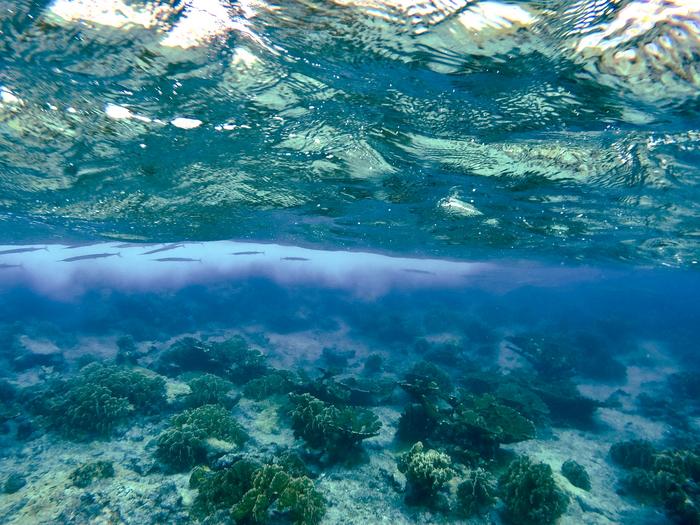
Fish and invertebrate animals are far more affected by warmer and more acidic seawater than was previously known. This is the conclusion of a study co-led by NIOZ marine biologist Katharina Alter, based on a new analysis method and published in the scientific journal Nature Communications.

Credit: Juliette Jacquemont
Fish and invertebrate animals are far more affected by warmer and more acidic seawater than was previously known. This is the conclusion of a study co-led by NIOZ marine biologist Katharina Alter, based on a new analysis method and published in the scientific journal Nature Communications.
Lead author Katharina Alter of the Royal Netherlands Institute for Sea Research (NIOZ) explains why it is essential to summarize and analyze the results of published studies addressing the effects of climate change: “To gain a better understanding of the overall worldwide impact of climate change, marine biologists calculate its effects on all fish or all invertebrate species lumped together. Yet, effects determined in different individual studies can cancel each other out: for example if invertebrate animals such as snails profit from a certain environmental change and other invertebrates, such as sea urchins, suffer from it, the overall effect for invertebrates is concluded to be zero, although both animal groups are affected.”
In fact, snails eat more due to climate change and sea urchins eat less. Alter: “Both effects matter and even have cascading effects: turf algae, the food for sea urchins, grow more while the growth of kelp, the food for gastropods, decreases. The difference in feeding in the two invertebrates causes a shift in the ecosystem from a kelp dominated ecosystem to a turf algae dominated ecosystem, consequently changing the living environment for all other animals living in this ecosystem.”
Important for understanding ecological shifts
Together with colleagues from Wageningen University and 12 other research institutions from the US, France, Argentina, Italy and Chile, dr. Alter developed the new research method that no longer cancels out seemingly contradictory results, but uses both to determine the consequences of climate change on animals’ fitness.
Before the use of this method, ocean warming and more acidic seawater was known to negatively affect fish and invertebrate animals in three general ways: their chance of survival is reduced, their metabolism is increased, and the skeletons of invertebrates are weakened.
Using the new method, the international group of marine researchers discovered that climate change has negative effects on additional important biological responses of fish and invertebrates: physiology, reproduction, behaviour and physical development. Alter: “Because this may result in ecological shifts impacting marine ecosystem structures, our results suggest that climate change will likely have stronger impacts than previously thought.”
Up to 100% of biological processes affected
Increasing levels of carbon dioxide in the air have been causing warmer and more acidic seawater for decades, a trend that is expected to continue in the future. However, it is unknown at which speed and to what extent.
Alter and her colleagues calculated the consequences of three projected scenarios of carbon dioxide increase, and thus of ocean warming and ocean acidification: extreme increase, moderate increase at the current speed and – due to possible measures – mitigated increase. Alter: “Our new approach suggests that if ocean warming and acidification continue on the current trajectory, up to 100% of the biological processes in fish and invertebrate species will be affected, while previous research methods found changes in only about 20 and 25% of all processes, respectively.”
Furthermore, the research shows that measures to mitigate atmospheric carbon dioxide levels will help reduce changes in biological processes: in the low carbon dioxide scenario, 50% of responses in invertebrates and 30% in fish will be affected.
Detect hidden impacts
The big gain of the new method, according to Alter, is that more details become known about effects of climate change on species. “The new calculation method weighs the significant deviation from the current state irrespective of its direction – be it beneficial or detrimental – and counts it as impact of warming and acidifying seawater. With our new approach, you can include the broadest range of measured responses and detect impacts that were hidden in the traditional approach.”
Journal
Nature Communications
Method of Research
Meta-analysis
Subject of Research
Animals
Article Title
Hidden impacts of ocean warming andacidification on biological responses ofmarine animals revealed through meta-analysis
Article Publication Date
3-Apr-2024
Cite Scienmag News
Sloane Callahan. (April 9, 2024). Impact of climate change on marine life much bigger than previously known. Scienmag. https://scienmag.com/impact-of-climate-change-on-marine-life-much-bigger-than-previously-known/
Sloane Callahan. "Impact of climate change on marine life much bigger than previously known." Scienmag, 9 April 2024, https://scienmag.com/impact-of-climate-change-on-marine-life-much-bigger-than-previously-known/. Accessed 3 September 2026.
Sloane Callahan. "Impact of climate change on marine life much bigger than previously known." Scienmag. April 9, 2024. https://scienmag.com/impact-of-climate-change-on-marine-life-much-bigger-than-previously-known/

