


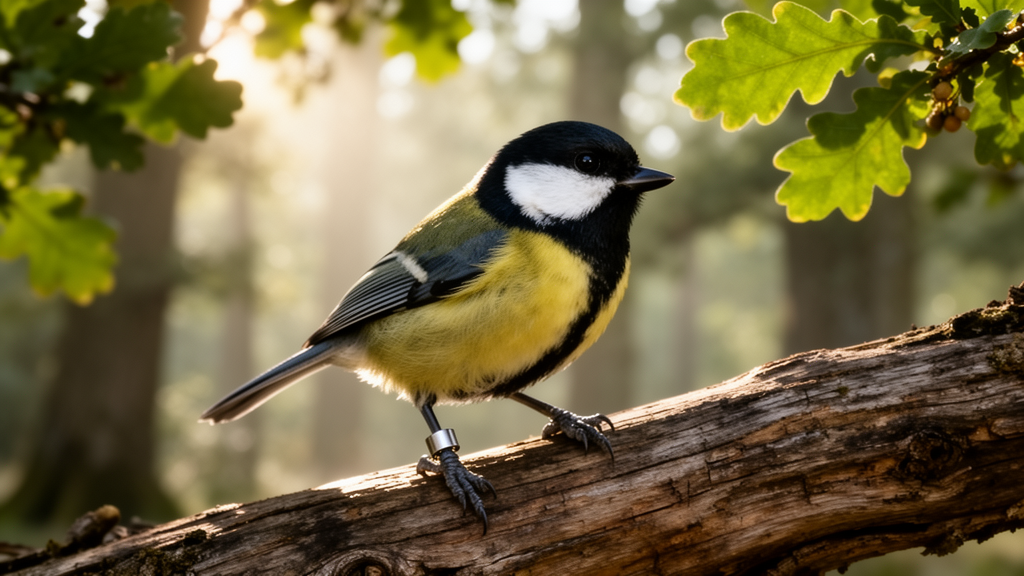
One of the most enduring puzzles in evolutionary biology is why populations that clearly possess heritable variation and experience strong natural selection so often fail to show the evolutionary change that theory predicts. This phenomenon, known as the paradox of stasis, has been debated for decades, yet it has rarely been measured directly in a wild population. A new multi-decadal study of great tits (Parus major), published in PLOS Biology, tackles the problem head-on by tracking the genetic evolution of clutch size in neighbouring populations before, during and after an experimental evolutionary perturbation, and it arrives at a striking conclusion: the movement of individuals between populations, known as gene flow, is central to explaining both why evolution sometimes stalls and why it sometimes surges.
The research team, led by Simon R. Evans with Henri Bouwmeester, Arie J. van Noordwijk, Marcel E. Visser and Erik Postma, took advantage of one of the longest-running and most intensively monitored wild bird study systems in the world. Great tits breeding in nest boxes across Dutch study populations have been recorded in extraordinary detail for generations, allowing researchers to link individual birds to their reproductive output, their genetic pedigree and their origins. Clutch size, the number of eggs a female lays, is a classic life-history trait: it is heritable, it varies consistently among females, and it is under persistent natural selection, making it an ideal trait for testing whether evolutionary predictions hold in the wild.
The paradox of stasis arises because standard quantitative genetic models make a clear prediction. If a trait is heritable and selection consistently favours particular values, the breeding values of the population, meaning the average genetic propensity of individuals, should shift generation after generation in the direction favoured by selection. Yet in study after study, from birds and mammals to plants, measurable genetic change in fitness-related traits falls far short of these expectations. The new study is unusual in that it does not merely observe stasis after the fact. Instead, it quantifies interannual genetic change in clutch size directly and compares it against explicit adaptive forecasts, distinguishing absolute stasis, where no directional genetic change occurs at all, from relative stasis, where change occurs but is weaker than predicted.
The results reveal a nuanced picture. Interannual genetic changes in clutch size were directionally consistent with the direction of selection, which refutes the idea of absolute stasis: the population was not frozen in evolutionary time. However, the magnitude of those genetic changes was consistently smaller than adaptive evolutionary models predicted, supporting relative stasis. In other words, evolution was happening, but it was happening more slowly than the textbook equations suggested it should. This tendency toward overprediction is precisely the pattern that has fuelled decades of debate, and the great tit data now provide a direct, quantified example of it in a free-living vertebrate population.
The breakthrough came from recognising a distinction that is often blurred in evolutionary studies: the difference between adaptation and evolution. Adaptation refers to populations becoming better matched to their environments, which can occur through selection on the individuals already present. Evolution, in the genetic sense, refers to changes in the genetic composition of the population, and that composition is shaped not only by selection but also by which individuals arrive, survive and breed. When new immigrants enter a population after selection has acted on the resident birds, they carry genes that were not filtered by local selection. The researchers term this post-selective immigration, and explicitly accounting for it dramatically improved the accuracy of their forecasts of genetic change.
By decomposing the interannual genetic change in clutch size into its contributing demographic processes, the team showed that immigration was the key variable explaining periods of both evolutionary stasis and evolutionary change. In years when many immigrants arrived, the genetic composition of the breeding population was reshuffled, diluting or reversing the genetic changes that selection had produced among residents. In years when immigration was low, selection’s signature could express itself more fully in the population’s genetic makeup. The evolutionary impact of gene flow therefore varied across time and space in a manner directly analogous to the well-known dynamism of natural selection itself, which fluctuates in strength and direction from year to year and from place to place.
This finding has profound implications for how evolutionary biologists interpret long-term monitoring data. Most studies of contemporary evolution in the wild estimate selection and genetic change within a defined study area, treating the population as a closed system. But real populations are rarely closed. Individuals disperse, and in a species such as the great tit, with its strong natal dispersal and its patchy distribution across habitat fragments, the arrival of first-time breeders from outside the study plots can constitute a substantial fraction of each new generation. If those immigrants differ genetically from residents, and if their numbers fluctuate, then gene flow becomes a dynamic evolutionary force in its own right rather than a static background parameter.
The study also helps resolve why the paradox of stasis has proved so stubborn. If stasis is identified a posteriori, simply as the gap between predicted and observed change, then any number of explanations can be invoked, from fluctuating selection to unmeasured environmental covariance between trait and fitness. The great tit study shifts the framing: rather than asking why selection fails to produce change, it asks how the demographic processes that build the breeding population each year transform selection into evolution. When post-selective immigration is included, the apparent mismatch between adaptive prediction and genetic reality shrinks, suggesting that much of the paradox may be an artefact of treating populations as closed and of conflating the response of residents to selection with the evolution of the population as a whole.
The experimental component of the study deserves particular emphasis. Because the researchers examined the populations before, during and after an experimental evolutionary perturbation, they could observe how the system responded to a deliberate disturbance in the selective regime, rather than relying solely on natural variation. This before-during-after design strengthens causal inference in a field where experiments on wild populations are rare and where most evidence is correlational. It allowed the team to test whether the contribution of gene flow changed predictably as the evolutionary dynamics of the population were perturbed, and the answer was that immigration’s role remained pivotal throughout, modulating the pace of genetic change in every phase.
Clutch size is not an incidental choice of trait. It is a key determinant of life history, shaping how many offspring a female attempts to raise and, ultimately, her contribution to the next generation. That gene flow is crucial to explaining the contemporary evolution and stasis of such a central fitness component suggests the same processes may operate broadly across wild populations and across many traits. For conservation biologists, the message is equally significant: fragmented populations connected by dispersal are not simply reservoirs of variation, they are dynamic evolutionary systems in which the timing and magnitude of movement can determine whether adaptation keeps pace with environmental change or falls behind. As climates shift and habitats transform, understanding how gene flow interacts with selection will be essential for predicting which populations can evolve quickly enough to survive. This study, grounded in decades of meticulous fieldwork on a familiar backyard bird, demonstrates that the answer to one of evolution’s oldest puzzles may lie not in the strength of selection alone, but in the constant traffic of individuals moving across the landscape.
Subject of Research: The role of gene flow in evolutionary stasis and change of clutch size in wild great tit populations
Article Title: Gene flow drives periods of both evolutionary stasis and change in a wild bird population
Article References: Evans, S. R., Bouwmeester, H., van Noordwijk, A. J., Visser, M. E., & Postma, E. (2026). Gene flow drives periods of both evolutionary stasis and change in a wild bird population. PLOS Biology, 24(9), e3004004. https://doi.org/10.1371/journal.pbio.3004004
Image Credits: AI Generated
DOI: 10.1371/journal.pbio.3004004
Keywords: great tits, gene flow, paradox of stasis, clutch size, evolutionary biology, natural selection, immigration, life history, quantitative genetics, wild populations, PLOS Biology, long-term study
Cite Scienmag News
Gavin Prescott. (October 9, 2026). Immigration Holds the Key to Evolutionary Stasis and Change in Wild Great Tits. Scienmag. https://scienmag.com/immigration-holds-the-key-to-evolutionary-stasis-and-change-in-wild-great-tits/
Gavin Prescott. "Immigration Holds the Key to Evolutionary Stasis and Change in Wild Great Tits." Scienmag, 9 October 2026, https://scienmag.com/immigration-holds-the-key-to-evolutionary-stasis-and-change-in-wild-great-tits/. Accessed 9 October 2026.
Gavin Prescott. "Immigration Holds the Key to Evolutionary Stasis and Change in Wild Great Tits." Scienmag. October 9, 2026. https://scienmag.com/immigration-holds-the-key-to-evolutionary-stasis-and-change-in-wild-great-tits/


