


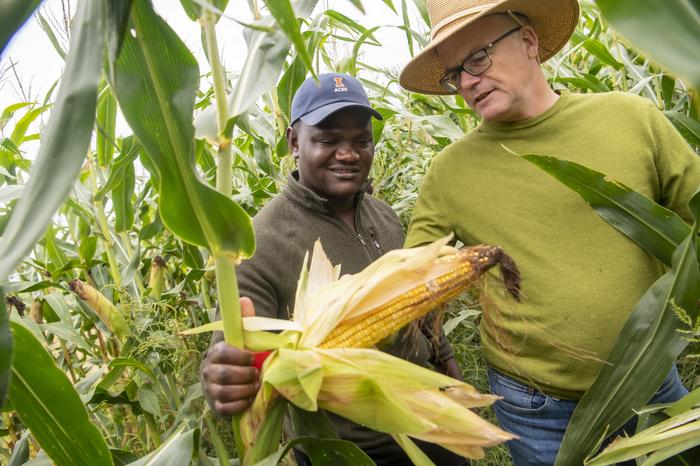
URBANA, Ill. — The USDA National Institute of Food and Agriculture is investing in University of Illinois Urbana-Champaign research that could expedite the development of climate-resilient corn.

Credit: University of Illinois Urbana-Champaign
URBANA, Ill. — The USDA National Institute of Food and Agriculture is investing in University of Illinois Urbana-Champaign research that could expedite the development of climate-resilient corn.
The three-year, $720,000 project adds greater detail to the process of genomic selection now standard in plant breeding, which uses computer models to predict plant performance based on genetic makeup. Genomic selection is more efficient than older breeding methods, which require making hundreds of crosses and growing them all in the field to measure phenotypic traits like yield and disease resistance. Although genomic selection models predict phenotypes with 80 to 90% accuracy, project leader Martin Bohn thinks the process could be improved further.
“Genomic selection works; plant breeding companies rely on it. However, we want to develop high-accuracy prediction models that can tell us how a genotype will perform in a certain environment. Unfortunately, predicting genotype by environment interactions is still kind of a problem,” said Bohn, a professor in the Department of Crop Sciences, part of the College of Agricultural, Consumer and Environmental Sciences (ACES) at Illinois.
Currently, genomic selection relies on single nucleotide polymorphisms: tiny differences in the genetic code that may or may not be meaningful for predicting traits breeders and farmers care about. Bohn’s team, which includes Illinois crop sciences professor Alex Lipka and researchers at the University of Arkansas and the University of Minnesota, will add markers related to gene expression to predict how new hybrids and inbreds will respond to a given environment.
“Corn inbred lines and hybrids vary with their response to the environment, and this is reflected in how genes are expressed. When there’s a drought or heat stress, certain genes are up-regulated (expressed more abundantly), and others are down-regulated. We will look at the abundance and variation of gene expression products, in this case RNA, as a response to heat and cold stress,” Bohn said. “That information will help plant breeders or companies target their breeding program for environments that are changing very rapidly.”
The team has gotten a head start on the project by leveraging data from another initiative called Genomes to Fields (G2F). Bohn and colleagues from the USDA Agricultural Research Service at Iowa State University and the University of Guelph used the G2F platform to test a set of 288 elite corn hybrids and inbred lines, which represent a major portion of the corn breeding materials used by breeders today, across 25 locations in the U.S. In the new project, Bohn’s team will subject hundreds of these seedlings to heat and cold stress in growth chambers and extract RNA to study gene expression. A single round of this process can be completed in a matter of weeks and within a few square feet, compared to large field trials that last a full growing season or longer.
This gene expression data can then be layered into genomic prediction models to find better-adapted genotypes for particular locations and future climates, with no wasted effort on hybrids and inbreds that don’t make the cut.
Bohn emphasizes the importance of investigating not only how individual genes are expressed in response to environmental stress but also the interactions and dynamics within gene co-expression networks.
“We want to know what genes are working together in response to a specific stress,” he said. “When one gene is up-regulated, is it possible that another gene is down-regulated as a response to that? Or is it the other way around, or are they multiplying their effects? We want to look at the variation of expression in a specific gene as a response to stress, but we also want to look at all the genes and how they group into specific co-expression networks, and then utilize that information for prediction.”
The team’s novel approach could set the stage for a new and even more efficient way of breeding corn, with the goal of enhancing food security under a changing climate.
“One of the grant’s objectives is to determine new ways of integrating information from these prediction models into breeding programs, asking what are the operational decisions that we have to make in order to make them useful for plant breeding,” Bohn said. “Or is it time to throw our current processes out the window and rethink corn breeding from the ground up? Given all the techniques we can use these days, is the status quo still the right way of doing things? We want to ask these questions with this project.
“Things are changing so rapidly and unpredictably that plant breeding companies need to invest in breeding strategies that allow them to make turns very rapidly. Utilizing gene expression, looking at the variation and the average gene expression as a response to new environmental conditions, will allow them to do that.”
Bohn is also affiliated with the Carl R. Woese Institute for Genomic Biology and the Center for Digital Agriculture at Illinois.
Cite Scienmag News
Alan Morgan. (August 20, 2024). Illinois scientists to revamp corn breeding with focus on climate resilience. Scienmag. https://scienmag.com/illinois-scientists-to-revamp-corn-breeding-with-focus-on-climate-resilience/
Alan Morgan. "Illinois scientists to revamp corn breeding with focus on climate resilience." Scienmag, 20 August 2024, https://scienmag.com/illinois-scientists-to-revamp-corn-breeding-with-focus-on-climate-resilience/. Accessed 5 September 2026.
Alan Morgan. "Illinois scientists to revamp corn breeding with focus on climate resilience." Scienmag. August 20, 2024. https://scienmag.com/illinois-scientists-to-revamp-corn-breeding-with-focus-on-climate-resilience/

