


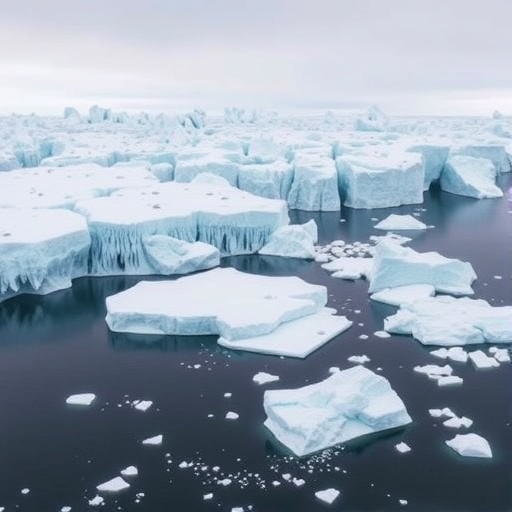
Ice, often perceived as a static and inert substance, has revealed surprising and dynamic chemical properties according to groundbreaking research from Umeå University. Recently published in the prestigious journal Proceedings of the National Academy of Sciences, this study elucidates how ice can significantly accelerate the dissolution of iron-bearing minerals. This discovery carries profound implications for understanding biogeochemical cycles, especially in polar and alpine environments, where iron availability controls ecosystem productivity and influences global carbon budgets.
Approximately 17 percent of Earth’s terrestrial surface is cloaked in permafrost, with expansive regions undergoing seasonal freeze-thaw transitions. As global temperatures rise, the frequency and intensity of these freeze-thaw cycles are predicted to increase, promoting physical and chemical changes in frozen landscapes. The research led by Professor Jean-François Boily at Umeå University reveals a previously underappreciated chemical phenomenon within ice, which may amplify the release of iron and potentially other trace elements from mineral matrices more than current environmental models predict.
Iron is a fundamental micronutrient driving primary productivity in aquatic and terrestrial ecosystems alike. It acts as a limiting nutrient for phytoplankton growth in large portions of the ocean and participates intimately in soil carbon sequestration processes. Variations in iron mobilization can cascade through food webs and alter water chemistry, coloration, and clarity. Therefore, understanding the precise mechanisms governing iron release under varying environmental conditions is critical for predicting future ecosystem responses to climate perturbations.
Central to Boily’s team investigation was the iron oxide mineral goethite (α-FeOOH), an abundant and widespread rust-colored mineral found in soils, sediments, and deposited dust. Starting from controlled experimental setups, the researchers examined how dissolved ligands—chemical species capable of binding to iron atoms—affect the dissolution kinetics of goethite when subjected to freezing. Ligands investigated included fluoride, sulfate, and perchlorate ions, each exerting differing affinities for iron binding.
Their experiments yielded a clear and compelling pattern: ice markedly enhanced mineral dissolution rates in the presence of ligands that strongly associate with iron. More specifically, fluoride, which bonds most tightly among the tested ligands, triggered an over fourfold increase in iron release under frozen conditions compared to liquid water environments. Sulfate also boosted dissolution, though to a lesser extent, while perchlorate, which interacts weakly with iron, did not demonstrate any effect regardless of phase.
This binding-dependent amplification of mineral breakdown points to an elegant but complex chemical mechanism intrinsic to microscopic domains within ice. As water freezes, it rejects solutes that cannot fit into the ice lattice, concentrating them in minuscule brine pockets trapped between growing ice crystals. Within these microscale microenvironments, solute concentrations swell dramatically—sometimes increasing up to 500 times relative to their initial concentration in liquid form. Elevated ionic strength and altered chemical potentials in these brine inclusions accelerate reaction rates, catalyzing the dissolution of iron minerals in ways unobservable in unfrozen conditions.
Professor Boily emphasizes the universality of this principle, suggesting that with knowledge of a ligand’s binding strength to iron, one might reliably predict the extent to which ice enhances mineral dissolution across diverse environmental chemistries. If shown to apply broadly, this insight could revolutionize how models incorporate freeze-thaw chemistry, leading to more accurate forecasts of nutrient fluxes, contaminant mobility, and geochemical transformations in cold regions worldwide.
The ecological implications of these findings are far-reaching. Enhanced iron mobilization from soils and sediments due to freeze-thaw cycling may alter nutrient availability in mountain streams, freshwater lakes, and coastal marine ecosystems, many of which are iron-limited. This could stimulate previously unrecognized increases in primary productivity or shift species composition. Moreover, since iron plays a role in binding organic carbon in soils, changes in its flux could feedback on carbon cycling and greenhouse gas emissions, potentially influencing global climate trajectories.
This study also challenges existing paradigms that treat ice simply as a passive medium. Instead, ice emerges as a chemically active phase capable of concentrating reactants and fostering reactions typically considered too slow or improbable at low temperatures. Such microscale “hot spots” within ice highlight the importance of re-examining freeze-thaw processes in geochemical and environmental sciences, particularly under the accelerating pressures of climate change.
Moving forward, further research is needed to explore how other minerals and ligands behave under similar freeze-thaw conditions, and to investigate the coupling of physical disruption caused by freeze-thaw cycles with these chemical enhancements. Understanding the interplay between physical fracturing of mineral substrates and chemically accelerated dissolution could yield comprehensive insight into freeze-thaw-driven landscape evolution.
In conclusion, the work by Jean-François Boily and his collaborators unveils a vital and previously hidden role of ice in controlling mineral weathering and nutrient release in cold environments. This new understanding not only advances fundamental geochemistry but also holds the promise of improving predictive models for environmental change. As our planet warms and the cryosphere increasingly retreats, such knowledge becomes indispensable for anticipating the fate of critical nutrient cycles and the ecosystems that depend on them.
Cite Scienmag News
Russell Cooper. (May 26, 2026). Ice Could Release More Iron Than Climate Models Anticipate, Study Finds. Scienmag. https://scienmag.com/ice-could-release-more-iron-than-climate-models-anticipate-study-finds/
Russell Cooper. "Ice Could Release More Iron Than Climate Models Anticipate, Study Finds." Scienmag, 26 May 2026, https://scienmag.com/ice-could-release-more-iron-than-climate-models-anticipate-study-finds/. Accessed 3 September 2026.
Russell Cooper. "Ice Could Release More Iron Than Climate Models Anticipate, Study Finds." Scienmag. May 26, 2026. https://scienmag.com/ice-could-release-more-iron-than-climate-models-anticipate-study-finds/


