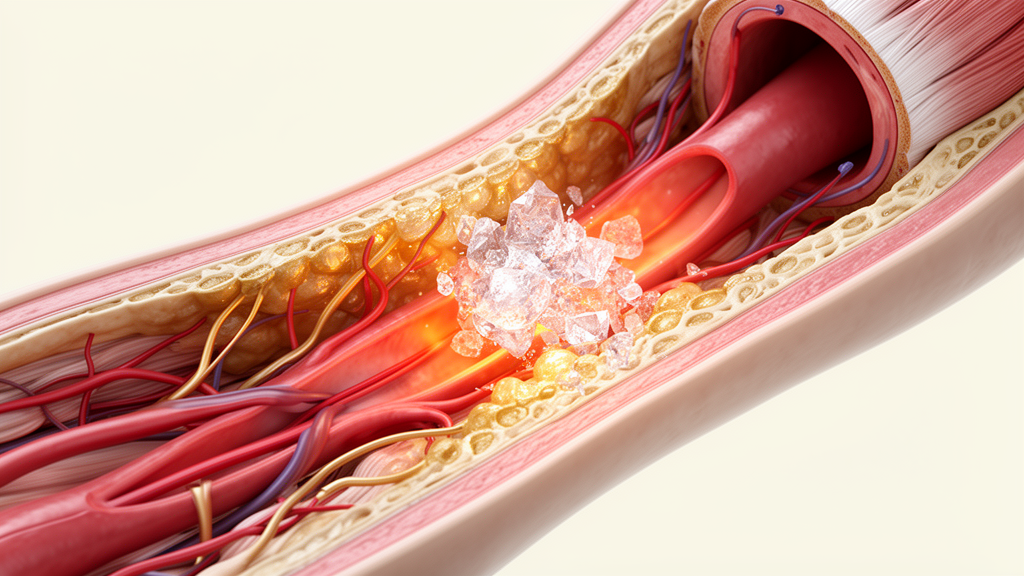
A 2026 narrative review concludes that elevated uric acid may contribute to erectile dysfunction through interacting abnormalities in oxidative stress, inflammation, nitric-oxide signaling and cavernosal smooth-muscle contraction. The authors describe the combination as hyperuricemia-associated erectile dysfunction, or HUAED, but emphasize that human evidence does not establish a uniform causal relationship, an erectile-specific serum-urate threshold or an effective integrated treatment. Human observations support an association while remaining inconsistent.
In two clinical datasets, each 100 μmol/L rise in serum urate was associated with higher odds of erectile dysfunction: the odds ratio was 2.522, with a 95% confidence interval of 1.068 to 5.958, in Study I, and 2.951, with a 95% confidence interval of 1.560 to 5.584, in Study II. A meta-analysis of 11 studies involving 454,510 participants reported higher odds of ED with categorical hyperuricemia, with a pooled odds ratio of 1.59 and a 95% confidence interval of 1.29 to 1.97. These were not categorical comparisons between hyperuricemic and normouricemic people in the two clinical datasets.
Other studies have produced divergent or inconclusive findings. An NHANES cross-sectional analysis of 3,810 US adults found no significant association between hyperuricemia and ED after multivariable adjustment, and Mendelian-randomization analyses have not confirmed a causal effect of genetically predicted serum urate on ED. A population-based cohort comparing 9,653 men with incident gout and 38,218 matched controls recorded 193 ED events per 10,000 person-years in the gout group versus 132 in controls, corresponding to an adjusted hazard ratio of 1.31 and a 95% confidence interval of 1.24 to 1.40.
Differences in age, metabolic disease, hormonal factors, hyperuricemia definitions, ED assessment tools and statistical adjustment may contribute to the heterogeneity. These observations identify elevated urate as a possible risk marker rather than proof that lowering urate will prevent or reverse ED. A pooled observational estimate reported in the review showed an odds ratio of 1.27, with a 95% confidence interval of 1.14 to 1.41, for no urate-lowering therapy versus therapy as described by the original authors.
Its reciprocal, 0.79, corresponds to approximately 21% lower odds among therapy users, not a 27% reduction. The contributing data were observational, and the original comparison coding was not transparently reported, so the estimate does not establish a preventive or therapeutic effect on erectile function. The strongest HUAED-specific mechanistic evidence in the review comes from animal and cellular experiments rather than human penile tissue studies.
One line of research indicates that urate can enter cavernosal smooth-muscle cells, interact with myosin light-chain kinase at N803, reduce NEDD4L-mediated ubiquitination and stabilize MLCK. The resulting rise in phosphorylated myosin light chain 2 favors contraction over relaxation, which is compatible with impaired erection. In Uox-knockout rats, this contractile pathway was increased at an early dysfunctional stage.
Overt muscle-fiber loss was apparent at 43 weeks but not at 20 weeks, suggesting that functional abnormalities preceded overt structural loss in that model. Direct human evidence that hyperuricemia causes penile fibrosis remains absent. Another proposed link involves reactive oxygen species and the nitric-oxide pathway required for erection.
Cavernous-nerve neuronal nitric oxide synthase contributes to neural initiation, while endothelial nitric oxide synthase helps amplify and maintain relaxation through soluble guanylate cyclase and cyclic guanosine monophosphate signaling. In one chemically induced hyperuricemic rat model, penile reactive oxygen species increased while eNOS, phosphorylated eNOS and nNOS signals decreased, alongside impaired erectile measures. An early Uox-knockout model produced a different pattern: nitric oxide metabolites were unchanged, the phosphorylated-to-total eNOS ratio fell and the phosphorylated-to-total nNOS ratio rose.
Neither model resolves the relative contributions of neural initiation and endothelial maintenance in human HUAED. Inflammatory and antioxidant mechanisms are plausible but less directly established. Reactive oxygen species can promote NLRP3 inflammasome assembly, caspase-1 activation and maturation of IL-1β and IL-18, while urate-related oxidative stress may damage vascular endothelium.
Results involving the Nrf2/HO-1 antioxidant system are context dependent: high urate suppressed protective pathways in one endothelial model, whereas suitable urate concentrations protected cells exposed to oxidized LDL through Keap1–Nrf2 signaling. Other experiments found benefits from Nrf2 activation in diabetic or hypertension-associated ED, but those were not HUAED-specific studies. The review notes that urate can appear antioxidant extracellularly while promoting reactive oxygen species within cells, making concentration, cellular compartment and exposure duration central uncertainties.
Current treatments address different parts of this proposed network. Urate-lowering therapy is used according to established hyperuricemia or gout indications, but it is not proven to improve erectile outcomes. Xanthine oxidase inhibitors such as febuxostat may also reduce enzyme-derived oxidative stress, so any vascular benefit cannot automatically be attributed to lower serum urate.
PDE5 inhibitors slow cGMP breakdown rather than generating it, and their effect therefore depends partly on functional nitric-oxide signaling and responsive soluble guanylate cyclase. In one observational cohort, febuxostat was associated with more incident ED than allopurinol, while animal experiments with febuxostat, benzbromarone and other agents reported improved erectile measures. These discordant findings do not justify categorical prescribing differences.
Traditional Chinese medicine is presented as a candidate research domain, not an established HUAED therapy. A related evidence cluster examined the formula Quyuhuatanerxian in an exploratory human biomarker cohort of 30 participants and a 60-rat HUAED experiment, while separate experiments tested linoleyl acetate and mandenol in similarly induced rat models. The investigators reported changes in inflammatory, oxidative and erectile-related markers, but the human study lacked a placebo-controlled erectile-function endpoint.
The animal publications came from an overlapping research group and used similar induction and fecal-transfer procedures without clearly documenting whether animals or samples overlapped, so they constitute a related evidence cluster requiring independent replication. Clinical studies of traditional Chinese herbal medicine combined with tadalafil provide indirect context rather than HUAED-specific efficacy evidence. A meta-analysis of 11 randomized trials involving 903 men with ED reported a mean difference of 2.49 points on the five-item International Index of Erectile Function, with a 95% confidence interval of 2.213 to 2.767, and a pooled relative risk of 1.191, with a 95% confidence interval of 1.025 to 1.384, for a positive response to the Sexual Encounter Profile question 2.
Hyperuricemia was not required for enrollment, the formulas and schedules varied, treatment lasted four to 12 weeks and follow-up was generally short. Safety reporting was also incomplete, preventing a reliable arm-specific assessment of whether combination therapy offered a dependable advantage. Suggested human endpoints combine validated sexual-function scores with serum urate, insulin resistance, glycated hemoglobin, lipids, inflammatory and oxidative-stress markers, penile Doppler measurements, nitric-oxide biomarkers and hormone assays.
An illustrative trial would compare a chemically and batch-standardized herbal product with matched placebo on stable background care, use change in the erectile-function domain of the IIEF as its primary endpoint and follow participants to week 24. Such a two-arm design could test incremental benefit, whereas demonstrating true synergy would require trials with each component alone, the combination and a common control, together with a prespecified interaction term.
Subject of Research: Mechanistic and clinical evidence linking hyperuricemia with erectile dysfunction
Article Title: Hyperuricemia-related erectile dysfunction: mechanistic links and a translational framework for integrated traditional Chinese and western medicine
Article References: Huang, S., Fang, Y., Jiang, M., Zong, Y., Zhang, Y., Ma, H., Zhu, L., Zhang, X., Yao, Y., Cao, Y., Yang, C., Zeng, J., Li, L., Sun, W., & Zheng, Y. (2026). Hyperuricemia-related erectile dysfunction: mechanistic links and a translational framework for integrated traditional Chinese and western medicine. Frontiers in Endocrinology, 17, Article 1911364. https://doi.org/10.3389/fendo.2026.1911364
Image Credits: AI Generated
DOI: 10.3389/fendo.2026.1911364
Keywords: hyperuricemia, erectile dysfunction, oxidative stress, nitric oxide signaling, inflammation, endothelial dysfunction, cavernosal smooth muscle, urate-lowering therapy, traditional Chinese medicine, clinical translation, Hyperuricemia-related, erectile
Cite Scienmag News
Cassandra Pierce. (October 24, 2026). Hyperuricemia may disrupt erection through vascular, inflammatory and smooth-muscle pathways. Scienmag. https://scienmag.com/hyperuricemia-may-disrupt-erection-through-vascular-inflammatory-and-smooth-muscle-pathways/
Cassandra Pierce. "Hyperuricemia may disrupt erection through vascular, inflammatory and smooth-muscle pathways." Scienmag, 24 October 2026, https://scienmag.com/hyperuricemia-may-disrupt-erection-through-vascular-inflammatory-and-smooth-muscle-pathways/. Accessed 24 October 2026.
Cassandra Pierce. "Hyperuricemia may disrupt erection through vascular, inflammatory and smooth-muscle pathways." Scienmag. October 24, 2026. https://scienmag.com/hyperuricemia-may-disrupt-erection-through-vascular-inflammatory-and-smooth-muscle-pathways/