


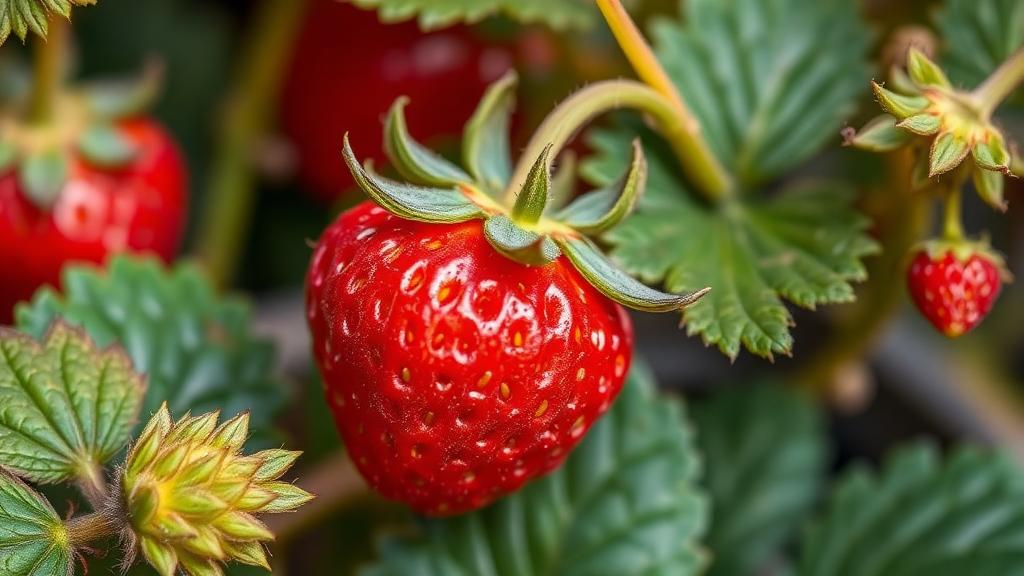
Powdery mildew is one of the most relentless enemies of strawberry growers worldwide. The fungal disease sweeps through leaves, flowers, and fruit in succession, and in severe outbreaks it can devastate a significant share of the roughly nine million tonnes of strawberries produced globally each year. Fungal diseases as a whole are estimated to claim between 20 and 30 percent of strawberry production, and powdery mildew is among the most dangerous culprits because it infects so easily. Now, a research team working at a polytunnel facility in Rostock, Germany, has demonstrated a way to spot the disease using a hyperspectral camera and a compact deep learning network, offering growers a non-destructive early warning system that could reduce fungicide use and crop losses alike.
The study, published in the journal Smart Agricultural Technology, was conducted by Jobin Francis, Ali Al Masri, Maximilian Pircher, and Philipp Wree, who set out to solve a problem that has long limited plant disease detection research: most hyperspectral imaging studies are performed in laboratories, where lighting, sample orientation, and ambient conditions can be carefully controlled. Real fields are far messier. Fluctuating illumination, wind, temperature shifts, and inconsistent leaf positioning can all degrade spectral data and undermine model performance. Because diseases like powdery mildew actually occur in open-field settings, the team deliberately chose to acquire data from strawberry plants growing under a semi-controlled polytunnel, a step closer to the conditions a working farm would face.
The experimental setup was elegantly practical. A Cubert X20 hyperspectral video camera, covering wavelengths from 350 to 1000 nanometers across 164 spectral bands, was mounted on a mechanized trolley that traveled along overhead rails above the strawberry canopy. The camera captured images at regular intervals with centimeter-precise localization, sweeping over the plants much as a robotic scouting platform might in a commercial operation. Crucially, no artificial inoculation was performed; powdery mildew occurred naturally on the leaves and progressed in severity over several weeks, meaning the study captured the disease exactly as it presents in the real world.
Calibration was treated as a make-or-break step. Before each acquisition session, the researchers performed dark calibration by covering the lens with an opaque cap, white calibration using a Spectralon tile with 99.9 percent reflectance, and distance calibration to fix the camera-to-object spacing. Raw images were then converted to calibrated reflectance values by subtracting the dark reference and normalizing against the white reference. But the team went further: as the camera moved along the rail, subtle drifts crept in from changing ambient light, shifting leaf orientation, and mechanical vibration. They therefore continuously compared each new frame’s spectral signatures against a reference spectrum from healthy leaves, and once deviations exceeded an acceptable threshold, all subsequent data were discarded. Only spectrally consistent, well-calibrated frames made it into the modeling pipeline, a discipline the authors credit for the robustness of their results.
The underlying physics of the detection method is what makes hyperspectral imaging so powerful. Healthy strawberry leaves show low reflectance across the visible range of 400 to 700 nanometers, with a characteristic green peak between 500 and 570 nanometers, a nitrogen absorption band near 550 nanometers, and a deep reflectance valley around 670 nanometers caused by strong chlorophyll absorption. Beyond that lies the sharp rise at the red edge and high reflectance in the near-infrared, where healthy leaf structure scatters light efficiently. Infected leaves tell a different story. Powdery mildew alters photochemical activity and pigment content, and these biochemical shifts show up as measurable deviations in the spectral fingerprint long before any human eye could see a lesion. Because molecular absorption depends on cellular composition, the disease essentially rewrites the leaf’s chemical signature in ways the camera can read.
Turning those raw spectra into a reliable classifier required careful preprocessing. The team first applied an Isolation Forest algorithm, an unsupervised outlier detection method that removes anomalous spectra caused by noisy measurements or inconsistent illumination. Next came Savitzky-Golay smoothing, which suppresses high-frequency noise while preserving the shape of the spectral curves. Two scatter-correction strategies were then evaluated: Standard Normal Variate and Multiplicative Scatter Correction, both designed to normalize each spectrum relative to the dataset mean and correct for scattering effects. The cleaned spectral data were extracted from regions of interest identified on RGB-equivalent composite images, yielding a balanced dataset of 1,940 spectra, evenly split between healthy and mildew-affected leaves.
For classification, the researchers built a one-dimensional convolutional neural network tailored to spectral data. Each spectrum was treated as a one-dimensional signal of 145 bands, fed into a compact architecture of four convolutional layers with 32, 64, and 128 filters, each using kernel size 3 and ReLU activation. Batch normalization stabilized training after every convolutional layer, while max-pooling layers reduced feature dimensions. The flattened features passed through a dense layer of 64 neurons, a dropout layer with a rate of 0.3 to prevent overfitting, and finally a sigmoid output neuron for the binary healthy-versus-mildew decision. Training used the Adam optimizer with binary cross-entropy loss, a learning rate of 0.0001, and 100 epochs on a stratified 70:15:15 split of the data.
The results were striking. Training accuracy climbed rapidly in the first 10 to 15 epochs and settled at 0.84, while validation accuracy stabilized between 0.83 and 0.86. On the independent test set, the network correctly identified 137 of 145 mildew samples, missing only 8 infections, while 108 of 146 healthy samples were correctly classified. The model achieved an area under the ROC curve of 0.933, indicating strong separability across all decision thresholds. Notably, the operating point favored sensitivity to disease: mildew recall reached 0.94, and most errors were false alarms on healthy leaves rather than missed infections, a favorable trade-off for screening scenarios where a missed case is far costlier than an unnecessary inspection. Because the ROC profile is strong, growers could recalibrate the decision threshold to suit their needs without retraining the model.
The deep learning approach also outperformed classical machine learning baselines trained on the same data. Random Forest led the traditional methods with an accuracy of 0.81 and an F1-score of 0.82, benefiting from its ability to capture non-linear spectral relationships. Decision Tree and Partial Least Squares Discriminant Analysis achieved moderate accuracies of 0.77 and 0.79 respectively, while a support vector machine with an RBF kernel struggled, showing a pronounced bias toward the healthy class and an accuracy of just 0.68. The comparison underscores a key advantage of the convolutional network: it learns discriminative features automatically from raw spectra rather than depending on manual feature engineering, and it offers more tunable operating characteristics for real-world deployment.
Perhaps the most commercially significant finding came from the wavelength selection pipeline. Because hyperspectral cubes contain hundreds of highly correlated bands, many of which carry noise or redundancy, the team developed a two-stage filter: first pruning wavelengths with variance below 0.001, then ranking the survivors by mutual information with the disease labels and keeping the most informative bands, expanded by their two nearest spectral neighbors to preserve local context. This compact band set concentrated on pigment- and structure-sensitive regions of the spectrum, and when fed into the network it improved test accuracy to 0.894 and pushed the AUC to 0.968, all while dramatically reducing input dimensionality. The authors point out that such a band set could directly inform the design of lightweight multispectral sensors with filters near the red edge and near-infrared clusters, paving the way for affordable, field-ready disease scouting systems. Future work, they note, should expand the dataset across cultivars, growth stages, and seasons, integrate spatial-spectral context through patch-based architectures, and calibrate decision thresholds to the specific costs of missed disease versus false alarms. If those steps succeed, the combination of hyperspectral sensing and deep learning could move from the research polytunnel to the commercial greenhouse, giving strawberry growers a real-time shield against one of their costliest foes.
Subject of Research: Hyperspectral imaging and deep learning detection of powdery mildew in strawberry leaves under polytunnel conditions
Article Title: Hyperspectral imaging and one–dimensional convolutional neural network (1D-CNN) based detection of strawberry powdery mildew under polytunnel conditions
Article References: Francis, J., Al Masri, A., Pircher, M., & Wree, P. (2026). Hyperspectral imaging and one–dimensional convolutional neural network (1D-CNN) based detection of strawberry powdery mildew under polytunnel conditions. Smart Agricultural Technology, 15, Article 102603. https://doi.org/10.1016/j.atech.2026.102603
Image Credits: AI Generated
DOI: 10.1016/j.atech.2026.102603
Keywords: hyperspectral imaging, powdery mildew, strawberry, 1D-CNN, deep learning, precision agriculture, plant disease detection, polytunnel, wavelength selection, machine learning, early disease diagnosis, smart farming
Cite Scienmag News
Alan Morgan. (October 2, 2026). Hyperspectral Camera and AI Catch Strawberry Mildew Before It Shows. Scienmag. https://scienmag.com/hyperspectral-camera-and-ai-catch-strawberry-mildew-before-it-shows/
Alan Morgan. "Hyperspectral Camera and AI Catch Strawberry Mildew Before It Shows." Scienmag, 2 October 2026, https://scienmag.com/hyperspectral-camera-and-ai-catch-strawberry-mildew-before-it-shows/. Accessed 4 October 2026.
Alan Morgan. "Hyperspectral Camera and AI Catch Strawberry Mildew Before It Shows." Scienmag. October 2, 2026. https://scienmag.com/hyperspectral-camera-and-ai-catch-strawberry-mildew-before-it-shows/


