


Freshwater scarcity has pushed membrane technology to the center of modern water treatment, and one of the field’s stubbornest problems is a fundamental trade-off: membranes that let water pass quickly also tend to let salts and contaminants slip through, while highly selective membranes demand more energy and more membrane area to do the same job. A team at the University of Tehran now reports a promising route around that compromise. In a study published in Polymer Bulletin, researchers Elnazalsadat Mirsaeidghazi, Alireza Shakeri and Hasan Salehi describe how a hyper-crosslinked polymer, strategically sandwiched inside a thin-film nanocomposite membrane, nearly doubled the membrane’s water flux while maintaining exceptional salt and dye rejection. The work targets forward osmosis, an emerging desalination and wastewater process that relies on osmotic pressure rather than hydraulic pressure to drive water across a membrane.
Forward osmosis works on a deceptively simple principle. Water spontaneously flows from a feed solution of lower osmotic pressure toward a concentrated draw solution on the other side of a semipermeable membrane. Because the process requires no external pumping pressure, it fouls less than pressure-driven reverse osmosis and can be paired with draw solutes that are easily recovered, or run as a pretreatment stage ahead of reverse osmosis. The heart of any such system is the membrane itself, typically a thin polyamide active layer formed on a porous support. The polyamide layer is created by interfacial polymerization, in which an aqueous amine monomer, usually m-phenylenediamine, meets an organic acyl chloride monomer, usually trimesoyl chloride, at the support’s surface. The reaction is fast and self-limiting, producing an ultrathin but dense film whose thickness, roughness and crosslinking density dictate how fast water moves and how well it rejects solutes.
For years, membrane scientists have tried to tune that film by embedding nanomaterials, a approach known as thin-film nanocomposite design. Nanoparticles of zeolites, metal-organic frameworks, carbon nanotubes, graphene oxide and MXenes have all been slipped into or beneath the polyamide layer, with mixed results. Additives can create extra water pathways and increase hydrophilicity, but they can also introduce defects, agglomerate into clumps that wreck selectivity, or leach out over time. The Iranian team chose a different class of additive altogether: a polyamide-based hyper-crosslinked polymer. Hyper-crosslinked polymers are amorphous, permanently porous networks built from rigid aromatic building blocks locked together by extensive covalent crosslinks. Their high internal surface area, tunable chemistry and chemical stability have made them popular in gas storage and catalysis, and this study puts them to work as a nanofiller for water membranes.
The synthesis itself was characterized with a battery of analytical techniques. Attenuated total reflectance Fourier-transform infrared spectroscopy, X-ray diffraction and transmission electron microscopy confirmed that the hyper-crosslinked polymer had formed successfully, revealing a layered morphology rather than a granular one. Elemental mapping of the material showed that nitrogen-bearing groups were distributed uniformly throughout the structure, a detail that matters because those amide and amine groups interact strongly with water and with the monomers used in membrane fabrication. The high nitrogen content and even dispersion suggested the polymer would integrate well into the polyamide chemistry rather than sitting inertly inside it as a foreign body.
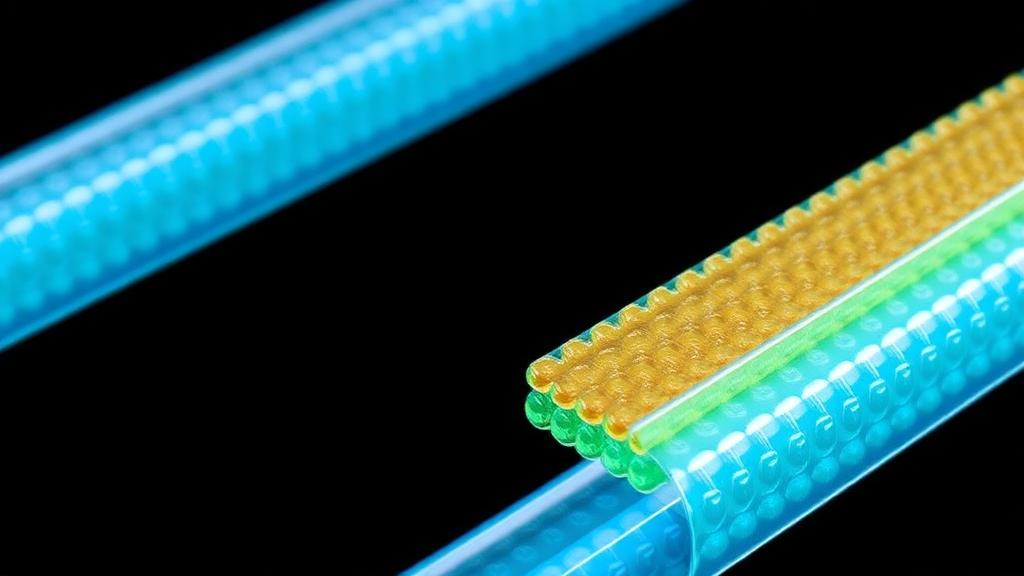
The genuinely clever part of the study is how the polymer gets into the membrane. Rather than blending it into the support or into the aqueous monomer solution, the researchers used what they call an intermediate strategy. The hyper-crosslinked polymer was dispersed in hexane, an organic solvent in which the polymer can be spread as a coating, and that dispersion was applied to the membrane support surface precisely between the aqueous amine phase and the organic acyl chloride phase. The polymer thus occupies the very frontier where interfacial polymerization happens. As the two monomers diffuse toward each other and react, they must contend with a porous, nitrogen-rich, layered material sitting at the reaction zone. The result is a polyamide film whose growth has been sculpted from the inside out.
That sculpting shows up clearly in the membrane’s final properties. The presence of the hyper-crosslinked layer changed the dynamics of monomer diffusion and film nucleation, and the modified active layers came out smoother, thinner and more hydrophilic than films polymerized without the additive. Each of those three attributes pushes performance in the right direction. A thinner film shortens the path water must travel. Greater hydrophilicity improves wetting and reduces the energetic penalty water pays entering the polymer network. Reduced roughness matters for fouling, because contaminants preferentially snag on peaks and valleys, so a smoother surface resists the accumulation of organic matter and dye molecules during long filtration runs. Chemical characterization confirmed the hyper-crosslinked polymer was stably embedded within the polyamide matrix rather than loosely deposited on top of it.
The performance numbers are the study’s headline. An unmodified forward osmosis membrane delivered a water flux of 12.2 liters per square meter per hour, a common benchmark unit abbreviated LMH. At the optimal loading of hyper-crosslinked polymer, flux rose to 23.4 LMH, an increase of more than 90 percent. Pushing the additive loading higher actually backfired, with flux declining again because excess polymer drove the formation of a thicker polyamide layer, which added resistance faster than the extra pathways added permeability. That dose-dependent behavior is typical of nanocomposite membranes and underscores why loading optimization is the central design variable. Importantly, the modified membrane also showed enhanced specific reverse salt flux, meaning that the salt that inevitably leaks backward from the draw solution did so at a rate disproportionately low relative to the water gained, an indicator that selectivity had not been sacrificed for speed.
To test the membrane under realistic and demanding conditions, the team ran a 24-hour continuous process concentrating reactive black B, a widely used anionic dye responsible for much of the colored effluent discharged by the textile industry. The membrane rejected more than 99.9 percent of the dye throughout the run and displayed an anti-fouling tendency, resisting the flux decline that usually plagues dye concentration processes as molecules build up on the membrane surface. The authors attribute this resilience to the combination of smoothness, hydrophilicity and stable integration of the hyper-crosslinked polymer within the active layer. Sustained performance over a full day of operation is a meaningful demonstration that the additive does not wash out, degrade or progressively separate from the polyamide, concerns that have undermined other nanofiller systems.
Why does a porous polymer interlayer boost flux so dramatically? The mechanistic picture, supported by the characterization data, centers on how the intermediate layer reshapes interfacial polymerization itself. Interfacial polymerization is governed by the diffusion of monomers into the reaction zone; anything that moderates that diffusion changes the film’s architecture. The hexane-dispersed hyper-crosslinked coating likely slows the amine monomer’s transport toward the organic phase and provides abundant hydrogen-bonding and amide interaction sites, yielding a film that is simultaneously thinner and more uniformly crosslinked. Related interlayer strategies in the literature, using materials from chitosan and cyclodextrins to covalent organic frameworks and MXene-carbon nanotube assemblies, have shown similar gains, confirming that controlling the reaction frontier is one of the most powerful levers in membrane design. What distinguishes the present work is the use of a permanently porous, polymer-based network rather than an inorganic nanoparticle, which sidesteps problems of particle agglomeration and interfacial incompatibility.
The broader significance lies in what the result says about the permeability-selectivity trade-off, the长久-standing constraint that forces membrane designers to choose between fast and clean. By growing a thinner, smoother, more hydrophilic polyamide film without opening defects, the hyper-crosslinked interlayer improved water transport while preserving rejection of salts and dyes, suggesting the trade-off is not an immutable law but a consequence of how films are made. For desalination, higher flux at equal selectivity translates directly into less membrane area and lower capital cost. For textile wastewater treatment, a membrane that concentrates reactive dyes with near-total rejection and low fouling could enable water reuse and dye recovery in one of the world’s most water-intensive industries. The study, published in Polymer Bulletin with financial and instrumental support from the University of Tehran, adds a versatile new tool, a synthetically tunable porous polymer, to the membrane engineer’s toolkit, and points toward a generation of forward osmosis membranes that no longer ask designers to choose between speed and selectivity.
Subject of Research: Modification of thin-film nanocomposite forward osmosis membranes with a hyper-crosslinked polymer interlayer to enhance water flux, salt rejection and dye concentration
Article Title: Modification of thin film nanocomposite forward osmosis membranes using hyper-crosslinked polymer via intermediate strategy
Article References: Mirsaeidghazi, E., Shakeri, A., & Salehi, H. (2026). Modification of thin film nanocomposite forward osmosis membranes using hyper-crosslinked polymer via intermediate strategy. Polymer Bulletin, 83(12), Article 652. https://doi.org/10.1007/s00289-026-06710-0
Image Credits: AI Generated
DOI: 10.1007/s00289-026-06710-0
Keywords: forward osmosis, thin-film nanocomposite membrane, hyper-crosslinked polymer, interfacial polymerization, polyamide, water desalination, dye concentration, anti-fouling, membrane modification, water flux, reverse salt flux, textile wastewater treatment
Cite Scienmag News
Neil Sanderson. (October 2, 2026). Hyper-Crosslinked Polymer Interlayer Nearly Doubles Water Flux in Forward Osmosis Membranes. Scienmag. https://scienmag.com/hyper-crosslinked-polymer-interlayer-nearly-doubles-water-flux-in-forward-osmosis-membranes/
Neil Sanderson. "Hyper-Crosslinked Polymer Interlayer Nearly Doubles Water Flux in Forward Osmosis Membranes." Scienmag, 2 October 2026, https://scienmag.com/hyper-crosslinked-polymer-interlayer-nearly-doubles-water-flux-in-forward-osmosis-membranes/. Accessed 4 October 2026.
Neil Sanderson. "Hyper-Crosslinked Polymer Interlayer Nearly Doubles Water Flux in Forward Osmosis Membranes." Scienmag. October 2, 2026. https://scienmag.com/hyper-crosslinked-polymer-interlayer-nearly-doubles-water-flux-in-forward-osmosis-membranes/


