


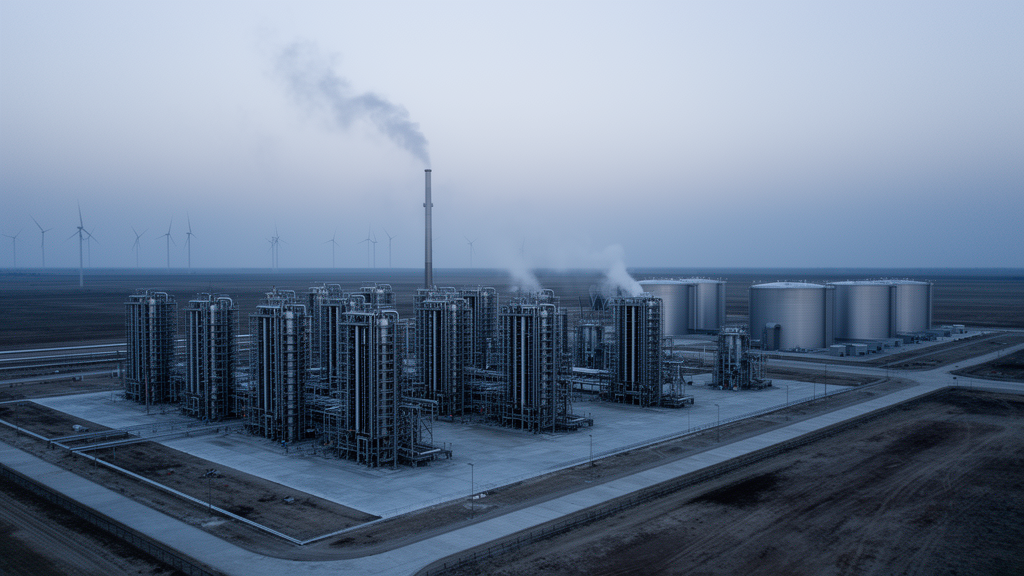
Hydrogen has been cast as the Swiss Army knife of the energy transition — a molecule that could decarbonize steel mills, power plants, trucks, ships and home heating alike. But a sweeping new analysis published in Nature Communications suggests that Europe’s hydrogen future may be far more modest, and far more specialized, than the hype implies. Using an ensemble of integrated assessment models, a team led by Amir Fattahi of TNO, the Netherlands Organisation for Applied Scientific Research, quantified how much hydrogen a climate-neutral Europe would actually use by mid-century, and where it would flow. The answer, averaged across models, is roughly 4 exajoules by 2050 — just 7 percent of final energy consumption.
The study is notable for its methodological ambition. Rather than relying on a single energy system model, whose idiosyncrasies can skew projections, the researchers pooled results from multiple integrated assessment models developed by teams across Europe, including groups at the Potsdam Institute for Climate Impact Research, IIASA, PBL Netherlands Environmental Assessment Agency, Delft University of Technology and several other institutions. Each model represents the energy economy with its own structure, cost assumptions and technological detail, so where they agree, the finding is robust; where they diverge, the spread itself becomes a measure of uncertainty. The work was carried out under the European Climate and Energy Modelling Forum, a consortium funded by the European Commission’s Horizon 2020 programme.
The headline numbers reveal a striking disagreement about hydrogen’s scale. In the net-zero scenario, modelled hydrogen uptake by 2050 ranges from 0.3 to 11.7 exajoules, corresponding to between 1 and 14 percent of final energy consumption. That forty-fold spread in absolute terms is not a rounding error; it reflects genuine disagreement among modelling teams about how cheap hydrogen production, storage and distribution will become, and how quickly competing technologies like direct electrification will improve. The ensemble average of about 4 exajoules — 7 percent of final energy — sits well below the heroic projections that have animated much of Europe’s hydrogen policy debate.
Where does the hydrogen actually go? The models converge on a clear answer: primarily industry and the production of synthetic fuels. Industrial processes that require high-temperature heat or hydrogen as a chemical feedstock — steelmaking via direct reduction, ammonia synthesis, methanol production and refinery upgrading — are the natural first customers, because they have few alternatives to a hydrogen molecule. Synthetic fuels, made by combining hydrogen with captured carbon dioxide, similarly depend on cheap hydrogen and can serve aviation and shipping, sectors where batteries struggle. In both cases, hydrogen is doing something no electron can easily do.
Just as telling is where hydrogen does not go. The models find that hydrogen contributes minimally to electricity generation, and that its direct use in transport and buildings remains limited through 2050. This challenges a popular vision in which hydrogen-fired turbines back up windless weeks and hydrogen boilers warm European homes. According to the model ensemble, direct electrification — heat pumps for buildings, batteries for cars and light trucks, and grid expansion to carry renewable power — outcompetes hydrogen in these applications on cost and efficiency. Converting electricity to hydrogen and back involves thermodynamic losses at every step, so hydrogen only wins where electricity cannot be used directly in the first place.
The near-term picture is even more sobering for policymakers. Despite projected carbon dioxide prices of 150 to 250 euros per tonne by 2030 — prices high enough, in principle, to make clean alternatives competitive — the models show hydrogen adoption remaining below 2 percent of final energy consumption, or roughly 7 million tonnes, by the end of the decade. The European Union’s official 2030 target calls for 20 million tonnes of green hydrogen from a combination of domestic production and imports. The modelling suggests that target is out of reach under realistic policy and cost conditions, a gap of nearly a factor of three between ambition and modelled reality.
Why the shortfall? Electrolysis remains expensive, green hydrogen competes against fossil-based hydrogen that is far cheaper, and the infrastructure to produce, store, transport and consume the molecule takes years to build. Carbon prices, even at the levels projected for 2030, may not be sufficient to close that gap quickly. The models also flag a structural blind spot: hydrogen trade is scarcely represented in most integrated assessment models, meaning international imports — a pillar of the EU strategy — are likely underrepresented in the results. That caveat cuts in the direction of somewhat higher potential uptake than the models show, but not enough, the authors argue, to change the fundamental picture of a slow 2020s.
The policy implication the researchers draw is a two-phase strategy. In the near term, Europe should prioritize electrification — the cheapest and most efficient decarbonization lever across buildings, road transport and much of industry — while preparing strategically for large-scale hydrogen expansion after 2040. That preparation means investing now in electrolyser manufacturing capacity, storage technologies such as salt caverns, pipeline retrofitting, and the industrial applications where hydrogen has no substitute, so that the option is ready to scale when and if the economics turn favorable. It also means resisting the temptation to lock in hydrogen for uses where electrification will remain superior, which would waste scarce capital and renewable electricity.
The wide model spread also carries a lesson about uncertainty itself. When projections for a single technology vary by a factor of forty across credible models, policymakers should treat any single number — including the ensemble average — as a scenario, not a forecast. The value of a multi-model ensemble lies precisely in exposing that range, allowing strategies to be designed that remain sensible across the span of possibilities. For hydrogen, that means building optionality rather than betting the energy system on one molecule’s success.
As Europe races toward climate neutrality, the study offers a corrective to a decade of hydrogen maximalism. The molecule will matter — in steel, chemicals and synthetic fuels — but it is likely to be a precision tool rather than a universal solvent for emissions. The models agree on that much, even as they disagree on the details. The task now is to align policy with the physics and economics of the transition: electrify what can be electrified, reserve hydrogen for what cannot, and build the infrastructure for a hydrogen scale-up that the models suggest will arrive later, and smaller, than the slogans promised.
Subject of Research: Energy systems modelling
Article Title: A multi-model analysis of hydrogen uptake in a climate-neutral Europe
Article References: Fattahi, A., van der Linden, M., Dalla Longa, F., van der Zwaan, B., Dekker, M. M., de Boer, H. S., Sanvito, F., Pfenninger-Lee, S., Pietzcker, R., Rodrigues, R., Zakeri, B., Awais, M., Huppmann, D., Sechi, S., Fragkos, P., Kannavou, M., Tatarewicz, I., Lewarski, M., Fejzic, E., & Usher, W. (2026). A multi-model analysis of hydrogen uptake in a climate-neutral Europe. Nature Communications. https://doi.org/10.1038/s41467-026-78681-9
Image Credits: AI Generated
DOI: 10.1038/s41467-026-78681-9
Keywords: hydrogen, integrated assessment models, climate-neutral Europe, energy transition, net-zero scenarios, electrification, green hydrogen, Nature Communications, energy policy, industrial decarbonization, synthetic fuels, ECEMF
Cite Scienmag News
Violet Maxwell. (October 16, 2026). Hydrogen’s role in Europe’s climate-neutral future may be far smaller than hoped. Scienmag. https://scienmag.com/hydrogens-role-in-europes-climate-neutral-future-may-be-far-smaller-than-hoped/
Violet Maxwell. "Hydrogen’s role in Europe’s climate-neutral future may be far smaller than hoped." Scienmag, 16 October 2026, https://scienmag.com/hydrogens-role-in-europes-climate-neutral-future-may-be-far-smaller-than-hoped/. Accessed 16 October 2026.
Violet Maxwell. "Hydrogen’s role in Europe’s climate-neutral future may be far smaller than hoped." Scienmag. October 16, 2026. https://scienmag.com/hydrogens-role-in-europes-climate-neutral-future-may-be-far-smaller-than-hoped/


