


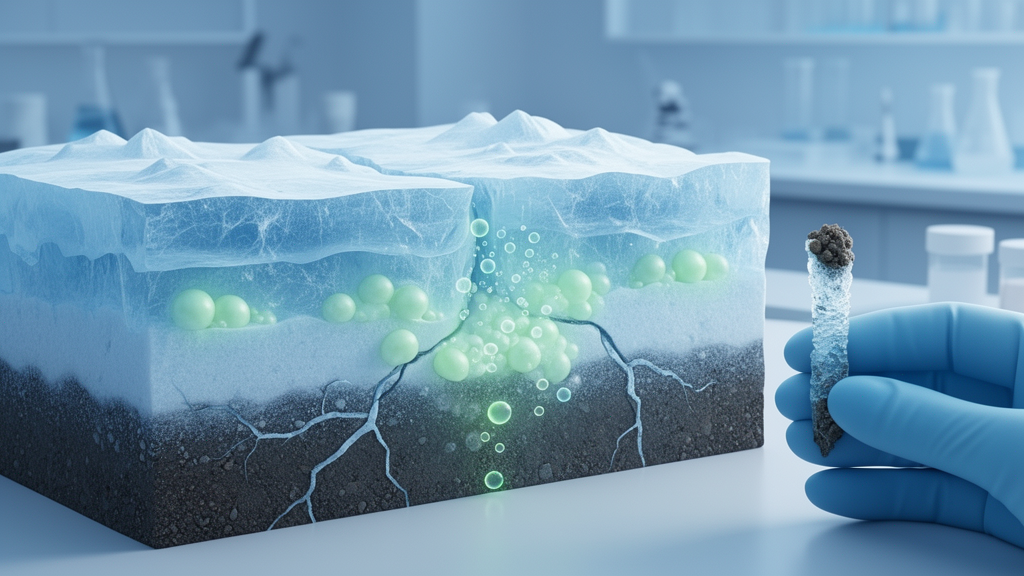
Deep beneath the frozen surface of the Arctic, vast reservoirs of methane sit trapped beneath a lid of ice-cemented soil. Scientists have long worried that as climate change thaws this permafrost, that lid could suddenly fail, releasing bursts of the potent greenhouse gas into the atmosphere. Now, a team of researchers at Texas A&M University has provided the first direct experimental measurements of exactly when and how gas breaks through frozen ground, revealing a dramatic threshold behavior that could help explain some of the Arctic’s most explosive phenomena.
The study, published in Frontiers in Environmental Science, focused on a silty sand collected from Alaska’s North Slope. Led by Zihao Shang, Leela Radarapu, and Marcelo Sanchez of the Zachry Department of Civil and Environmental Engineering, the research team subjected saturated soil samples to carefully controlled freezing and thawing cycles while measuring how much gas pressure was needed to force nitrogen through the frozen material. Their findings demonstrate that permafrost does not leak gradually like a weakening dam. Instead, it holds firm until a critical pressure threshold is crossed, at which point gas suddenly punches through in a process the researchers call gas breakthrough.
The stakes of this research are enormous. Permafrost soils across the Northern Hemisphere store an estimated 1,700 gigatons of organic carbon, roughly twice the amount of carbon currently in the atmosphere. Beyond organic carbon, these frozen environments frequently contain free gas accumulations and gas hydrate deposits, particularly in Arctic and sub-Arctic regions and beneath the seafloor. As surface temperatures rise, ground heat flux increases, thawing the permafrost and deepening the active layer. This thaw destabilizes ice-rich soils, causing surface subsidence, thermokarst formation, landslides, and the collapse of ice-wedge polygons. The degradation also alters subsurface hydrology, facilitating the migration and release of previously trapped methane and carbon dioxide, which in turn enhances atmospheric warming and accelerates further thaw in a self-reinforcing feedback loop.
While much attention has focused on methane generation within thawing permafrost, the Texas A&M team focused on a different pathway: methane migration from deeper sources, including thermogenic gas and gas hydrates, through thaw-induced permeable channels such as taliks, fractures, and thawed conduits. In this view, permafrost should not be seen as an impermeable barrier but rather as an evolving medium through which gas may accumulate, migrate, and ultimately escape. Progressive thawing, stress redistribution, and ice-water phase change may create preferential pathways that enable rapid gas breakthrough, potentially acting as tipping points for sudden methane release.
The experimental program was methodical and comprehensive. The researchers first characterized the unfrozen water content of the soil across a range of subzero temperatures, revealing a sharp, nonlinear reduction below 0 degrees Celsius. The most significant decline occurred between -1 and -2 degrees Celsius, corresponding to the primary phase-change zone where bulk pore water transitions to ice. Below approximately -5 degrees Celsius, the decrease became gradual and asymptotic, with a residual unfrozen water content persisting even at -20 degrees Celsius due to adsorbed water films on clay mineral surfaces. The team also observed minor thermal hysteresis between freezing and thawing paths, meaning the soil behaved differently depending on whether it was cooling or warming, an important consideration for field applications where thawing is the dominant process.
Direct tensile tests revealed a strong, nonlinear increase in tensile strength with decreasing temperature. Near -2 degrees Celsius, specimens exhibited low tensile resistance and ductile behavior, deforming significantly before failure. As temperatures dropped to -3, -5, -7, -10, and -15 degrees Celsius, peak tensile strength increased substantially, exceeding 2,500 kilopascals at the lowest temperatures, while failure became distinctly brittle. Near -1 degree Celsius, tensile resistance was negligible and measurements were unreliable due to minimal ice bonding between soil particles. This transition from ductile to brittle behavior occurred across a narrow temperature window between approximately -1 and -5 degrees Celsius, precisely where the most dramatic changes in unfrozen water content were observed.
The gas breakthrough experiments themselves were conducted in two configurations. Under constant-volume conditions, which simulate laterally constrained deep permafrost environments, specimens were frozen at -7 degrees Celsius and then subjected to gas injection pressures ranging from 1 to 5 megapascals while temperature was progressively increased. In one test, no breakthrough occurred at -7 degrees Celsius even at 5 megapascals, but when temperature rose to -5 degrees Celsius, gas broke through. In another test at 3 megapascals, breakthrough occurred only after the specimen had been held at -4 degrees Celsius for approximately two days. In a third test, breakthrough required 2.5 megapascals at -2 degrees Celsius. Notably, these breakthrough pressures consistently exceeded the unconfined tensile strengths measured at the same temperatures, highlighting the critical role of lateral confinement in resisting gas-driven fracture.
Under stress-controlled triaxial conditions, which replicate in-situ overburden stresses at depths ranging from approximately 20 to 220 meters, the researchers identified clear threshold behavior across seven test cases. At low gas pressures of 200 to 500 kilopascals, no gas migration occurred even after complete thawing to 0 degrees Celsius, establishing a lower bound for the pressure required to initiate migration regardless of thermal state. At an intermediate gas pressure of 750 kilopascals under moderate confinement, breakthrough occurred only after complete thawing, when ice cementation and cryogenic suction had effectively disappeared. At higher confining stresses of 2,200 to 4,000 kilopascals, breakthrough occurred near -1 degree Celsius at gas pressures between 2,000 and 3,900 kilopascals, substantially exceeding unconfined tensile strengths.
The most critical temperature range for breakthrough was found to lie between approximately -2 and -1 degree Celsius, coinciding with the steepest increase in unfrozen water content along the thawing path and the most pronounced reduction in tensile strength. In several cases, breakthrough was characterized by transient flow responses, including short-lived flow peaks followed by rapid declines. The researchers attributed these patterns to the combined effects of finite gas supply and limited transmissivity of newly formed pathways, with the presence of significant unfrozen water near the thawing point potentially promoting partial resealing of fractures through redistribution of liquid water and ice regelation. At the field scale, similar transient breakthrough events near the thawing point may manifest as episodic methane emissions rather than sustained releases, consistent with observations of intermittent gas seepage in degrading permafrost terrain.
The findings have significant implications for understanding explosive gas-emission craters in Siberian permafrost, which previous modeling suggests form when subsurface gas pressures reach values comparable to or exceeding the combined lithostatic load and tensile strength of an ice-rich permafrost cap, typically on the order of a few tenths to a few megapascals. The experimental thresholds identified in this study, ranging from hundreds of kilopascals under shallow conditions to nearly 4 megapascals under deep confinement, fall squarely within this range. The researchers caution that their results should be interpreted as constitutive-scale thresholds rather than direct field analogues, given that the laboratory specimens were homogeneous and relatively small compared with natural permafrost systems. Nevertheless, the data provide a crucial foundation for developing physically based breakthrough criteria that can be incorporated into numerical models of permafrost degradation and methane emissions, ultimately improving predictions of how these frozen carbon reservoirs will respond to continued Arctic warming.
Subject of Research: Experimental measurement of threshold-driven gas breakthrough pressures in thawing permafrost soils
Article Title: Experimental evidence of threshold-driven gas breakthrough in thawing permafrost
Article References: Shang, Z., Radarapu, L., & Sanchez, M. (2026). Experimental evidence of threshold-driven gas breakthrough in thawing permafrost. Frontiers in Environmental Science, 14, Article 1820261. https://doi.org/10.3389/fenvs.2026.1820261
Image Credits: AI Generated
DOI: 10.3389/fenvs.2026.1820261
Keywords: permafrost, methane, gas breakthrough, unfrozen water content, tensile strength, cryogenic suction, Arctic, climate feedback, frozen soil, gas hydrates, thawing, greenhouse gases
Cite Scienmag News
Violet Maxwell. (October 16, 2026). Frozen Ground on the Brink: Lab Tests Reveal the Pressure Threshold That Unleashes Arctic Methane. Scienmag. https://scienmag.com/frozen-ground-on-the-brink-lab-tests-reveal-the-pressure-threshold-that-unleashes-arctic-methane/
Violet Maxwell. "Frozen Ground on the Brink: Lab Tests Reveal the Pressure Threshold That Unleashes Arctic Methane." Scienmag, 16 October 2026, https://scienmag.com/frozen-ground-on-the-brink-lab-tests-reveal-the-pressure-threshold-that-unleashes-arctic-methane/. Accessed 16 October 2026.
Violet Maxwell. "Frozen Ground on the Brink: Lab Tests Reveal the Pressure Threshold That Unleashes Arctic Methane." Scienmag. October 16, 2026. https://scienmag.com/frozen-ground-on-the-brink-lab-tests-reveal-the-pressure-threshold-that-unleashes-arctic-methane/


