


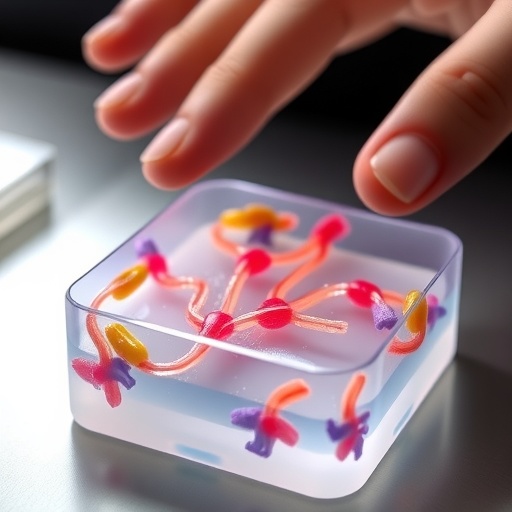
Researchers at Tampere University have developed a light-activated hydrogel platform that could make the construction of advanced biomaterials faster, simpler and far more adaptable. The system uses three broadly accessible ingredients—blue light, riboflavin, also known as vitamin B2, and biological building blocks modified with gallic acid chemistry—to create hydrated, tissue-like materials under conditions compatible with living cells. The approach allows proteins, peptides, DNA and RNA to be incorporated into a hydrogel as it forms, without requiring each biological molecule to undergo a separate chemical modification. The result is a modular “plug-and-play” technology designed to help researchers build customised environments for tissue engineering, disease modelling, drug discovery and regenerative medicine. Its combination of simple ingredients and biological flexibility could make it especially attractive for laboratories seeking to reproduce the complexity of human tissues in three-dimensional culture systems.
Hydrogels are networks of polymer chains that retain large quantities of water. Because their composition and mechanical behaviour can resemble aspects of the extracellular matrix—the supportive material surrounding cells in the body—they are widely used in biomedical research. Researchers use them to grow cells in three dimensions, deliver therapeutic compounds, study disease processes and explore how cells respond to physical and biochemical signals. Yet many existing hydrogel systems are difficult to customise. They may require several rounds of chemical modification, specialised crosslinkers or synthetic photoinitiators. Some reagents can be toxic to cells, while harsh reaction conditions may damage sensitive proteins or nucleic acids before they can perform their biological functions. These limitations can force scientists to choose between creating a mechanically stable material and preserving the activity of the molecules that make the material biologically meaningful.
The Tampere platform addresses this challenge by introducing gallic acid-derived groups into biopolymers used to construct the hydrogel. Gallic acid is a naturally occurring antioxidant found in plants, fruits and tea leaves. Its molecular structure contains gallol groups, which are rich in chemical sites capable of interacting with biological molecules and participating in oxidative crosslinking reactions. When the modified biopolymer is exposed to blue light in the presence of riboflavin, the vitamin absorbs the light and helps initiate the reactions that connect the polymer chains. These bonds transform the initially fluid material into a stable, water-rich network. At the same time, the gallic acid chemistry provides a form of molecular adhesion that can capture proteins and nucleic acids within the developing matrix. In some experiments, ordinary cell culture medium supplied enough photochemical support for gel formation, reducing the need for an additional initiator.
This simultaneous formation and loading process is central to the technology’s appeal. In conventional biomaterial fabrication, a researcher may first prepare a hydrogel, then attach a signalling protein through another reaction, and finally test whether the protein remains active. Each step introduces opportunities for unwanted chemical changes or loss of biological function. The new method is intended to combine those operations into a single, gentler process. Proteins, peptides, DNA and RNA can be added directly to the precursor mixture before blue-light exposure. As the network forms, the biomolecules become retained through interactions with the gallic acid-modified matrix. Because they do not need to be chemically altered in advance, their structure and activity may be better preserved. This is particularly important for signalling proteins and nucleic acids, whose three-dimensional shape or sequence can determine whether they continue to communicate with cells.
The researchers demonstrated this principle using Wnt3A, a signalling protein involved in pathways that regulate cell growth, differentiation and tissue development. Wnt signals are notoriously sensitive to their surroundings, and maintaining their activity inside a biomaterial can be challenging. In the experiments, Wnt3A incorporated into the hydrogel remained biologically active after gelation and continued to influence cell behaviour. The hydrogels also supported high cell viability and enabled cells to grow in three-dimensional environments rather than being restricted to flat laboratory surfaces. Such environments can produce more realistic cellular responses because cells experience spatial constraints, mechanical forces and molecular signals that more closely approximate those found in living tissue. The ability to combine an active signalling molecule with a tunable physical matrix could help researchers investigate how biochemical and mechanical cues work together during development, disease and repair.
Another feature of the material is its capacity to behave more like biological tissue than a rigid synthetic scaffold. Natural tissues are not simply hard or soft; many are viscoelastic, meaning that they deform under force and gradually respond over time. They can also remodel themselves, recover from minor damage and adhere to surrounding structures. The researchers report that their gallol-modified hydrogels display adhesive and self-healing characteristics, allowing the material to maintain its integrity after mechanical disruption. These properties arise from the reversible and dynamic interactions associated with gallol chemistry, alongside the more permanent connections that stabilise the polymer network. A hydrogel that can stretch, recover and remain attached may be useful in applications where materials must withstand movement or repeated deformation, including models of soft tissues and future approaches to regenerative medicine.
The use of riboflavin and blue light adds another layer of practical significance. Riboflavin is a naturally occurring vitamin already present in biological systems and is commonly considered more cell-compatible than many conventional photoinitiators. Blue light can be applied with relatively precise spatial and temporal control, allowing researchers to decide when and where a hydrogel forms. This could support patterned materials, compartmentalised cultures or biofabrication procedures in which different regions of a construct are given distinct physical or biochemical properties. The chemistry may also reduce the number of components that need to be introduced into a cell-containing system. Fewer reagents can simplify manufacturing, lower the risk of unwanted interactions and make protocols easier to reproduce across laboratories. However, as with any light-activated biomaterial, the wavelength, exposure time, light intensity and sample thickness must be carefully controlled to ensure that the process does not stress or damage embedded cells.
The platform is designed to be modular rather than tied to a single polymer, cell type or biological signal. By changing the underlying biopolymer, adjusting its degree of gallic acid modification or selecting different incorporated molecules, researchers can tune the resulting hydrogel for particular experimental purposes. A softer matrix might be used to model a compliant tissue, while a stronger or more adhesive formulation could be developed for mechanically demanding environments. Different proteins could provide instructions for cell differentiation, while DNA or RNA could be used to study gene regulation or deliver molecular cues. This flexibility could make the system valuable for personalised disease models, in which patient-derived cells are grown in matrices designed to imitate features of an individual’s tissue. It could also support drug testing by creating three-dimensional models that respond more realistically than conventional two-dimensional cultures.
The researchers describe the long-term vision in terms of assembling human tissues from molecular “building blocks,” much as components are combined in a modular construction system. That vision remains a research goal rather than an immediate clinical reality, but the new platform could help move the field in that direction by lowering the technical barriers to biomaterial design. A researcher could, in principle, select a compatible matrix, add the biological signals of interest and use blue light to lock the components into a functional three-dimensional environment. Such a workflow may accelerate the development of organoid cultures, biofabrication strategies, regenerative medicine scaffolds and hydrogel-based therapies. Before clinical translation, the materials will require extensive testing for long-term stability, immune compatibility, degradation behaviour, manufacturing consistency and safety. Even so, a hydrogel system that combines rapid formation, active biomolecule incorporation, cell-friendly chemistry and tissue-like mechanics offers a promising route toward more realistic biological models and more precisely engineered regenerative materials.
News Publication Date: 25-Jul-2026
Web References: https://doi.org/10.1016/j.xcrp.2026.103457
References: Cell Reports, DOI: 10.1016/j.xcrp.2026.103457
Keywords
Hydrogels, biomaterials, tissue engineering, regenerative medicine, gallic acid, gallol chemistry, riboflavin, blue-light crosslinking, Wnt3A, three-dimensional cell culture, biofabrication, drug discovery, self-healing materials, molecular engineering
Cite Scienmag News
Bethany Barker. (August 21, 2026). Hydrogel platform streamlines creation of living tissue models. Scienmag. https://scienmag.com/hydrogel-platform-streamlines-creation-of-living-tissue-models/
Bethany Barker. "Hydrogel platform streamlines creation of living tissue models." Scienmag, 21 August 2026, https://scienmag.com/hydrogel-platform-streamlines-creation-of-living-tissue-models/. Accessed 3 September 2026.
Bethany Barker. "Hydrogel platform streamlines creation of living tissue models." Scienmag. August 21, 2026. https://scienmag.com/hydrogel-platform-streamlines-creation-of-living-tissue-models/


