


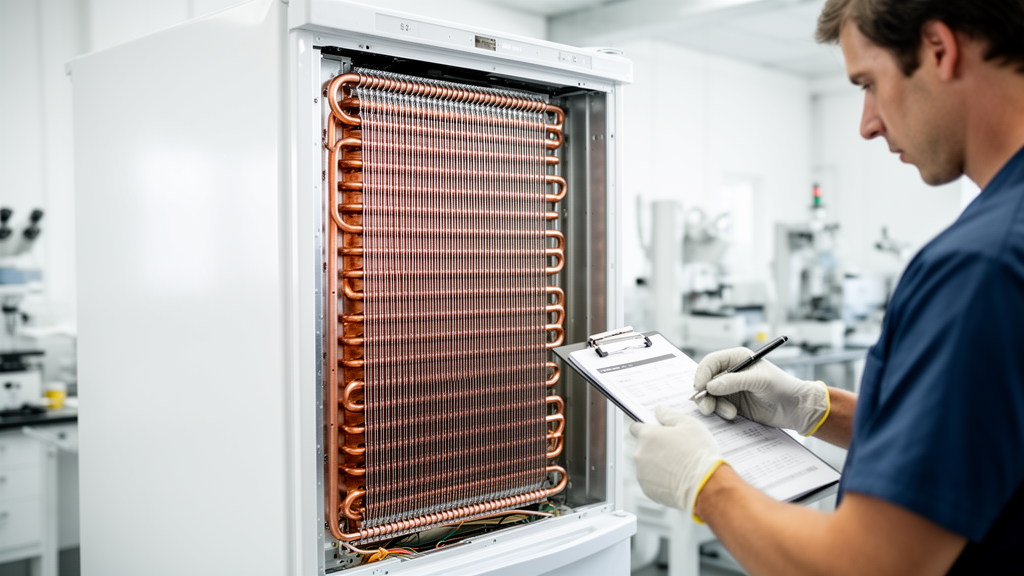
Household refrigerators run around the clock in hundreds of millions of homes, and the refrigerants circulating inside them have become a central concern for engineers trying to reconcile cooling performance with climate protection. A research team from Bells University of Technology, Covenant University, and Olabisi Onabanjo University in Nigeria has now published a detailed thermodynamic modeling study examining how two hydrocarbon refrigerants behave in a domestic vapor compression refrigerator when the condenser length is changed. The work, published in Frontiers in Thermal Engineering, uses the CYCLE_D-HX software developed at the National Institute of Standards and Technology to simulate the performance of a 50-liter test refrigerator fitted with either liquefied petroleum gas (LPG), a blend of 60 percent propane and 40 percent butane, or isobutane (R600a), with condenser lengths of 2.5 and 5 meters.
The motivation behind the study stems from the accelerating phaseout of conventional hydrofluorocarbon refrigerants under international agreements such as EU regulation 517/2014, which restricts the use of fluids with high global warming potential. Isobutane and LPG have emerged as popular retrofit candidates for the phased-out R12 and R134a working fluids because their thermophysical properties closely resemble those of the legacy refrigerants, they deliver improved latent heat transfer, they are compatible with the mineral and synthetic oils already used in compressor lubrication, and flammability risks can be managed with established control methods. Because experimental trials with flammable hydrocarbons are costly, time-consuming, and prone to human error, the researchers turned to numerical modeling, which can deliver accuracy comparable to physical testing while eliminating many practical constraints.
The test rig at the heart of the study is a compact domestic refrigerator with a 120-watt compressor, an air-cooled condenser, a 2-meter capillary tube, and a plate-type evaporator. During the experimental phase, the team gathered data using pressure gauges, K-type thermocouples, a refrigerant flowmeter, and a wattmeter, averaging results across three repeated tests for each combination of refrigerant and condenser length to ensure repeatability. These averaged experimental values were then fed into CYCLE_D-HX, which models each subcomponent of the vapor compression cycle, including the compressor, condenser, capillary tube, and evaporator, and evaluates performance based on user-defined specifications such as refrigerant type, cycle configuration, and heat exchanger temperature profiles.
The modeling framework draws on well-established heat transfer theory. For the air-cooled condenser, the researchers applied the log mean temperature difference method, computing the bare-tube area, fin area, and flow areas from the condenser geometry, then deriving the air-side convective heat transfer coefficient using the Kays and London correlation for free convection across tube banks. The refrigerant-side coefficient during condensation was calculated from mixture Reynolds number correlations that account for the coexistence of liquid and vapor phases along the tube. The overall heat transfer coefficient was then assembled as the reciprocal sum of the individual thermal resistances, incorporating the convective coefficients on both sides and the conduction resistance of the aluminum tube wall, whose thermal conductivity is 237 watts per meter-kelvin. Pressure drop in the condenser was modeled using modified Chawla correlations for two-phase flow, capturing the frictional losses that arise as the refrigerant changes phase from vapor to liquid.
One of the most practically significant findings concerns pull-down time, the interval required for the evaporator chamber to cool from ambient temperature, set at 32 degrees Celsius under the ISO-8187 standard for this refrigerator class, down to the target temperature of minus 12 degrees Celsius. When the system ran on R600a with the 5-meter condenser, the cabinet reached minus 11 degrees Celsius within the 240-minute pull-down window, satisfying the ISO requirement. With the shorter 2.5-meter condenser, R600a achieved only minus 5 degrees Celsius in the same period. LPG performed less impressively on this metric, reaching minus 3 degrees Celsius with the short condenser and minus 9 degrees Celsius with the long one. The researchers attribute R600a’s superior cooling performance to its nature as a single-component, refined fluid that compresses easily and absorbs more latent heat during expansion, whereas the multi-component LPG mixture compresses less readily and absorbs less latent heat.
The coefficient of performance, the ratio of useful cooling delivered to the electrical energy consumed by the compressor, told a different story. At the 2.5-meter condenser length, COP ranged from 1.73 to 2.57 for LPG and from 1.68 to 2.42 for R600a, with the highest value of 2.57 achieved by LPG. At 5 meters, COP ranged from 1.43 to 2.26 for LPG and 1.34 to 2.20 for R600a, with the lowest value of 1.34 recorded for R600a. On average, LPG delivered a COP approximately 4.42 percent higher than R600a at the shorter condenser length and about 4.07 percent higher at the longer length. The COP declined over time for both refrigerants, reflecting the changing operating conditions as the cabinet cooled toward its setpoint.
Power consumption patterns reinforced LPG’s efficiency advantage. With the 2.5-meter condenser, LPG consumed between 1.56 and 2.32 kilowatts during operation, roughly 16.02 percent less on average than R600a, which ranged from 1.65 to 2.37 kilowatts. At the 5-meter length, the gap narrowed considerably, with LPG consuming about 3.75 percent less than R600a, whose consumption ranged from 1.82 to 2.98 kilowatts. The researchers note that power consumption increased both with time and with condenser length, driven primarily by the rising mass flow rate of refrigerant through the compressor. The lowest power draw of 1.56 kilowatts was recorded for LPG with the short condenser, making that configuration the most energy-frugal option in the study.
Heat rejection and heat transfer characteristics favored R600a. The average heat rejection rate with R600a exceeded that of LPG by 1.23 percent at the 2.5-meter condenser and by 1.85 percent at the 5-meter length, with R600a values ranging from 5.65 to 6.98 kilowatts depending on configuration. The overall heat transfer coefficient followed a similar pattern, running 0.98 percent higher for R600a at the short length and 1.39 percent higher at the long length, with values spanning 0.668 to 0.822 kilowatts per square meter-degree Celsius. Both coefficients increased with condenser length, indicating that longer condensers transfer heat more effectively. The researchers point out that R600a’s lower global warming potential makes it a preferred choice for modern systems despite LPG’s efficiency edge in other metrics.
Pressure drop inside the condenser tubes, which arises from both friction and the phase change from vapor to liquid, also differentiated the two refrigerants. R600a exhibited an average pressure drop 7.46 percent greater than LPG at the 2.5-meter length and 6.50 percent greater at 5 meters, with values ranging from 21.0 to 47.4 kilopascals for R600a and 20.1 to 43.4 kilopascals for LPG. Pressure drop increased with condenser length for both fluids, and the researchers emphasize that high pressure drops degrade system performance and component reliability, while low pressure drops prolong equipment life. The thermophysical properties of the refrigerants, including density, latent heat, and kinematic viscosity, strongly influence this behavior, which explains why the LPG mixture consistently produced the lowest pressure losses.
Taken together, the results present a nuanced picture with no single dominant configuration. The system performed best with LPG and a 2.5-meter condenser in terms of coefficient of performance and power consumption, while R600a with a 5-meter condenser excelled in cooling capacity, achieving the lowest cabinet temperature, and in heat rejection from the condenser. The findings suggest that refrigerant selection and condenser geometry must be optimized jointly rather than in isolation, and that the ideal choice depends on whether the design priority is energy savings, rapid pull-down, or thermal performance. As climate pressures intensify and regulations tighten around high global warming potential fluids, studies of this kind provide a computational foundation for designing the next generation of energy-efficient, environmentally responsible domestic refrigerators.
Subject of Research: Thermodynamic modeling of domestic refrigeration using hydrocarbon refrigerants with varying condenser lengths
Article Title: Thermodynamic modeling and performance assessment of a domestic refrigeration system using selected hydrocarbon refrigerants with varying condenser lengths
Article References: Oyedepo, S. O., Adelekan, D. S., Adenugba, O. E., Oyebanji, J. A., Babarinde, T. O., Kilanko, O., Banjo, S. O., & Nwaokocha, C. N. (2026). Thermodynamic modeling and performance assessment of a domestic refrigeration system using selected hydrocarbon refrigerants with varying condenser lengths. Frontiers in Thermal Engineering, 6, Article 1794072. https://doi.org/10.3389/fther.2026.1794072
Image Credits: AI Generated
DOI: 10.3389/fther.2026.1794072
Keywords: domestic refrigerator, hydrocarbon refrigerants, R600a, LPG, condenser length, coefficient of performance, CYCLE_D-HX, thermodynamic modeling, heat transfer, energy efficiency, vapor compression, global warming potential
Cite Scienmag News
Denise Maddox. (October 16, 2026). Hydrocarbon Refrigerants and Condenser Length Shape the Efficiency of Domestic Refrigerators in New Simulation Study. Scienmag. https://scienmag.com/hydrocarbon-refrigerants-and-condenser-length-shape-the-efficiency-of-domestic-refrigerators-in-new-simulation-study/
Denise Maddox. "Hydrocarbon Refrigerants and Condenser Length Shape the Efficiency of Domestic Refrigerators in New Simulation Study." Scienmag, 16 October 2026, https://scienmag.com/hydrocarbon-refrigerants-and-condenser-length-shape-the-efficiency-of-domestic-refrigerators-in-new-simulation-study/. Accessed 16 October 2026.
Denise Maddox. "Hydrocarbon Refrigerants and Condenser Length Shape the Efficiency of Domestic Refrigerators in New Simulation Study." Scienmag. October 16, 2026. https://scienmag.com/hydrocarbon-refrigerants-and-condenser-length-shape-the-efficiency-of-domestic-refrigerators-in-new-simulation-study/


