


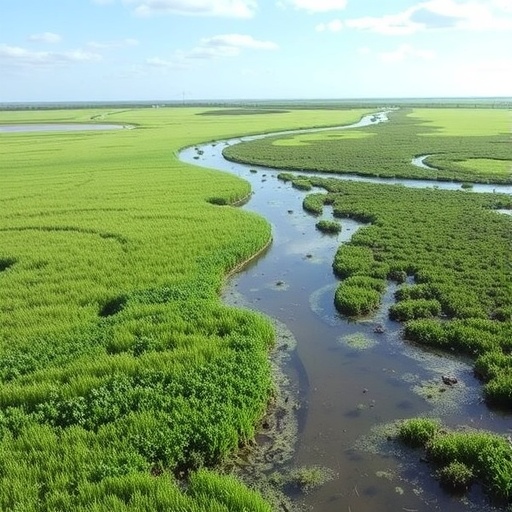
In recent years, the restoration of coastal wetlands has surged to the forefront of environmental science and conservation efforts, driven by their unparalleled importance in mitigating climate change, protecting biodiversity, and enhancing ecosystem services. However, the complexities inherent in these dynamic environments have long posed a challenge to restoration practitioners and researchers alike. A groundbreaking study spearheaded by Ren, Wang, Zhang, and colleagues, soon to be published in Nature Communications, unveils how hydro-geomorphological processes operating across spatial and temporal scales fundamentally influence the trajectory and success of coastal wetland restoration. Their pioneering work not only deepens scientific understanding but also holds promising implications for scaling effective restoration strategies in a rapidly changing world.
Coastal wetlands are unique ecosystems situated at the interface of land and sea, where fresh and saltwater interactions create rich biological habitats and intricate sedimentary environments. They offer critical ecosystem services, including carbon sequestration, storm buffering, and water filtration. Yet, decades of anthropogenic pressures—ranging from land reclamation to pollution and climate-induced sea-level rise—have severely degraded many wetlands, disrupting their delicate hydro-geomorphic balance. Restoration efforts thus require more than simple replanting or sediment replacement; they must engage with the evolving physical processes that sustain wetland morphology and function over time.
Ren and colleagues address this complexity by investigating how hydro-geomorphological drivers—comprising hydrodynamic forces like tides, waves, and river flows, as well as geomorphic factors such as sediment supply, erosion, and landform evolution—interact across scales to shape restoration outcomes. The study employs cutting-edge modeling techniques alongside comprehensive field observations from diverse coastal settings to dissect these multifaceted interactions. Their integrative approach reveals that restoration trajectories are not linear or uniform but instead depend heavily on context-specific hydro-geomorphic feedbacks, which can either accelerate recovery or induce unexpected setbacks.
One of the central advances of this research lies in framing wetland restoration within a multi-scale perspective. At macro scales, large-scale hydrodynamic regimes and sediment availability determine whether restored sites maintain elevation relative to sea level, thereby preventing drowning under rising tides. At micro to meso scales, localized processes such as vegetation growth, sediment trapping, and channel formation dynamically alter sediment deposition patterns and landscape morphology. By identifying scale-dependent drivers and their feedbacks, the study elucidates why some restoration projects succeed swiftly while others falter or even degrade further despite similar initial interventions.
Moreover, the team highlights the critical role of geomorphological history and legacy effects in influencing restoration trajectories. Coastal wetlands are products of historical sediment accumulation and erosion patterns that leave persistent imprints on topography and substrate composition. These antecedent conditions can constrain or facilitate sediment retention and vegetation establishment needed for wetland building. Restoration strategies that overlook or inadequately account for such legacy effects risk misallocating resources or imposing designs incompatible with the site’s inherent physical dynamics.
The researchers also document how hydro-geomorphological drivers influence biotic components integral to wetland resilience. Hydrodynamic regimes regulate nutrient fluxes and salinity gradients that affect plant community composition and productivity. In turn, vegetation modifies sediment dynamics by stabilizing soils and attenuating wave energy, thus creating a tightly coupled system where biological and physical factors co-evolve during the restoration process. This reciprocity demonstrates why multidisciplinary approaches combining geomorphology, hydrology, and ecology are essential to devise adaptive management frameworks capable of anticipating ecological feedbacks.
An important outcome of the study is its revelation of thresholds and tipping points within wetland recovery trajectories. The authors identify critical conditions under which restored wetlands can transition from degradation toward self-sustaining states, or conversely, experience collapse due to insufficient sediment inputs or excessive hydrodynamic stress. Recognizing these thresholds enables practitioners to predict restoration trajectories with greater confidence and tailor interventions such as sediment augmentation, hydrological modifications, or species selection to steer ecosystems across stability boundaries.
Furthermore, the study underscores the impact of climate change drivers on hydro-geomorphic processes affecting restoration. Rising sea levels, changing storm patterns, and altered freshwater inflows modulate sediment budgets and hydrodynamics in ways that can hasten inundation or desiccation, leading to spatial shifts in wetland habitats. The authors advocate for flexible restoration designs incorporating scenario planning and adaptive monitoring capable of responding to climatic uncertainties, thus enhancing long-term resilience and ecosystem service provision.
In addition to providing scientific insights, this comprehensive work offers practical guidelines for restoration practitioners. It calls for integrative assessment frameworks combining geomorphic mapping, hydrodynamic modeling, and vegetation analyses to inform site selection and intervention design. Moreover, ongoing monitoring of physical and biological indicators is emphasized to detect early signs of trajectory divergence and prompt adaptive management actions. The study also promotes collaboration across disciplines and stakeholders, recognizing the need for integrating scientific knowledge with traditional ecological understanding and community engagement to foster sustainable coastal wetland stewardship.
The implications of Ren et al.’s findings extend beyond academic circles into policy and conservation domains. Coastal wetlands are pivotal to achieving global environmental goals, including biodiversity targets and carbon neutrality commitments. By delineating the hydro-geomorphological mechanisms underpinning restoration success, the research equips policymakers with evidence-based parameters to prioritize investment and regulate coastal development. It also informs international frameworks aimed at enhancing nature-based solutions to climate adaptation and disaster risk reduction.
This landmark study represents a critical step forward in dissecting the complex interplay between physical processes and ecological dynamics in coastal wetland restoration. Its emphasis on scale-dependent hydro-geomorphic drivers challenges reductionist paradigms, advocating for a systems-thinking approach at the nexus of geology, hydrology, and ecology. The framework and findings presented by Ren and colleagues offer a transformative roadmap for restoring these vital ecosystems amidst accelerating environmental change, with the potential to galvanize innovation, collaboration, and impact in global conservation efforts.
As environmental pressures mount and restoration becomes an urgent imperative, the integration of multidisciplinary science, adaptive management, and policy support will be crucial to safeguarding coastal wetlands and their invaluable services for future generations. The scientific community and restoration practitioners alike stand to benefit immensely from this study’s holistic perspective and rigorous methodology, setting a new standard for both research and practice in the field. By harnessing the complex hydro-geomorphological drivers that shape wetland trajectories, humanity can better navigate the challenges of restoration, fostering resilient and thriving coastal landscapes capable of withstanding the trials of the 21st century and beyond.
This pioneering research underscores a broader message: successful restoration is not merely a matter of ecological reparation, but an integrative process grounded in understanding and working with the physical world’s inherent dynamics. It is an invitation to rethink traditional restoration paradigms and embrace the complexity and adaptability of nature as allies rather than adversaries. The trajectory of coastal wetlands, much like the coastlines themselves, is ever-evolving, reaffirming that restoration is as much an art informed by science as a science inspired by nature’s resilience.
Cite Scienmag News
Cole Johnston. (April 22, 2026). Hydro-Geomorphology Shapes Coastal Wetland Restoration Trajectories. Scienmag. https://scienmag.com/hydro-geomorphology-shapes-coastal-wetland-restoration-trajectories/
Cole Johnston. "Hydro-Geomorphology Shapes Coastal Wetland Restoration Trajectories." Scienmag, 22 April 2026, https://scienmag.com/hydro-geomorphology-shapes-coastal-wetland-restoration-trajectories/. Accessed 4 September 2026.
Cole Johnston. "Hydro-Geomorphology Shapes Coastal Wetland Restoration Trajectories." Scienmag. April 22, 2026. https://scienmag.com/hydro-geomorphology-shapes-coastal-wetland-restoration-trajectories/


