


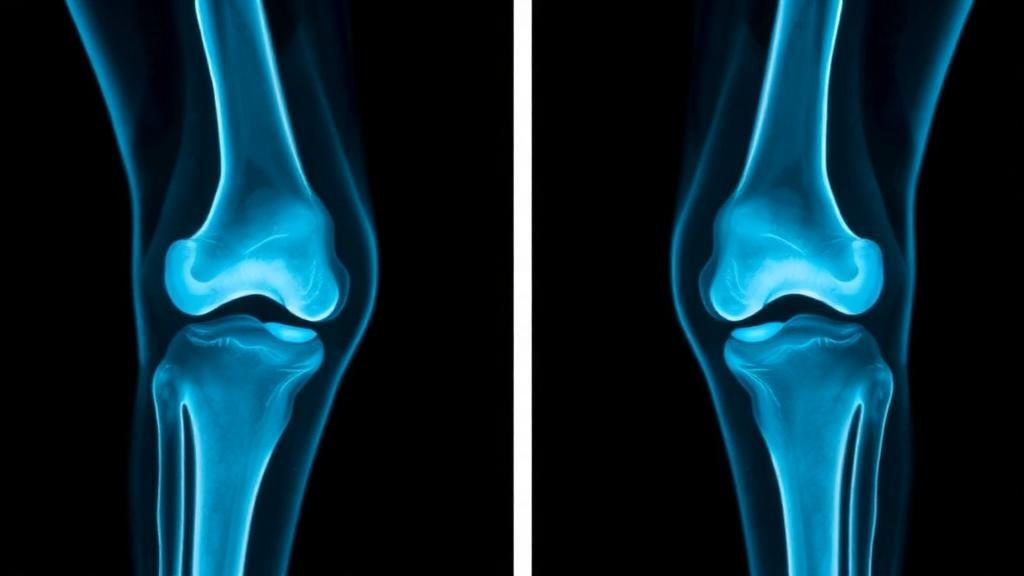
Osteoporosis is often called a silent disease because it strips bone of density long before a fracture announces its presence. Now, researchers at VIT-AP University in India have built an artificial intelligence system that reads ordinary knee X-rays and classifies them as normal, osteopenic, or osteoporotic with 91 percent accuracy, while showing clinicians exactly where the network looked to reach its decision. The study, published in Frontiers in Signal Processing, describes a hybrid deep learning architecture that fuses convolutional feature extraction, channel attention, transformer-based global reasoning, and bidirectional recurrent modeling into a single diagnostic pipeline.
The clinical stakes are considerable. Reduced bone mineral density and deteriorating bone microarchitecture make weight-bearing joints fragile, and the condition poses particular problems in orthopaedic surgery. Patients undergoing total knee arthroplasty who harbor undetected low bone density face higher risks of implant instability and postoperative complications, and distal femur fractures become far harder to fix when the surrounding bone lacks structural strength. Early identification of osteoporosis from routine radiographs could therefore change how surgeons plan interventions and how physicians time preventive treatment.
Most existing AI approaches to osteoporosis screening rely on convolutional neural networks or transfer learning from pretrained image classifiers. These architectures excel at picking up local patterns, such as texture changes in trabecular bone, but they struggle to capture long-range spatial dependencies across an entire radiograph. The research team, Sudhir Kumar Sangula and Siddique Ibrahim S. P., set out to close that gap by combining several complementary mechanisms that each address a different weakness of standard convolutional models.
The pipeline begins with two blocks of depthwise separable convolutions, each followed by batch normalization, ReLU activation, and max pooling. The first block uses 64 filters and the second 128, both with 3-by-3 kernels. Separable convolutions factor a standard convolution into a depthwise step and a pointwise 1-by-1 combination, which slashes computational cost while still capturing spatial information efficiently. Input images are resized to 224 by 224 pixels and represented in three-channel RGB format even though the original X-rays are grayscale, a common convention that keeps the architecture compatible with standard deep learning frameworks.
Next comes the squeeze-and-excitation block, the first of the architecture’s attention mechanisms. Global average pooling condenses each feature channel into a single descriptor, and two dense layers with ReLU and sigmoid activations learn a set of channel weights that rescale the feature map. Channels carrying diagnostically useful information are amplified while less relevant ones are suppressed. The authors chose this lightweight channel-attention design over heavier alternatives such as CBAM or full self-attention modules because it offers a favorable trade-off between performance and computational overhead, an important consideration for medical imaging tasks with limited data.
The reshaped feature maps then flow into a transformer encoder with four attention heads and an embedding dimension of 256. By treating spatial locations as a sequence of tokens, the transformer applies multi-head self-attention to model relationships between distant regions of the image, something convolutional kernels with small receptive fields cannot do directly. Layer normalization, residual connections, and feed-forward dense layers stabilize training and deepen the contextual reasoning. The output of this stage is a set of globally informed feature embeddings that encode how bone density patterns in one part of the knee relate to structures elsewhere in the radiograph.
Two recurrent layers then refine these embeddings in sequence. A bidirectional long short-term memory network reads the feature sequence in both forward and backward directions, capturing long-range contextual dependencies, and a bidirectional gated recurrent unit follows with a more parameter-efficient gating mechanism that further polishes the representations. The authors report that stacking the two recurrent types produced consistent gains over intermediate configurations, with the BiLSTM contributing deep contextual memory and the BiGRU adding computational economy. A final softmax layer assigns probabilities to the three diagnostic classes.
Trained for 120 epochs on a publicly available Zenodo dataset of knee X-rays augmented to 5,400 images, the model reached 91.0 percent accuracy, 91.0 percent precision, 90.2 percent recall, and an F1-score of 90.4 percent on a held-out test set. Across five independent runs with different random seeds, mean precision, recall, and F1-score held steady at 0.91, 0.90, and 0.90 respectively, and the 95 percent confidence interval for accuracy spanned 89.8 to 92.2 percent. Paired t-tests confirmed statistically significant improvements over every baseline, including an ensembling method that scored 87.3 percent. Perhaps most strikingly, the entire network contains only about 1.1 million parameters and trained in under 59 seconds, compared with training times exceeding 760 seconds for VGG-16 and nearly 975 seconds for ResNet-50.
An ablation study traced the value of each component. A baseline CNN scored an F1 of 0.83; adding the SE block lifted it to 0.85, the transformer encoder to 0.87, the BiLSTM to 0.89, and the full stack with BiGRU to 0.90, with every incremental gain statistically significant. Gradient-weighted Class Activation Mapping, or Grad-CAM, provided the explainability layer, generating heatmaps that showed the network concentrating on knee joint regions, cortical bone boundaries, and surrounding bone density structures. In normal cases the activations were diffuse and mild, while osteopenic and osteoporotic images produced strong localized attention around areas of reduced bone density, suggesting the model learned clinically meaningful features rather than image artifacts.
The authors are candid about the study’s limits. Evaluation rested on a single dataset, confusion between osteopenia and early osteoporosis reflected the genuine difficulty of separating gradual bone loss on imaging alone, and the Grad-CAM interpretation remained qualitative without physician-annotated validation. They suggest that fusing complementary clinical data such as bone mineral density scores, patient age, and risk factors could sharpen discrimination between adjacent disease stages. Multi-center external validation will be essential before such a system enters clinical practice, but as a compact, fast, and transparent screening tool, the hybrid SE-Transformer architecture offers a compelling glimpse of how explainable AI could bring routine bone health assessment into the radiology workflow.
Subject of Research: Explainable hybrid deep learning for knee osteoporosis classification from X-ray images
Article Title: An explainable AI-driven hybrid SE-transformer architecture for robust knee osteoporosis classification from X-ray data
Article References: Sangula, S. K., & S. P., S. I. (2026). An explainable AI-driven hybrid SE-transformer architecture for robust knee osteoporosis classification from X-ray data. Frontiers in Signal Processing, 6, Article 1853106. https://doi.org/10.3389/frsip.2026.1853106
Image Credits: AI Generated
DOI: 10.3389/frsip.2026.1853106
Keywords: osteoporosis, knee X-ray, deep learning, transformer, squeeze-and-excitation, BiLSTM, BiGRU, Grad-CAM, explainable AI, medical imaging, computer-aided diagnosis, bone density
Cite Scienmag News
Blake Davidson. (October 16, 2026). Hybrid AI Reads Knee X-Rays to Catch Osteoporosis Early. Scienmag. https://scienmag.com/hybrid-ai-reads-knee-x-rays-to-catch-osteoporosis-early/
Blake Davidson. "Hybrid AI Reads Knee X-Rays to Catch Osteoporosis Early." Scienmag, 16 October 2026, https://scienmag.com/hybrid-ai-reads-knee-x-rays-to-catch-osteoporosis-early/. Accessed 16 October 2026.
Blake Davidson. "Hybrid AI Reads Knee X-Rays to Catch Osteoporosis Early." Scienmag. October 16, 2026. https://scienmag.com/hybrid-ai-reads-knee-x-rays-to-catch-osteoporosis-early/


