


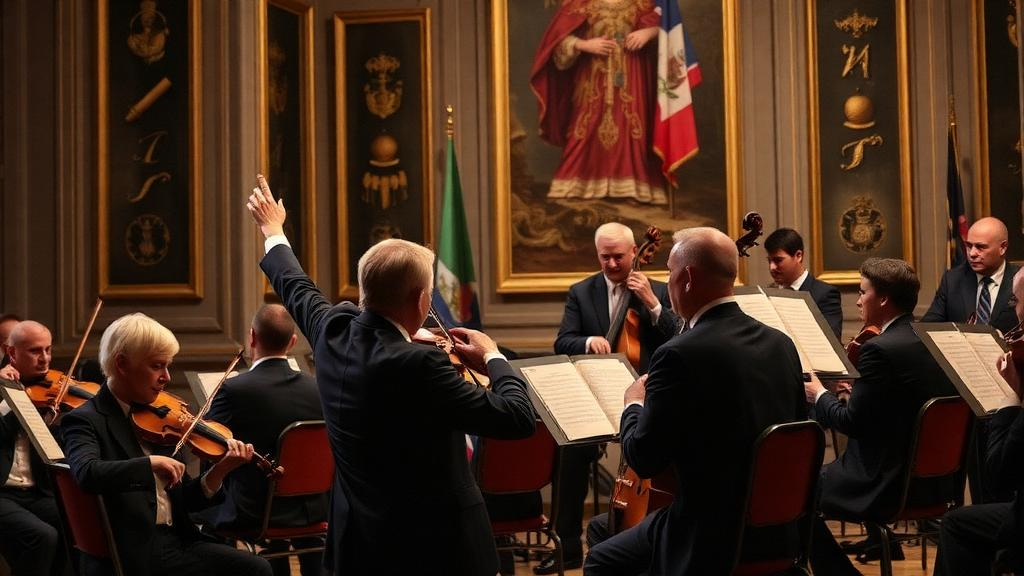
In the gilded Grand Hall of the Saint Petersburg State Philharmonic, audiences hear more than symphonies. According to new research, the concert programs themselves have become instruments of statecraft, quietly shaping how Russian citizens understand who they are. A study published in the European Journal of Cultural Management and Policy argues that the Philharmonic’s season programming between 2013 and 2023 systematically mirrored the Kremlin’s national identity agenda, making classical music a functioning tool of what the author calls national identity actualization.
The research, conducted by Kara Erika Koskinen of the University of Helsinki, is a qualitative single case study grounded in a social constructivist approach. It analyzed two bodies of documented data: Russian cultural policy reports issued between 2014 and 2023, and the Saint Petersburg State Philharmonic’s season programs spanning the 2013-14 through 2022-23 seasons. Using thematic analysis, the study first identified the core themes of national identity promoted in official policy documents, then examined how those same themes surfaced in the concert hall.
The starting point for the analysis was a decisive political shift. When President Vladimir Putin delivered his 2013 speech at the Valdai Club, framed around the question of who Russians are as a nation, it marked the beginning of a fundamental conservative turn in the country’s cultural policy-making. Throughout his third presidential term, the Kremlin institutionalized its national identity discourse into government use, and the cultural field was rapidly reformed with new ideology-compliant reports beginning in 2014. Their core idea is a single national identity, and cultural procedures designed to build what the state considers true and compliant Russian citizens.
Thematic analysis of the cultural policy reports produced five themes: Proud History and Patriotism, Russian Language and Literature, Upbringing, Enlightenment, and Religion and Spirituality. Each of these themes, the study found, was actualized in the Philharmonic’s season programming. The report on the Basics of the State Cultural Policy, for example, presents Russian historical path as the cornerstone of national identity and warns against the deformation of historical memory, meaning criticism of the Great Patriotic War and other periods central to the unifying national story. The Strategy of the State Cultural Policy goes further, describing domestic classical music as the national glory and pride of the Russian Federation and calling for patriotic education of youth through culture.
The numbers reveal how strongly the first theme dominated. Proud History and Patriotism was the largest thematic category in every season studied, accounting for between 39 and 51 percent of all concerts, and between 57 and 69 percent of thematized concerts. Over the decade, the number of such concerts grew by 72, a 12 percentage point increase relative to all concerts. The programming included subscription cycles honoring the October Revolution centenary, the 180th anniversary of the Dvoryansky Hall, and the 75th anniversary of the complete liberation of Leningrad from the fascist siege. Annual patriotic concerts celebrated Victory in the Great Patriotic War, honored veterans, and included the Yellow Stars memorial concerts for Holocaust victims, alongside memorial concerts for figures such as Tchaikovsky, Pushkin, and Akhmatova.
The second theme, Russian Language and Literature, remained the second largest category, fluctuating between 8 and 13 percent of all concerts. Policy documents elevate the Russian language as the unifier of the multinational Russian people and call for literature that preserves all-Russian civic identity, while the amended Basics directs the state to supervise norms of the modern Russian literary language and diminish foreign vocabulary. At the Philharmonic, this translated into vocal music cycles devoted to Russian romance and opera, literary spectacles such as Unknown Friend, based on Ivan Bunin and narrated by actress Kseniya Rappoport, and Evenings of Creativity and Poetry featuring figures like historian Edvard Radzinsky and journalist Vladimir Pozner.
Upbringing, the third theme, targets the youngest audiences. Cultural policy reports frame education as essential to transmitting moral, ethical, and aesthetic values that form the foundation of national identity, and the 2023 amended Basics gives cultural organizations a strengthened role in children’s historical and cultural education. The Philharmonic’s children’s programming included story-based subscription cycles such as Great Music for Younger Children and Visiting a Fairytale, instrument introductions like Who is Playing on What, and a cycle introducing Russian composers and their works, which the study links directly to state patriotic educational programs. The category grew steadily before the pandemic, from 40 concerts in 2013-14 to 60 in 2018-19, before falling and partially recovering.
Enlightenment, the fourth theme, addresses adult education. Policy reports describe cultural enlightenment as a defense against what the state views as the harmful influence of Western lifestyle and individualism, and they promise funding to organizations whose educational activities align with government ideology. The Philharmonic responded with cycles such as Guide to Classics and, notably, Dialogues about Art, a collaboration with the Hermitage and later the Russian Museum that was renamed Dialogues about Russian Art in the final season and given a patriotic undertone pairing Russian art with symphonic masterpieces by Tchaikovsky and Prokofiev. The category stayed stable at roughly 4 to 6 percent of all concerts.
Religion and Spirituality was the smallest theme, at 1 to 6 percent of concerts, but the study argues it carries symbolic weight. The policy documents position Orthodoxy as the sacred essence of Russian identity while adopting the language of interreligious harmony to remain inclusive of the multinational population. The Philharmonic hosted cycles of spiritual choral music, Easter and Christmas celebrations featuring Rachmaninov’s All-night Vigil and works by Bortnyansky and Sviridov, and festivals such as the Academy of Orthodox Music and the All-Russian Festival of Orthodox Singing Tradition. The study reads the growing emphasis on traditional spiritual, moral, and family values in the 2023 amended policy as a further tightening of state control over programming.
The structural evidence for state control runs through the Philharmonic’s charter. The organization executes a state task created and authorized by the Ministry of Culture, which also allocates its subsidies, controls the appointment of the artistic director, and holds ultimate authority over branches, real estate use, and reorganization. Although the charter grants the Philharmonic the right to make independent artistic choices, the study describes this as oxymoronic, since those choices operate within parameters set by Russian law and ministry direction. By the final season under study, 2022-23, thematized concerts had risen to 75 percent of all programming, up from 69 percent a decade earlier, meaning roughly four out of five concerts carried ideology-based content. The author concludes that classical music can be a powerful tool of national identity formation and recommends extending the analysis to other Russian state classical music institutions and later seasons to test whether the trend continues.
Subject of Research: The use of classical music concert programming as an instrument of national identity actualization in Russia
Article Title: The role of classical music as an instrument of national identity actualization in the Russian Federation; the case of concert programming in the Saint Petersburg State Philharmonic
Article References: Koskinen, K. E. (2026). The role of classical music as an instrument of national identity actualization in the Russian Federation; the case of concert programming in the Saint Petersburg State Philharmonic. European Journal of Cultural Management and Policy, 15, Article 14832. https://doi.org/10.3389/ejcmp.2025.14832
Image Credits: AI Generated
Keywords: classical music, national identity, Russia, cultural policy, Saint Petersburg Philharmonic, concert programming, propaganda, thematic analysis, patriotism, Kremlin, cultural institutions, soft power
Cite Scienmag News
Kristina Jarvis. (October 16, 2026). How Russia Turns Classical Music Into a Tool of National Identity. Scienmag. https://scienmag.com/how-russia-turns-classical-music-into-a-tool-of-national-identity/
Kristina Jarvis. "How Russia Turns Classical Music Into a Tool of National Identity." Scienmag, 16 October 2026, https://scienmag.com/how-russia-turns-classical-music-into-a-tool-of-national-identity/. Accessed 16 October 2026.
Kristina Jarvis. "How Russia Turns Classical Music Into a Tool of National Identity." Scienmag. October 16, 2026. https://scienmag.com/how-russia-turns-classical-music-into-a-tool-of-national-identity/


