


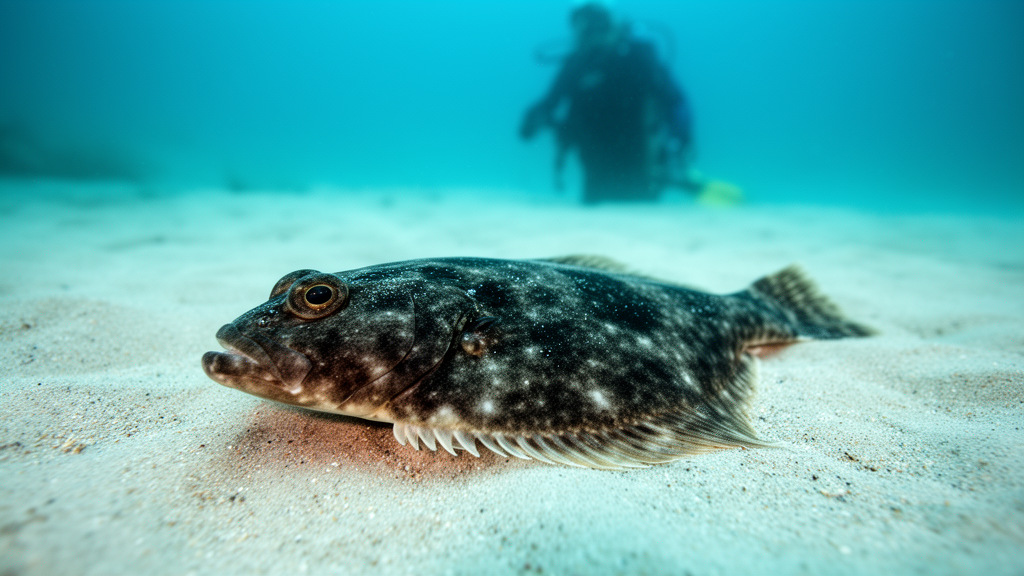
A small, oval flounder hauled up as bycatch off the Penghu Islands has delivered one of the more satisfying payouts in modern fish taxonomy: the first confirmed record of Hureau’s flounder, Engyprosopon hureaui, from Taiwanese waters. The finding, published in Acta Ichthyologica et Piscatoria, rests on a single female specimen just over four centimeters long, preserved and catalogued at the National Museum of Marine Biology and Aquarium in Pingtung, together with fresh photographs of a second individual that was not retained. Until now, this little lefteye flounder had been known only from scattered points across the Indo-West Pacific, from the Red Sea to the Maldives, Australia, New Caledonia, and southern Japan. The Taiwanese specimen slots neatly into the huge empty space on that map, connecting populations separated by thousands of kilometers of open ocean and vindicating a prediction that the species lurks, unnoticed, along the island’s shallow sandy bottoms.
The story behind the discovery is as instructive as the specimen itself. Between 2021 and 2024, an extensive survey of bycatch from the silver-stripe round herring fishery at Chi-kan, on the northern coast of Penghu, has been steadily yielding new species and new distributional records. The lights of this fishery attract dense schools of Spratelloides gracilis, and with them an unappreciated menagerie of small reef and sand-dwelling fishes, including cardinalfish, goatfish, and sandperches, that end up in nets as non-target catch. It was among this material that collectors H.-W. Chen, L.-A. Chen, and R.-L. Quin secured the flounder on 16 August 2024, at depths not exceeding 30 meters. The specimen was fixed in 4% formaldehyde, transferred to 70% ethanol, and deposited in the museum’s Pisces Collection under the catalogue number NMMB-P 41171, becoming the physical anchor for a species previously invisible in Taiwanese checklists.
Identifying a flounder to species is a demanding exercise in counting and measuring, because the group’s members differ in subtle proportions rather than flamboyant markings. The genus Engyprosopon is the most species-rich in the family Bothidae, with 35 valid species, and its members share a suite of traits: the isthmus begins below about the middle of the lower eye, the interorbital space is usually concave and wider in males than in females, the scales on the eyed side are large with short, weak ctenii, and males often carry dark pigment on the blind side. The Taiwan specimen’s counts read like a fingerprint: 74 dorsal-fin rays, 51 anal-fin rays, a caudal fin of 3 + 11 + 3 rays, 11 and 9 pectoral-fin rays on the ocular and blind sides respectively, six pelvic rays on each side, six gill rakers on the first arch, roughly 38 lateral-line scales, and 33 vertebrae arranged as 10 plus 23.
Crucially, several of those characters exclude every close relative in Taiwanese waters. The gill rakers on the first arch are smooth rather than serrated along their inner edges, the teeth in the upper jaw are arranged in a single row, the lower jaw measures 11.9% of standard length on the eyed side, the front margin of the head is rounded without a notch, the interorbital space bears no dark cross bands, and the distal margin of the caudal fin carries no black blotches. Taken together, these features match the original 1990 description by Quéro and Golani, which was based on specimens from North Beach at Eilat in the Gulf of Aqaba, where the fish was collected at depths of just one to 1.5 meters. The authors of the new study confirmed the identification by comparing the specimen against published data from the Red Sea types, New Caledonian material, Japanese records, and Australian listings.
The comparison also revealed that no two populations of Hureau’s flounder are perfectly alike. The Taiwanese female shows 51 anal-fin rays where previous specimens ranged from 52 to 58, a body depth of 59.6% of standard length against a previously documented range of 49.5% to 56.1%, a slightly longer interorbital width of 5.9% of standard length versus 2.7% to 5.2%, and a slightly shorter pelvic-fin base on the eyed side. The researchers interpret these departures as intraspecific variation rather than evidence of a distinct population, a caution that reflects a broader truth in flatfish taxonomy: meristic counts and proportions drift with geography, age, and sex, and a single specimen can only sketch the edges of a species’ natural variability. Fresh photographs of the unretained individual added valuable color information, showing a uniformly yellowish eyed side scattered with irregular brown spots and a pale, faintly yellowish blind side.
In life, the fish is a masterclass in camouflage suited to a life pressed against sand. The eyed side bears fins and flanks flecked with brown spots similar in size to those on the body, while all spots on the preserved specimen measure smaller than the pupil. Both eyes sit on the left side of the body, the hallmark of lefteye flounders, with the rostral spine present on the snout and no orbital spines or flaps. The mouth is small and oblique, teeth in both jaws uniserial, and scales deciduous on both sides of the body, so easily shed that scale pockets had to be used when counting lateral-line scales. These features, documented in painstaking detail with digital calipers under a stereomicroscope and X-radiography of the vertebral column, bring the total morphological picture of the species into sharper focus than any previous single account.
Beyond the specimen itself, the study delivers a practical gift to anyone sorting flatfishes in the region: a revised identification key to all 12 species of Engyprosopon now known from Taiwan. The key walks users through a branching sequence of contrasts, beginning with whether the distal half of the caudal fin carries a pair of black blotches, then moving through gill raker counts, body depth, upper-jaw dentition, interorbital width, and eye placement to separate species such as E. grandisquama, E. macrolepis, E. maldivense, and E. mogkii. Three of the dozen Taiwanese species, E. brevifrontale, E. keliaoense, and E. parvipectorale, were originally described from the island, underscoring how much of the local flatfish diversity has come to light only in recent years through targeted surveys of shallow, well-sampled-looking habitats.
The biogeographic implications are arguably the most striking part of the report. A species recorded from the Gulf of Aqaba, the Maldive Islands, Australia, New Caledonia, and Tanegashima Island in Japan, but not anywhere in between, poses an obvious puzzle: were those scattered records the result of sampling gaps, or does the flounder genuinely occur in disjunct pockets? The Taiwanese record, collected within a routine nearshore fishery at under 30 meters, strongly suggests the former. It fills the distribution gap in the northwestern Pacific between Japan and New Caledonia and implies that suitable sandy and muddy bottoms across the tropical West Pacific may harbor the species wherever anyone thinks to look. Given that Hureau’s flounder has been documented at depths of 1 to 81 meters, shallow lagoons, bays, and strait-floor sediments are all plausible habitat.
There is also a conservation-adjacent lesson in how the fish was found. Bycatch, the unwanted minority of a catch, is usually dismissed as ecological noise, yet systematic bycatch surveys have become one of the most productive engines of marine biodiversity discovery in Asia. The same Penghu herring fishery that yielded this flounder has recently produced new species and range extensions across multiple fish families, suggesting that small, shallow, heavily fished habitats still hold taxonomic surprises. For a species as small and cryptic as Hureau’s flounder, which would almost never appear in diver surveys or targeted collections, a fishing net can be the only realistic sampling instrument.
What remains to be learned dwarfs what this single specimen can tell us. Nothing is known of the species’ abundance in Taiwanese waters, its reproductive season, diet, or genetic relationship to populations in the Red Sea, Indian Ocean, and Coral Sea. Whether the Taiwanese fish belongs to a continuous west Pacific population or represents the edge of a chain of isolated demes will require DNA barcoding of material from across the range, ideally including fresh tissue from the bycatch fishery that produced this record. For now, the flounder’s quiet arrival on the national checklist stands as a reminder that even in well-studied seas, a humble four-centimeter fish can redraw a map, and that the frontier of discovery often lies not in distant abyssal trenches but in the mundane catches of small-scale fisheries examined by patient, well-trained eyes.
Subject of Research: First record of the lefteye flounder Engyprosopon hureaui in Taiwan and a revised identification key to the genus
Article Title: First record of Engyprosopon hureaui ( Actinopterygii , Pleuronectiformes , Bothidae ) from Taiwan, with a revised key to Engyprosopon in Taiwan
Article References: Su, Y., Cheng, Y.-N., & Shyu, J.-F. (2025). First record of Engyprosopon hureaui (Actinopterygii, Pleuronectiformes, Bothidae) from Taiwan, with a revised key to Engyprosopon in Taiwan. Acta Ichthyologica et Piscatoria, 55, 93-99. https://doi.org/10.3897/aiep.55.146367
Image Credits: AI Generated
Keywords: Engyprosopon hureaui, flatfish, Bothidae, Taiwan, Penghu, new record, bycatch, marine biodiversity, taxonomy, biogeography, identification key, Pleuronectiformes
Cite Scienmag News
Margaret Porter. (October 19, 2026). Hureau’s Flounder Surfaces in Taiwan for the First Time, Filling a Vast Pacific Distribution Gap. Scienmag. https://scienmag.com/hureaus-flounder-surfaces-in-taiwan-for-the-first-time-filling-a-vast-pacific-distribution-gap/
Margaret Porter. "Hureau’s Flounder Surfaces in Taiwan for the First Time, Filling a Vast Pacific Distribution Gap." Scienmag, 19 October 2026, https://scienmag.com/hureaus-flounder-surfaces-in-taiwan-for-the-first-time-filling-a-vast-pacific-distribution-gap/. Accessed 19 October 2026.
Margaret Porter. "Hureau’s Flounder Surfaces in Taiwan for the First Time, Filling a Vast Pacific Distribution Gap." Scienmag. October 19, 2026. https://scienmag.com/hureaus-flounder-surfaces-in-taiwan-for-the-first-time-filling-a-vast-pacific-distribution-gap/


