


A tiny zone at the back of the thyroid gland has long been one of the most feared addresses in neck surgery. Bounded by the trachea, the esophagus, and the recurrent laryngeal nerve, this pocket of anatomy—known as the thyroid danger triangle—leaves almost no room for error. Tumors that grow there sit millimeters from the nerve that controls the voice and the glands that regulate calcium. For years, the standard answer was a scalpel. Now, a five-year, dual-center study suggests that a needle and a carefully controlled burst of heat can do the job just as well, with far less collateral damage.
The new research, published in Frontiers in Endocrinology, compared ultrasound-guided thermal ablation with conventional surgical resection in patients with small papillary thyroid carcinomas confined to the danger triangle. Papillary thyroid carcinoma is the most common thyroid malignancy, accounting for more than 80 percent of all thyroid cancers, and most of these tumors are indolent—slow-growing enough that treatment decisions hinge on balancing cure against harm. The danger triangle, however, raises the stakes: its cramped geometry complicates both surgery and ablation, and earlier studies had only short-term data to justify treating tumors there with heat rather than resection.
The study team reviewed 470 patients treated at two Chinese hospitals between September 2016 and April 2020 and, after applying strict criteria, analyzed 194 of them: 103 who received thermal ablation and 91 who had surgery. Because patients were not randomized, the researchers used propensity score matching to balance the two groups on age, sex, tumor size and volume, hormone levels, and precise anatomical distances—such as how far the tumor sat from the tracheoesophageal groove. After matching, 84 patients per group remained, and the groups were statistically indistinguishable at baseline.
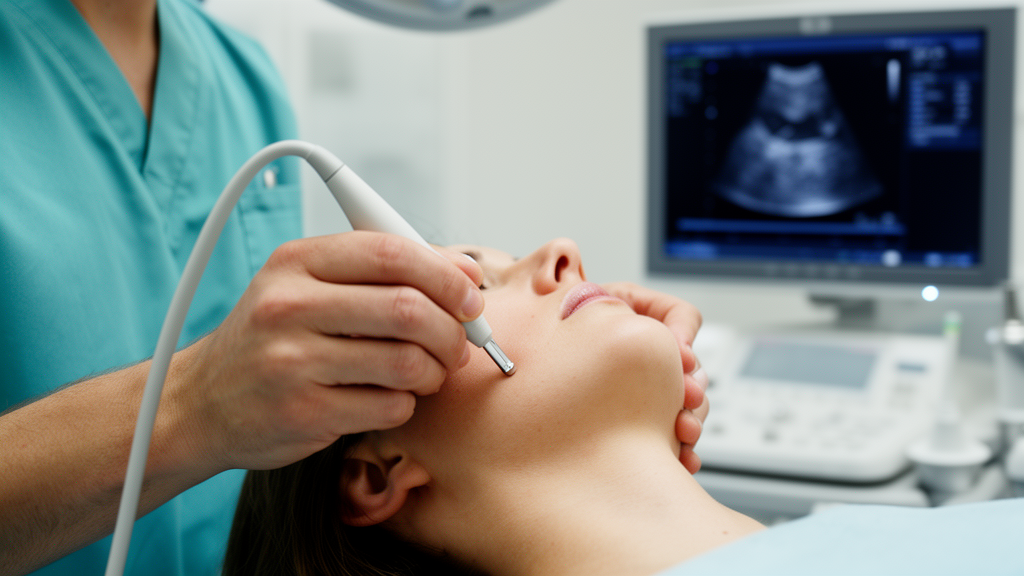
The ablation technique itself is a study in precision. Performed under local anesthesia and real-time ultrasound guidance, the procedure uses either radiofrequency or microwave energy delivered through a thin electrode inserted through the isthmus of the gland. To protect the recurrent laryngeal nerve, trachea, and esophagus, the team continuously infused 5 percent dextrose solution around the tumor—a technique called hydrodissection that pushes vulnerable structures at least 5 millimeters away from the heat zone. Operators then used a low-power, moving-shot technique to destroy the tumor plus a margin of at least 3 millimeters, sparing the capsule where margins could not be extended safely. Immediate contrast-enhanced ultrasound confirmed that every treated lesion showed no residual blood flow, a 100 percent technical success rate.
Surgery, by contrast, followed Chinese national consensus guidelines and included prophylactic central neck dissection in all cases—a precaution reflecting concern that tumors abutting the posterior capsule carry a higher risk of hidden lymph node spread. Most surgical patients (88 percent) underwent lobectomy; the rest had total thyroidectomy, often driven by family history of thyroid cancer. The mean incision measured about 7.2 centimeters, compared with a 1-to-2-millimeter puncture for ablation.
After a median follow-up of roughly five and a half years in both groups, the oncologic results were strikingly similar. Overall disease progression occurred in 6.0 percent of the ablation group versus 4.8 percent of the surgery group—a difference with no statistical significance. Regional lymph node metastasis appeared in 1.2 percent of ablated patients and 3.6 percent of surgical patients; local tumor progression at the treatment site occurred in 3.6 percent versus 1.2 percent. Disease-free survival was 94 percent after ablation and 95.2 percent after surgery. No patient in either group developed distant metastasis. Notably, the ablation zone vanished completely in 94 percent of treated nodules over time, with smaller T1a tumors disappearing faster (a median of 24 months) than the larger T1b tumors (36 months).
The safety picture told a different story. Total complications were nearly three times more common after surgery: 16.7 percent versus 6.0 percent, a statistically significant difference. Every major complication occurred in the surgical group—four cases of permanent hoarseness from nerve injury and two cases of permanent hypoparathyroidism, both in patients who had total thyroidectomy. In the ablation group, the only complications were five cases of transient hoarseness, all of which resolved within six months without treatment. Among the smallest tumors (T1a, one centimeter or less), the safety gap widened further: 3.0 percent complication rate for ablation versus 15.3 percent for surgery. The authors caution that this subgroup finding is exploratory, given the small number of events.
Efficiency metrics favored ablation across the board. The average procedure took 23 minutes versus 82 minutes for surgery. Hospital stay averaged one day versus 3.3 days. Estimated blood loss was about 2 milliliters versus nearly 20. For elderly patients or those with comorbidities, the authors argue, such a short, low-risk pathway reduces not only perioperative danger but also healthcare resource use. And because ablation preserves the gland, patients avoid lifelong thyroid hormone replacement—a meaningful quality-of-life advantage that surgery cannot offer unless only one lobe is removed.
The study’s authors are careful about what the data do and do not show. Because no formal sample size calculation was performed, the similar outcomes cannot be formally interpreted as proof of equivalence or non-inferiority—a statistical distinction that matters. The retrospective design leaves room for unmeasured confounders such as patient preference and frailty. The ablation cohort mixed radiofrequency and microwave devices, and every ablation was performed by radiologists with more than a decade of experience, limiting generalizability to lower-volume centers. Differing follow-up schedules—ablation patients were imaged more often early on—could also bias event detection. Still, the authors note that progression rates rose only slightly from their earlier three-year report (from 4.4 to 6.0 percent in the ablation group), confirming durable oncologic stability.
The significance of the work lies in where it lands. The danger triangle has been a holdout region, where the proximity of nerve, trachea, and esophagus made many clinicians reluctant to ablate. By pairing hydrodissection with low-power, short-electrode techniques and rigorous ultrasound surveillance, this study shows that the same rules that made ablation safe elsewhere in the gland can be stretched into its most hostile corner. The authors call for multicenter randomized trials to confirm the findings, but for now the message is concrete: for carefully selected patients with small papillary thyroid carcinomas in the danger triangle, a needle, some dextrose, and a steady ultrasound-guided hand can match the oncologic results of surgery while sparing the voice, the parathyroids, and most of a hospital week.
Subject of Research: Long-term comparison of thermal ablation versus surgical resection for T1N0M0 papillary thyroid carcinoma in the thyroid danger triangle
Article Title: Long term (over five-year) outcomes of thermal ablation vs surgical resection for T1N0M0 papillary thyroid carcinoma in danger triangle: a propensity-matched dual-center study
Article References: Zhang, D., Chen, S., Yang, J., Qiu, Y., Zhao, Z., Tang, L., Hu, T., Yu, M.-A., & Wu, S. (2026). Long term (over five-year) outcomes of thermal ablation vs surgical resection for T1N0M0 papillary thyroid carcinoma in danger triangle: a propensity-matched dual-center study. Frontiers in Endocrinology, 17, Article 1887923. https://doi.org/10.3389/fendo.2026.1887923
Image Credits: AI Generated
DOI: 10.3389/fendo.2026.1887923
Keywords: papillary thyroid carcinoma, thermal ablation, radiofrequency ablation, thyroid danger triangle, propensity score matching, disease-free survival, recurrent laryngeal nerve, hydrodissection, thyroid surgery, minimally invasive treatment, lymph node metastasis, complication rates
Cite Scienmag News
Nathaniel Bowman. (October 19, 2026). Thermal ablation matches surgery for thyroid cancers in the danger triangle. Scienmag. https://scienmag.com/thermal-ablation-matches-surgery-for-thyroid-cancers-in-the-danger-triangle/
Nathaniel Bowman. "Thermal ablation matches surgery for thyroid cancers in the danger triangle." Scienmag, 19 October 2026, https://scienmag.com/thermal-ablation-matches-surgery-for-thyroid-cancers-in-the-danger-triangle/. Accessed 19 October 2026.
Nathaniel Bowman. "Thermal ablation matches surgery for thyroid cancers in the danger triangle." Scienmag. October 19, 2026. https://scienmag.com/thermal-ablation-matches-surgery-for-thyroid-cancers-in-the-danger-triangle/


