

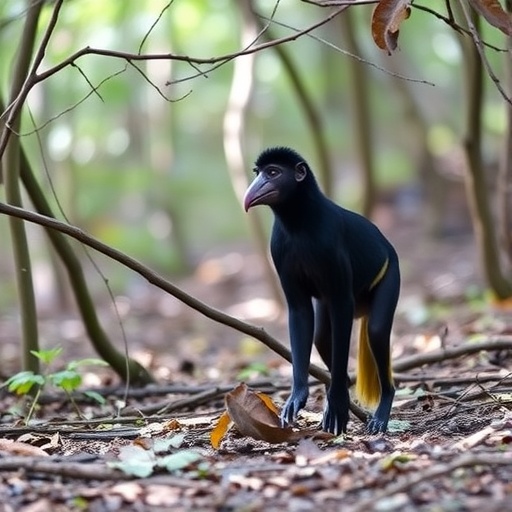
Africa’s largest and most vividly colorful primate, the mandrill (Mandrillus sphinx), is confronting an alarming conservation crisis within protected forests. Recent research led by the University of Bristol’s Veterinary School, in collaboration with the Bristol Zoological Society and local partners in Equatorial Guinea, has exposed the detrimental impact of hunting pressures on mandrill populations within Monte Alén National Park—one of Central Africa’s most vital rainforest ecosystems. This emerging evidence lays bare the stark reality that even designated protected areas may no longer provide sanctuary for this vulnerable species.
Mandrills, with their striking facial coloration and large stature, play a pivotal ecological role as seed dispersers and bioindicators of forest health. However, the species is classified as Vulnerable on the IUCN Red List, reflecting ongoing declines mostly attributed to escalating habitat loss and unsustainable hunting practices. Despite their ecological importance, comprehensive studies across significant segments of their range have been limited. The latest observational research employs extensive camera-trapping techniques to monitor mandrill distribution and habitat utilization across Monte Alén National Park, elucidating how human activities, especially hunting, are reshaping their spatial ecology.
The study utilized 35 camera traps strategically positioned by Bristol Zoological Society’s Equatorial Guinea Conservation Programme, accumulating a total of 10,800 trap-days of data collection. Across this extensive monitoring period, only 79 mandrill detections were recorded—a telling indicator of population pressures. Spatial analyses revealed a pronounced avoidance of areas proximate to hunting camps, underscoring the direct influence of anthropogenic disturbance on habitat accessibility for mandrills. This pattern of spatial exclusion highlights a critical conservation bottleneck, shrinking the species’ viable habitat even within legally protected zones.
Intriguingly, mandrills exhibited a strong ecological preference for regions adjacent to riparian environments. Rivers and streams, providing vital drinking water, supplemental feeding opportunities, and thermal refuge, emerged as focal points of mandrill activity. This finding underscores the essential role of riparian habitats in facilitating the species’ survival and emphasizes the need to integrate watercourse protection into broader conservation frameworks.
Tim Bray, Conservation Programme Manager at Bristol Zoological Society and a co-author of the study, emphasized the multifaceted threats mandrills face: “Our findings clearly demonstrate that hunting pressure, even within a national park’s boundaries, undermines habitat quality and directly threatens mandrill viability. The conservation of key habitats alongside community-engaged strategies to mitigate hunting pressures is paramount if we are to secure a future for these iconic primates.”
Seasonal behavioral patterns revealed additional insights. During the wet seasons, mandrills concentrated their activities within fewer, higher-quality sites—likely tracking the ephemeral availability of seasonal fruiting trees and other resources. Conversely, in the dry seasons, they dispersed more broadly across the landscape, suggesting an adaptive strategy to cope with fluctuating resource landscapes. This plasticity, however, is constrained by the extent of human disturbance; only low-impact areas appear capable of supporting such dynamic habitat use.
The broader implications of this study extend beyond mandrills, highlighting the urgent need to reconsider conservation strategies within protected areas. The complex interplay between environmental variables and anthropogenic threats necessitates a multifaceted, landscape-level approach that addresses both ecological requirements and human socio-economic realities. It is apparent that strict protectionist policies alone are insufficient when enforcement is weak, or local communities harbor dependencies on bushmeat hunting.
Lead author Tania Guzman Santillan, who conducted this research during her MSc in Global Wildlife Health and Conservation at Bristol, stressed the transformative potential of integrated approaches: “Mandrill persistence hinges on protecting critical habitats while simultaneously reducing hunting and fostering alternative livelihoods for local people. Without coupling ecological science with socio-economic solutions, even Africa’s largest monkey risks extirpation from areas previously deemed safe.”
This research underscores the vital importance of deploying modern wildlife monitoring technologies, such as camera trapping, to gain nuanced insights into species ecology and anthropogenic impacts. Moreover, the collaborative framework between academic institutions, conservation NGOs, and local communities exemplifies a model for participatory conservation science—one that holds promise for tackling complex environmental challenges.
The University of Bristol’s MSc program in Global Wildlife Health and Conservation offers an exemplary training ground for conservation scientists, integrating rigorous academic study with hands-on fieldwork and mentorship by global conservation experts. This kind of applied research education produces highly skilled professionals who contribute directly to the protection and sustainable management of endangered wildlife.
In the face of mounting anthropogenic pressures globally, studies like this contribute invaluable data and practical recommendations to safeguard biodiversity hotspots. The plight of the mandrill in Monte Alén National Park serves as a sobering reminder that conservation success requires vigilance, innovation, and inclusive strategies that encompass ecological and human dimensions alike.
Given the mandrill’s ecological significance and striking presence, ensuring its survival is not merely about preserving a single species—it is about maintaining the intricate web of rainforest ecosystems that depend on such keystone creatures. Developing and implementing evidence-based conservation interventions that prioritize critical habitats, control hunting, and engage local communities is imperative to reversing population declines and fostering resilient ecosystems in Central Africa.
Subject of Research: Animals
Article Title: Impact of environmental and anthropogenic factors on Mandrill (Mandrillus sphinx) occupancy and habitat use in Monte Alén National Park, Equatorial Guinea
News Publication Date: 23-Feb-2026
Web References:
- University of Bristol Veterinary School
- Bristol Zoological Society
- IUCN Red List Mandrillus sphinx
- American Journal of Primatology Article DOI
References:
Bray, T., Santillan, T. G., et al. (2026). Impact of environmental and anthropogenic factors on Mandrill (Mandrillus sphinx) occupancy and habitat use in Monte Alén National Park, Equatorial Guinea. American Journal of Primatology. DOI: 10.1002/ajp.70125.
Image Credits: University of Bristol/Bristol Zoological Society
Keywords
Mandrillus sphinx, mandrill conservation, hunting pressure, Monte Alén National Park, camera trapping, anthropogenic disturbances, riparian habitats, Central African rainforest, vulnerable species, habitat occupancy, wildlife monitoring, conservation strategies.


