


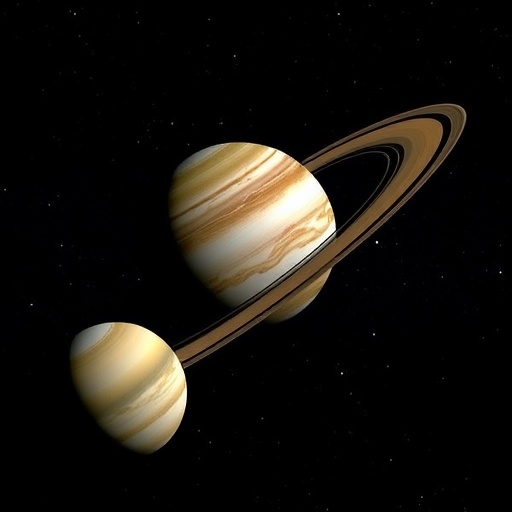
In the vast expanses of our Solar System, Jupiter and Saturn are renowned as the colossal gas giants with the most abundant satellite systems, captivating scientists for centuries. Despite both giants sharing many characteristics, the nature and architecture of their moon systems starkly diverge, posing intriguing questions for planetary scientists. Recent groundbreaking research from a collaborative team involving Kyoto University and other institutions in Japan and China has shed new light on why Jupiter boasts a compact array of large moons, while Saturn’s system is dominated by a lone giant moon and a larger number of smaller satellites.
Jupiter’s impressive retinue includes over 100 moons, with its four Galilean moons—Io, Europa, Ganymede, and Callisto—being substantial bodies, most notably Ganymede, the largest moon in the Solar System. Contrastingly, Saturn, despite having more than 280 moons and an intricate ring system, primarily revolves around Titan, the second-largest moon in the system. This pronounced difference in moon system architecture has persisted as a complex puzzle for astronomers attempting to unravel the physical processes at play during the early epochs of gas giant formation.
At the heart of this enigma lies the circumplanetary disk—a vast accumulation of gas, dust, and debris orbiting a young planet—that serves as the birthplace of moons. Traditional models of satellite formation have struggled to fully incorporate the role played by a planet’s magnetic field in shaping the circumplanetary environment. Historically, it was unclear whether the magnetic interactions could sculpt these disks enough to influence moon formation dynamics significantly. However, recent insights into stellar and planetary magnetic fields have motivated researchers to revisit and enhance these theoretical frameworks.
Leading this pioneering investigation, Yuri I. Fujii and colleagues employed detailed numerical simulations to probe the interior evolution of gas giants in their infancy, revealing intricate connections between their thermal histories, magnetic field strengths, and resulting circumplanetary disk structures. Using advanced computational resources at the National Astronomical Observatory of Japan’s Center for Computational Astrophysics, the team modeled the circumplanetary disks of Jupiter and Saturn alongside intricate N-body simulations that track the formation and migration of moons within disk environments.
The findings were revelatory: Jupiter’s strong magnetic field was capable of generating a magnetospheric cavity—a region within the circumplanetary disk cleared of gas due to magnetic forces. This cavity fundamentally altered the environment, creating a gravitational and magnetic trap where moons such as Io, Europa, and Ganymede could be captured and stabilized. By contrast, Saturn’s weaker magnetic field was insufficient to carve out such a cavity, resulting in a circumplanetary disk where migrating moons were unable to settle into stable orbits and were more likely to spiral into the planet or be ejected.
These insights uncover a new dimension in understanding satellite system formation that transcends mere gravitational and gas dynamic considerations, emphasizing the pivotal role of magnetohydrodynamic processes. The presence or absence of a magnetospheric cavity appears to be a natural regulator of moon system architecture, dictating not only the number but also the size distribution of satellites around gas giants. This paradigm also aligns with observed differences in Jupiter and Saturn’s satellite systems, providing a physically consistent mechanism grounded in their intrinsic magnetic properties.
Beyond explaining the satellite dichotomy within our Solar System, this research bears profound implications for the study of exoplanetary systems. As astronomers increasingly detect gas giants orbiting distant stars, the ability to predict the presence and nature of accompanying moon systems becomes highly valuable. The team’s model predicts that gas giants comparable in size or larger than Jupiter will tend to harbor multiple large moons in compact configurations, while planets akin to Saturn will likely display sparser moon populations dominated by a few large satellites.
Understanding the interplay of magnetic fields and circumplanetary disks paints a more holistic picture of planet and satellite formation, potentially extending to substellar objects and brown dwarfs with disk environments. Furthermore, this work opens pathways to refining observational strategies aimed at discovering exomoons and characterizing circumplanetary disk properties through next-generation telescopes, which could validate these theoretical predictions.
The nuanced magnetic interaction model also helps resolve longstanding debates surrounding inward migration of moons and their survival timelines within gaseous disks. The magnetospheric cavity acts as a barrier against rapid inward spiral, ensuring moon systems can achieve stable configurations. This reconceptualization aids in explaining the stability and longevity of the Galilean satellites, whose sizes and orbital resonances have perplexed researchers in the absence of such magnetic considerations.
Looking forward, this study lays a robust foundation for further investigations into the diversity of satellite systems beyond our Solar System and fosters a deeper understanding of planetary magnetism’s role in shaping planetary environments. The research team plans to extend their modeling efforts to a broader array of planetary masses and magnetic field strengths, aspiring to predict the architectures of yet-undiscovered satellite systems and refine our comprehension of planet-moon coevolution.
Ultimately, these revelations exemplify how combining detailed computational astrophysics with magnetic field theory not only advances our knowledge of Solar System formation but also enriches the broader quest to understand planetary systems across the cosmos. As observational techniques progress and new data emerge, the interplay between magnetic fields and satellite formation promises to remain a vibrant and fruitful domain of planetary science research.
News Publication Date: 2-Apr-2026
Web References:
http://dx.doi.org/10.1038/s41550-026-02820-x
Keywords
Jupiter, Saturn, satellite systems, moons, circumplanetary disk, magnetospheric cavity, magnetic field, gas giants, planetary formation, exomoons, numerical simulations, N-body simulations, planetary magnetism
Cite Scienmag News
Grant Pearson. (April 7, 2026). Jupiter Outpaces Saturn in Growing More Large Moons. Scienmag. https://scienmag.com/jupiter-outpaces-saturn-in-growing-more-large-moons/
Grant Pearson. "Jupiter Outpaces Saturn in Growing More Large Moons." Scienmag, 7 April 2026, https://scienmag.com/jupiter-outpaces-saturn-in-growing-more-large-moons/. Accessed 4 September 2026.
Grant Pearson. "Jupiter Outpaces Saturn in Growing More Large Moons." Scienmag. April 7, 2026. https://scienmag.com/jupiter-outpaces-saturn-in-growing-more-large-moons/


