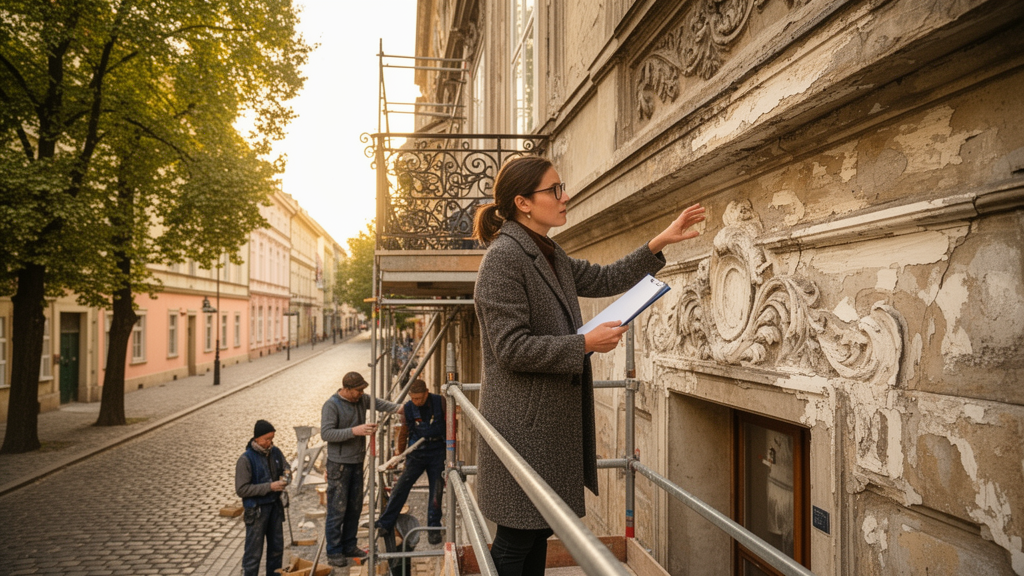
Urban conservation in Hungary underwent a decisive transformation in the 1970s, and a new study argues that this shift began well before the political turn of 1989 and continued to shape post-socialist practice. The research, published in the journal Built Heritage, traces how three innovations emerged in the late socialist period: the extension of the protection regime beyond national designations, the systematic assessment of historic neighbourhoods outside protected perimeters, and the introduction of new planning methodologies for urban rehabilitation. Drawing on specialised journals and archival documents, the author, Franz Bittenbinder, examines regional cities rather than the well-studied capital, and treats 1989 not as a breaking point but as one moment within a longer, uneven process of heritage transition.
The study challenges an inherited narrative in post-socialist scholarship on Hungarian monument protection: the idea of a golden age. According to this interpretation, which originated in anniversary publications issued by monument protection agencies in 1987 and 1997, a flourishing period followed the institutional frameworks established after the Hungarian Revolution of 1956 and lasted until the 1970s, after which the 1980s became a decade of decline. The author shows that these retrospectives, while rich in detail about events, projects and protagonists, perpetuated a narrow perspective on urban conservation, reducing it largely to the delimitation of national protection areas and regulations for new architecture in historic environments. Recent work by urban historians, sociologists, geographers and planners has begun to fill the gap, highlighting the convergence of conservation and redevelopment policies outside national protection areas from the late socialist period onward.
To understand what changed, the article first reconstructs the system of the 1960s that formed the precondition for reform. Since that decade, national areas of monument significance had been the primary tool for safeguarding the urban built environment. These areas shifted legislative attention from individual buildings to portions of settlements characterised by a high density of listed buildings, including the urban fabric around them. Yet the individual monument remained the conceptual backbone, and a parallel framework of historic cityscape protection covered buildings with cityscape relevance or contiguous streetscapes. The first areas were delimited on the proposals of Superintendent László Gerő, and their perimeters correlated with, if not coincided with, the walled city centre commonly attributed to medieval urbanisation. Where the protected area was smaller than the walled centre, the urban modernisation agenda appears to have been decisive, creating a regulatory gap between historic and non-historic parts of the city.
International debates supplied key stimuli. Hungarian experts were already involved in European scholarship, participating in UNESCO and ICOMOS events, and Hungary promoted its first World Heritage Sites in 1987, only two years after joining the World Heritage Convention. The European Architectural Heritage Year of 1975 proved especially consequential: although Hungary was not a member of the Council of Europe, the Amsterdam Declaration adopted at its final congress introduced the wider perspective of integrated conservation, embracing all buildings of cultural value from the greatest to the humblest. András Román, a leading figure at the National Inspectorate of Monuments, attended the congress on behalf of the city of Sopron but, in line with official directives, did not promote the Declaration directly. He nevertheless disseminated its key concepts by recommending a book published by the German Commission for UNESCO that explicitly discussed the Heritage Year and its results. A third concept, city-wide protection for small historic towns, was formalised in the 1987 ICOMOS Charter for the Conservation of Historic Towns and Urban Areas, prepared by the International Committee on Historic Cities, which had its seat in Eger with Román as founding president and Tamás Fejérdy as scientific secretary.
Stimulated by these debates, Román was among the first experts to denounce the deficiencies of the Hungarian status quo, publishing critical writings on the nexus between urban planning and monument protection from the early 1970s. His attention focused on the outer margins of national protection areas, mostly neighbourhoods established during the post-Ottoman urbanisation period, where radical redevelopment produced stark contrasts in urban layout and building heights. Because official directives from the mid-1970s discouraged the designation of new national protection areas, Román resorted to monument environments, which the Inspectorate could appoint directly without ministerial confirmation. By 1990, the number of protected instances had increased considerably through the efforts of Román and, later, Fejérdy. Román also commissioned the Institute of Construction Economics and Organisation, a state research agency with a national network of regional offices, to assess cities with areas of monument significance and propose new policies.
The resulting assessments revealed systematic problems. Planner Zsuzsanna Székelyné Egri’s team focused on the isolation of protected areas, described as incapable of survival, and on the inadequate integration of new mid-rise housing that was building a wall around the inner city. In the case of Eger, a medium-sized baroque city on the economic periphery, the report proposed a new zoning system of strict protection, preserving redevelopment and areas without development restraint, with the middle category acting as a buffer where urban structure, character and scale would be maintained during rehabilitation. The survey was extended to five other settlements without protected areas, revealing cases where housing estates had become the main cityscape-shaping element, alongside more promising cases such as Szekszárd, where a harmonious connection of areas still seemed possible. Expert meetings across Hungary, including the Eger Summer University workshop and a symposium in Vác, made historic neighbourhoods a frequent topic throughout the decade, although the awarded Vác competition projects largely recreated houses with history-inspired new interventions rather than conserving them.
A third innovation concerned planning methodology. From the mid-1970s, preservation experts promoted mandatory methodologies requiring detailed historic assessments as the basis for urban planning. The architect and urban planner Gábor Winkler, working at the Győr-Sopron Council Planning Company, launched an extensive study of Pápa, a small city in Transdanubia, using archival sources and on-site surveys, and proposed a division into intervention areas with graduated restrictions, from minor interventions and infill in the monument protection area to gradual building replacement under settlement structure protection. In the 1980s, further methodologies followed, including one developed for Székesfehérvár by István Schulz, which prescribed archive work on urban morphology, on-site analysis, geometric surveys of roofscapes and streetscapes, mapping of commercial and touristic activities, and assessment of housing sociology. By the mid-1980s, a new plan type emerged, the monument protection-based rehabilitation plan, and the term rehabilitation came to denote more attentive transformation of the built environment, contrasted with reconstruction as the more invasive alternative.
Protection also diversified at the local level. From the mid-1970s, council protection emerged as a local tool for buildings and areas of local and regional value, implemented through city or county decrees in cities such as Pápa, Sopron and Mosonmagyaróvár. These decrees drew on an earlier proposal by Zsolt Máté for Csongrád in the late 1960s, which had regulated plot alterations, street lines and building positions. The 1977 decree of the Baranya County Council regulated construction and demolition with reference to settlement-scale values and streetscapes, and proposed learning from pre-existing urban morphology rather than imitating vernacular styles. In Esztergom, planning studies in the 1980s differentiated to-be-protected streetscapes from areas with to-be-protected building lines, and mapped rehabilitation areas ranging from gradual redevelopment to complete redevelopment, extending preservation to historic neighbourhoods while retaining a spatial bias toward more central areas.
Implementation lagged behind concepts. Rehabilitation projects of the 1980s continued to concentrate on national protection areas, hampered by a lack of financial resources amid worsening economic recession. Some approved plans still reflected the invasive schemes of the 1960s, such as the Zalár Street block in Eger, where block-internal buildings were demolished. Rising critique of systematic demolitions, however, accompanied more attentive programmes in Pécs between 1986 and 1990 and in Győr shortly before 1989. After 1989, the state’s regulatory leverage decreased and local governments gained autonomy over urban regeneration, yet continuity prevailed: experts transferred to the new National Monument Protection Authority, local protection by decree was reintroduced in the 1997 law on the built environment, with roughly 500 local decrees recorded by 1999, and rehabilitation methodologies persisted in reorganised planning companies. In Győr, where the municipality retained a high share of properties, income from commercial spaces funded continued projects, though the rehabilitation of nearby historic neighbourhoods remained unfeasible, cementing the zoning pattern of the 1960s. The author notes that further research is needed to clarify the extent of extramural preservation policies and to compare regional cities with Budapest.
Subject of Research: A historical study of how urban conservation concepts, planning methodologies and protection institutions in Hungary evolved from the 1970s to the early 1990s, arguing that key innovations predated the 1989 political transition.
Article Title: On the shift that started before the political turn: urban conservation in Hungary from the 1970s to the early 1990s
Article References: Bittenbinder, F. (2026). On the shift that started before the political turn: urban conservation in Hungary from the 1970s to the early 1990s. Built Heritage, 10(1), Article 77. https://doi.org/10.1186/s43238-026-00316-1
Image Credits: AI Generated
DOI: 10.1186/s43238-026-00316-1
Keywords: urban conservation, Hungary, monument protection, historic neighbourhoods, heritage studies, post-socialist cities, planning methodology, ICOMOS, rehabilitation, local protection, late socialism, regional cities
Cite Scienmag News
Margaret Porter. (October 28, 2026). Hungary’s urban conservation shift began years before the 1989 political turn. Scienmag. https://scienmag.com/hungarys-urban-conservation-shift-began-years-before-the-1989-political-turn/
Margaret Porter. "Hungary’s urban conservation shift began years before the 1989 political turn." Scienmag, 28 October 2026, https://scienmag.com/hungarys-urban-conservation-shift-began-years-before-the-1989-political-turn/. Accessed 28 October 2026.
Margaret Porter. "Hungary’s urban conservation shift began years before the 1989 political turn." Scienmag. October 28, 2026. https://scienmag.com/hungarys-urban-conservation-shift-began-years-before-the-1989-political-turn/