Thursday, October 29, 2026
Science
No Result
View All Result
  • Login
  • HOME
  • SCIENCE NEWS
  • CONTACT US
  • HOME
  • SCIENCE NEWS
  • CONTACT US
No Result
View All Result
Scienmag
No Result
View All Result
Home Science News Technology and Engineering

Normalization Stabilizes Shallow Graph Networks but Cannot Stop Deep Oversmoothing

October 28, 2026
in Technology and Engineering
Blake Davidson
By Blake Davidson Scienmag Editorial Profile - Data Science
Reading Time: 2 mins read
0
Normalization Stabilizes Shallow Graph Networks but Cannot Stop Deep Oversmoothing

Normalization Stabilizes Shallow Graph Networks but Cannot Stop Deep Oversmoothing

65
SHARES
587
VIEWS
Share on FacebookShare on Twitter
ADVERTISEMENT

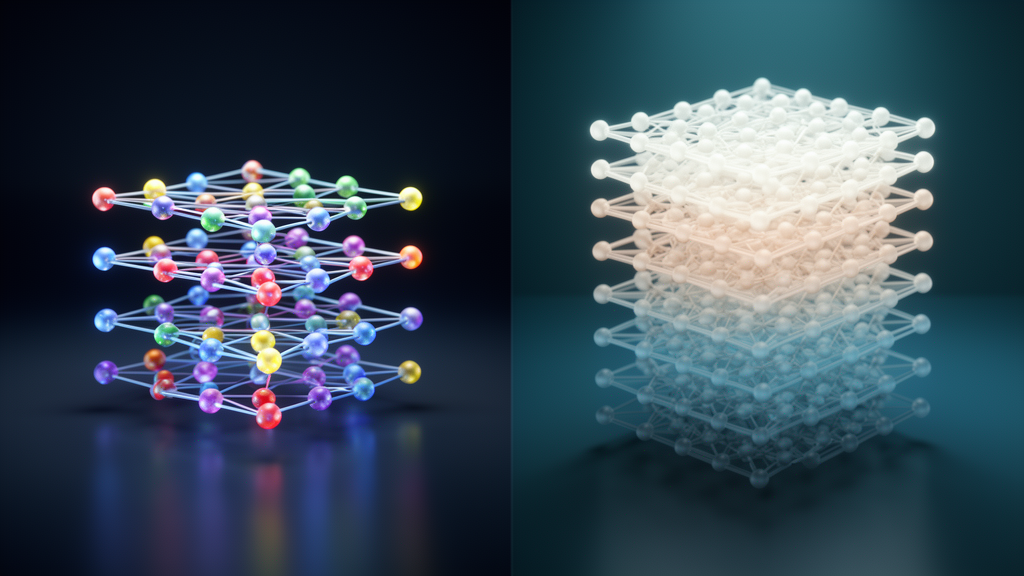
Graph convolutional networks (GCNs) lose accuracy as they get deeper, a phenomenon known as oversmoothing, and researchers have long disagreed about whether normalization techniques can counteract it. A new controlled empirical study published in Neural Processing Letters revisits that question under unusually strict conditions: a vanilla GCN architecture, fully fixed hyperparameters, no architectural augmentations, six normalization schemes, six node-classification benchmarks, and network depths from 1 to 20, totaling 3,600 experimental runs.

The study reports three main observations. First, the effects of normalization concentrate at the transition from one to two layers and show diminishing returns beyond depth 3. At a single layer, normalization is structurally inoperative, and all six schemes behave identically. Second, once depth reaches six or more, the graph’s topology governs the accuracy trajectory. Among the topological properties tested, homophily—the tendency of connected nodes to share labels—was the only statistically significant predictor of depth-sensitivity, with a correlation of -0.87 and a p-value of 0.02. Spectral gap, degree, and clustering were not significant within the dataset family studied.

Third, normalization substantially reduces cross-seed training variance—by up to 90 percent at depth 2 on dense graphs—but it does not prevent eventual collapse. Depth-20 results confirmed continued degradation on all datasets, with Cora accuracy falling from 0.75 to 0.57 and then to 0.31 as depth increased.

Statistical testing sharpened the comparison between schemes. Wilcoxon signed-rank tests at depth 10 showed that BatchNorm and GraphNorm significantly outperformed the no-normalization baseline, while NodeNorm significantly underperformed it, all with p-values below 0.001.

The authors frame these findings as a redefinition of what normalization can and cannot do in deep graph networks. Rather than acting as a remedy for propagation-driven oversmoothing, normalization functions as an optimization stabilizer at shallow-to-moderate depth. The practical implication is that practitioners seeking depth-robust graph models should look beyond normalization alone and consider how the homophily of their graphs will shape performance as layers accumulate.

Beyond the empirical results, the paper contributes a reproducible stress-test protocol for evaluating depth-robust mechanisms in graph neural networks. By holding hyperparameters fixed and sweeping depth systematically across multiple benchmarks and schemes, the design isolates the interaction between depth, normalization, and graph structure that earlier, less controlled comparisons may have confounded. The work is published as open access, with the accepted version citable under a permanent DOI ahead of the final Version of Record.

Subject of Research: How depth, normalization schemes, and graph topology affect oversmoothing in vanilla graph convolutional networks.

Article Title: Depth, Normalization, and Graph Structure in Vanilla GCNs: A Controlled Empirical Study

Article References: Zheng, G., & Liu, X. (2026). Depth, Normalization, and Graph Structure in Vanilla GCNs: A Controlled Empirical Study. Neural Processing Letters. https://doi.org/10.1007/s11063-026-11892-9

Image Credits: AI Generated

DOI: 10.1007/s11063-026-11892-9

Keywords: graph neural networks, oversmoothing, normalization, GCN, node classification, homophily, deep learning, benchmark study, reproducibility, Depth, Graph, Structure

Cite Scienmag News

Blake Davidson. (October 28, 2026). Normalization Stabilizes Shallow Graph Networks but Cannot Stop Deep Oversmoothing. Scienmag. https://scienmag.com/normalization-stabilizes-shallow-graph-networks-but-cannot-stop-deep-oversmoothing/


Blake Davidson. "Normalization Stabilizes Shallow Graph Networks but Cannot Stop Deep Oversmoothing." Scienmag, 28 October 2026, https://scienmag.com/normalization-stabilizes-shallow-graph-networks-but-cannot-stop-deep-oversmoothing/. Accessed 29 October 2026.

Blake Davidson. "Normalization Stabilizes Shallow Graph Networks but Cannot Stop Deep Oversmoothing." Scienmag. October 28, 2026. https://scienmag.com/normalization-stabilizes-shallow-graph-networks-but-cannot-stop-deep-oversmoothing/

Tags: architecture-free analysis of GCN normalizationbenchmark studychallenges of deep graph neural networks stabilizationdeep learningdepthempirical study on GCN depth and normalizationGCNgraphgraph neural network normalization effectsGraph Neural Networksgraph topology and node classification benchmarkshomophilyimpact of normalization techniques on GCN accuracylimitations of normalization in preventing deep oversmoothingnode classificationnormalizationoversmoothingoversmoothing in deep graph convolutional networksreproducibilityrole of homophily in GCN performancespectral properties affecting GCN stabilitystructuretopological factors influencing GCN depth sensitivityvariance reduction through normalization in graph networks
Share26Tweet16
Previous Post

More Danes in their 50s and 60s are caring for ageing parents, study finds

Next Post

Momentary mood tracking links positive affect to lighter dizziness in chronic vestibular patients

Related Posts

Midday Sunlight Yields Smaller Copper Nanoparticles With Stronger Antibacterial Activity
Biotechnology

Midday Sunlight Yields Smaller Copper Nanoparticles With Stronger Antibacterial Activity

October 29, 2026
Few-Shot AI Tool Reads Cancer Genome Rearrangements from Single-Cell Hi-C Data
Biotechnology

Few-Shot AI Tool Reads Cancer Genome Rearrangements from Single-Cell Hi-C Data

October 29, 2026
New Numerical Schemes Keep Dispersive Wave Simulations Energy-Conserving
Technology and Engineering

New Numerical Schemes Keep Dispersive Wave Simulations Energy-Conserving

October 29, 2026
Tensor-Compressed Federated Learning Keeps Patient Data Private While Cutting Edge Latency
Technology and Engineering

Tensor-Compressed Federated Learning Keeps Patient Data Private While Cutting Edge Latency

October 29, 2026
Explainable AI decodes dairy cow welfare risk from routine milk records
Technology and Engineering

Explainable AI decodes dairy cow welfare risk from routine milk records

October 29, 2026
Machine Learning Flags Preterm Birth Risk Across Eleven African Countries
Technology and Engineering

Machine Learning Flags Preterm Birth Risk Across Eleven African Countries

October 29, 2026
Next Post
Momentary mood tracking links positive affect to lighter dizziness in chronic vestibular patients

Momentary mood tracking links positive affect to lighter dizziness in chronic vestibular patients

  • Mothers who receive childcare support from maternal grandparents show more optimized

    Mothers who receive childcare support from maternal grandparents show more parental warmth, finds NTU Singapore study

    27656 shares
    Share 11059 Tweet 6912
  • University of Seville Breaks 120-Year-Old Mystery, Revises a Key Einstein Concept

    1061 shares
    Share 424 Tweet 265
  • Bee body mass, pathogens and local climate influence heat tolerance

    682 shares
    Share 273 Tweet 171
  • Researchers record first-ever images and data of a shark experiencing a boat strike

    546 shares
    Share 218 Tweet 137
  • Groundbreaking Clinical Trial Reveals Lubiprostone Enhances Kidney Function

    531 shares
    Share 212 Tweet 133
Science

Embark on a thrilling journey of discovery with Scienmag.com—your ultimate source for cutting-edge breakthroughs. Immerse yourself in a world where curiosity knows no limits and tomorrow’s possibilities become today’s reality!

RECENT NEWS

  • Global Financing Facility falls short on adolescent health funding in three country case studies
  • Prostate Cancer Detection Rose After MRI Arrived, But a Single-Centre Study Says the Reason Stays Unclear
  • Midday Sunlight Yields Smaller Copper Nanoparticles With Stronger Antibacterial Activity
  • Never-Smoker COPD Shows Stronger Lung Function Gains from Salbutamol and Glycopyrronium

Categories

  • Agriculture
  • Anthropology
  • Archaeology
  • Athmospheric
  • Biology
  • Biotechnology
  • Blog
  • Bussines
  • Cancer
  • Chemistry
  • Climate
  • Earth Science
  • Editorial Policy
  • Marine
  • Mathematics
  • Medicine
  • Pediatry
  • Policy
  • Psychology & Psychiatry
  • Science Education
  • Science News
  • Social Science
  • Space
  • Technology and Engineering

Subscribe to Blog via Email

Enter your email address to subscribe to this blog and receive notifications of new posts by email.

Join 5,151 other subscribers

© 2025 Scienmag - Science Magazine

Welcome Back!

Login to your account below

Forgotten Password?

Retrieve your password

Please enter your username or email address to reset your password.

Log In
No Result
View All Result
  • HOME
  • SCIENCE NEWS
  • CONTACT US

© 2025 Scienmag - Science Magazine

Discover more from Science

Subscribe now to keep reading and get access to the full archive.

Continue reading