Friday, October 30, 2026
Science
No Result
View All Result
  • Login
  • HOME
  • SCIENCE NEWS
  • CONTACT US
  • HOME
  • SCIENCE NEWS
  • CONTACT US
No Result
View All Result
Scienmag
No Result
View All Result
Home Science News Biotechnology

Optimized Fermentation Boosts Streptococcus suis Biomass for Inactivated Vaccine Testing

October 28, 2026
in Biology, Biotechnology
Kristina Jarvis
By Kristina Jarvis Scienmag Editorial Profile - Infectious Disease Medicine
Reading Time: 2 mins read
0
Optimized Fermentation Boosts Streptococcus suis Biomass for Inactivated Vaccine Testing

Optimized Fermentation Boosts Streptococcus suis Biomass for Inactivated Vaccine Testing

65
SHARES
587
VIEWS
Share on FacebookShare on Twitter
ADVERTISEMENT

Researchers have developed a scalable fermentation process for growing Streptococcus suis serotype 31, a clinically important swine pathogen, and used it to produce an inactivated vaccine candidate that showed protective activity in a mouse challenge model. The study, published in BMC Biotechnology, addresses a persistent problem in veterinary vaccine manufacturing: conventional culture methods often yield insufficient bacterial biomass, while aggressive high-density fermentation can perturb the physiological features that determine vaccine quality.

The team used a Response Surface Methodology (RSM) guided strategy that combined single-factor screening with Box-Behnken modeling to optimize the culture microenvironment. This statistical approach identified glucose, organic nitrogen and newborn bovine serum as the dominant growth variables affecting SS31 cultivation.

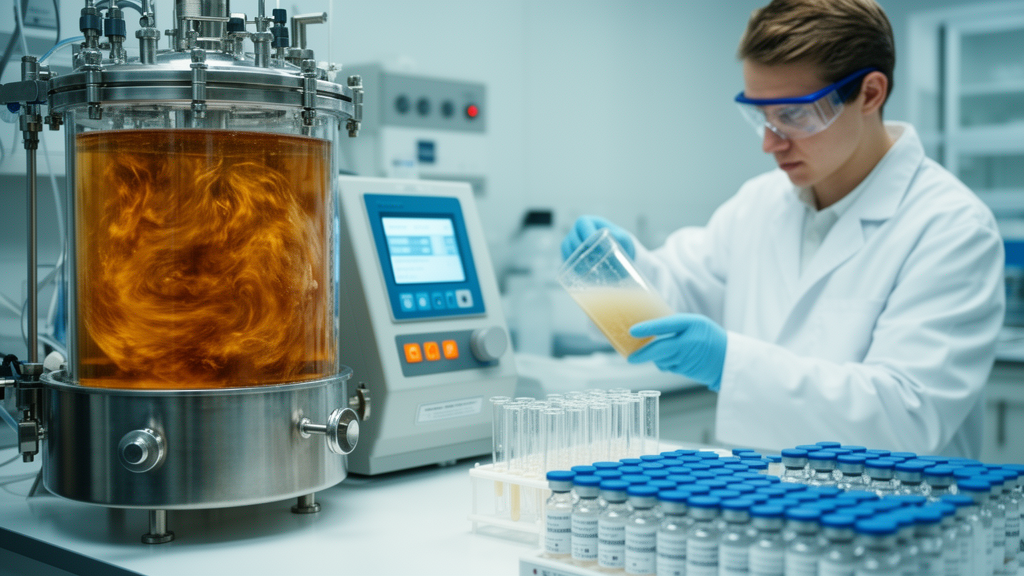
The optimized formulation contained 2.19 g/L glucose, 43.8 g/L organic nitrogen and 5.89% serum. When the process was scaled to a 14-L bioreactor with residual sugar controlled at 1–3 g/L and pH maintained at 7.2, it achieved 1.51 × 10¹⁰ CFU/mL, approximately seven-fold higher than shake-flask cultivation.

The researchers also examined how the culture medium influenced the bacterium’s virulence-associated phenotype. The LD₅₀ estimate was 2.50 × 10⁶ CFU/mouse for SS31 cultured in the optimized medium, compared with 2.14 × 10⁷ CFU/mouse for SS31 cultured in Martin medium, indicating a difference in virulence-associated phenotype under the experimental conditions. The authors note that these estimates do not demonstrate the conservation or enhancement of vaccine antigens.

Four vaccine formulations were tested in the study. The aluminum-adjuvanted vaccine containing 3 × 10⁹ pre-inactivation CFU equivalents/mL yielded the highest observed survival, protecting 10 of 10 mice after challenge with 2 LD₅₀ of the pathogen.

Organ bacterial-load and histopathological findings were evaluated descriptively, providing supporting observations alongside the survival data rather than formal statistical comparisons.

According to the authors, the findings demonstrate the technical feasibility of the SS31 cultivation process at the 14-L scale and support further evaluation of the resulting inactivated vaccine against S. suis. The work represents an early-stage proof of process scalability rather than a validated commercial vaccine protocol.

The study is published as an open-access article in BMC Biotechnology, with the version shared carrying a permanent DOI and subject to further edits before the final Version of Record.

Subject of Research: Fermentation optimization and inactivated vaccine development for Streptococcus suis serotype 31

Article Title: High-density fermentation of Streptococcus suis serotype 31 for inactivated vaccine production

Article References: Liu, L., Zhou, T., Cui, J., Han, S., Hu, J., Gao, J., & Liu, Z. (2026). High-density fermentation of Streptococcus suis serotype 31 for inactivated vaccine production. BMC Biotechnology. https://doi.org/10.1186/s12896-026-01241-y

Image Credits: AI Generated

DOI: 10.1186/s12896-026-01241-y

Keywords: Streptococcus suis, serotype 31, high-density fermentation, inactivated vaccine, Response Surface Methodology, bioreactor, biomass, LD50, aluminum adjuvant, swine pathogen, vaccine development, Box-Behnken design

Cite Scienmag News

Kristina Jarvis. (October 28, 2026). Optimized Fermentation Boosts Streptococcus suis Biomass for Inactivated Vaccine Testing. Scienmag. https://scienmag.com/optimized-fermentation-boosts-streptococcus-suis-biomass-for-inactivated-vaccine-testing/


Kristina Jarvis. "Optimized Fermentation Boosts Streptococcus suis Biomass for Inactivated Vaccine Testing." Scienmag, 28 October 2026, https://scienmag.com/optimized-fermentation-boosts-streptococcus-suis-biomass-for-inactivated-vaccine-testing/. Accessed 30 October 2026.

Kristina Jarvis. "Optimized Fermentation Boosts Streptococcus suis Biomass for Inactivated Vaccine Testing." Scienmag. October 28, 2026. https://scienmag.com/optimized-fermentation-boosts-streptococcus-suis-biomass-for-inactivated-vaccine-testing/

Tags: aluminum adjuvantbiomassbioprocess optimization for veterinary vaccinesbioreactorbioreactor scale-up for vaccine manufacturingBox-Behnken designculture medium optimization for Streptococcus suiseffects of fermentation conditions on bacterial virulencehigh-density fermentationhigh-density fermentation for pathogen biomassimproving bacterial biomass yield for vaccine qualityinactivated bacterial vaccine productioninactivated vaccineLD50response surface methodologyResponse Surface Methodology in microbial cultivationscalable bacterial fermentation processserotype 31statistical modeling in bioprocess developmentStreptococcus suisStreptococcus suis vaccine developmentswine pathogenVaccine developmentvaccine efficacy testing in mouse models
Share26Tweet16
Previous Post

Piperazine Derivatives Show Potent Antimicrobial and Anticancer Activity in Review

Next Post

From Nanoemulsion-Templated Drug Nanoparticles to Machine Learning Property Prediction: The Research Path of Lucas Attia

Related Posts

Microbial Sources and Stress Shape the Hidden Endophytes of an Invasive Plant
Biology

Microbial Sources and Stress Shape the Hidden Endophytes of an Invasive Plant

October 30, 2026
Firebreaks Leave Lasting Scars in Grasslands While Wildfire Heals Fast
Biology

Firebreaks Leave Lasting Scars in Grasslands While Wildfire Heals Fast

October 30, 2026
One gene locus flags atrial fibrillation risk after major surgery, UK Biobank study finds
Medicine

One gene locus flags atrial fibrillation risk after major surgery, UK Biobank study finds

October 30, 2026
Hidden Peptides in Non-Coding RNAs Reshape Cardiovascular Biology
Biology

Hidden Peptides in Non-Coding RNAs Reshape Cardiovascular Biology

October 30, 2026
Phage K Holin’s C-Terminal Region Shapes Antibacterial Activity, Study Finds
Biotechnology

Phage K Holin’s C-Terminal Region Shapes Antibacterial Activity, Study Finds

October 30, 2026
Computational screen flags five natural compounds that bind a tuberculosis virulence enzyme
Chemistry

Computational screen flags five natural compounds that bind a tuberculosis virulence enzyme

October 30, 2026
Next Post
From Nanoemulsion-Templated Drug Nanoparticles to Machine Learning Property Prediction: The Research Path of Lucas Attia

From Nanoemulsion-Templated Drug Nanoparticles to Machine Learning Property Prediction: The Research Path of Lucas Attia

  • Mothers who receive childcare support from maternal grandparents show more optimized

    Mothers who receive childcare support from maternal grandparents show more parental warmth, finds NTU Singapore study

    27656 shares
    Share 11059 Tweet 6912
  • University of Seville Breaks 120-Year-Old Mystery, Revises a Key Einstein Concept

    1061 shares
    Share 424 Tweet 265
  • Bee body mass, pathogens and local climate influence heat tolerance

    682 shares
    Share 273 Tweet 171
  • Researchers record first-ever images and data of a shark experiencing a boat strike

    546 shares
    Share 218 Tweet 137
  • Groundbreaking Clinical Trial Reveals Lubiprostone Enhances Kidney Function

    531 shares
    Share 212 Tweet 133
Science

Embark on a thrilling journey of discovery with Scienmag.com—your ultimate source for cutting-edge breakthroughs. Immerse yourself in a world where curiosity knows no limits and tomorrow’s possibilities become today’s reality!

RECENT NEWS

  • Trademarks Meet Patents in New Method to Spot Technology Opportunities
  • Reddit self-declarations offer auditable labels for demographic inference
  • Scots pine needles map trace element pollution in Polish industrial town
  • Dual-blockchain scheme secures vehicle handovers without pre-shared keys

Categories

  • Agriculture
  • Anthropology
  • Archaeology
  • Athmospheric
  • Biology
  • Biotechnology
  • Blog
  • Bussines
  • Cancer
  • Chemistry
  • Climate
  • Earth Science
  • Editorial Policy
  • Marine
  • Mathematics
  • Medicine
  • Pediatry
  • Policy
  • Psychology & Psychiatry
  • Science Education
  • Science News
  • Social Science
  • Space
  • Technology and Engineering

Subscribe to Blog via Email

Enter your email address to subscribe to this blog and receive notifications of new posts by email.

Join 5,150 other subscribers

© 2025 Scienmag - Science Magazine

Welcome Back!

Login to your account below

Forgotten Password?

Retrieve your password

Please enter your username or email address to reset your password.

Log In
No Result
View All Result
  • HOME
  • SCIENCE NEWS
  • CONTACT US

© 2025 Scienmag - Science Magazine

Discover more from Science

Subscribe now to keep reading and get access to the full archive.

Continue reading