


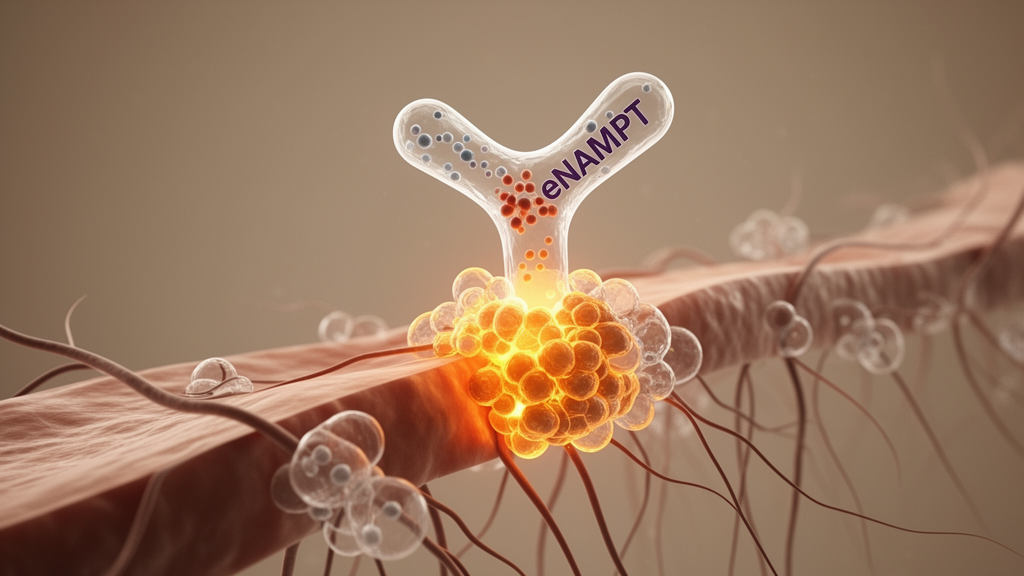
A humanized monoclonal antibody designed to neutralize extracellular nicotinamide phosphoribosyltransferase, or eNAMPT, reduced pain-related behaviors and mitigated bone loss in a mouse model of cancer-induced bone pain. The preclinical study tested the antibody, ALT-100, in breast-cancer cells, osteoclast precursor cells and female mice with breast tumors introduced into the femur. The findings support eNAMPT as a potential therapeutic target, but they do not establish clinical benefit in people.
Cancer-induced bone pain is a common symptom among patients with metastatic cancer, and health professionals can face challenges in managing the associated pain. The study focused on eNAMPT, a damage-associated molecular pattern described as overexpressed in metastatic breast carcinoma. According to the proposed mechanism, eNAMPT binds to Toll-like receptor 4 and triggers a nuclear factor kappa B signaling cascade associated with inflammation, osteoclastogenesis and pain. The researchers investigated whether neutralizing eNAMPT could reduce pain-related behavior and bone loss in experimental models.
To examine eNAMPT production, the investigators used enzyme-linked immunosorbent assays to measure eNAMPT synthesis and secretion by EO771 mouse breast adenocarcinoma cells. Levels increased over time and reached a maximum at 48 hours. ALT-100 reduced the measured eNAMPT signal, consistent with the antibody’s function as an eNAMPT-neutralizing monoclonal antibody. These results characterized the antibody’s effect in the EO771 cell-culture system rather than in human cancer cells or patients.
The researchers next examined osteoclast differentiation using RAW 264.7 osteoclast precursor cells. Recombinant eNAMPT significantly increased tartrate-resistant acid phosphatase activity, which the researchers used as a measure of osteoclastogenesis. Adding ALT-100 alongside recombinant eNAMPT significantly reduced that increase. The cell experiment therefore showed that eNAMPT promoted an osteoclast-associated response in this model and that the antibody inhibited the response. It did not by itself determine the antibody’s effectiveness in human osteoclasts or establish a treatment dose.
For the in vivo experiment, female C57BL/6J mice underwent intramedullary femoral injection of EO771 cells to establish cancer-induced bone pain, while other mice received sham surgery. One week later, the animals received either ALT-100 at 4 mg/kg by intraperitoneal injection or saline control. The researchers then assessed pain-related behaviors longitudinally and examined the femurs through radiographic analysis. These procedures modeled aspects of breast-cancer-associated bone pain in mice.
Compared with cancer-bearing mice that received saline, mice treated with ALT-100 showed significantly reduced pain-related behaviors. Radiographic analysis also showed that ALT-100 mitigated cancer-induced bone loss. The observed effects came from a controlled murine experiment using a specific administration schedule and dose. The study therefore provides evidence of activity against pain-related behavior and bone loss in the model, rather than proof of benefit for people with cancer-induced bone pain.
Together, the cell and animal findings suggest that ALT-100 can interfere with two measured features of the investigated disease process: eNAMPT-induced osteoclast differentiation and pain-related behavior in mice. Its broader significance is that the study provides experimental support for targeting eNAMPT in cancer-induced bone pain. The authors present this approach as a potential alternative therapeutic strategy, but the reported evidence comes from cultured cells and a murine breast-cancer model, not from a human clinical trial.
The results remain preclinical. The study used EO771 cells, RAW 264.7 cells and female C57BL/6J mice to examine a proposed inflammatory and bone-remodeling pathway associated with eNAMPT. ALT-100 reduced eNAMPT-related assay signals, inhibited the rise in tartrate-resistant acid phosphatase activity caused by recombinant eNAMPT, and improved measured pain-related behavior and radiographic bone loss in the mouse model. Whether the antibody can safely and effectively treat cancer-induced bone pain in humans cannot be determined from these findings alone.
Subject of Research: Preclinical testing of an eNAMPT-neutralizing antibody for cancer-induced bone pain in cells and mice
Article Title: A humanized eNAMPT -neutralizing monoclonal antibody reduces cancer-induced bone pain and osteoclastogenesis in murine breast cancer model
Article References: Mathur, N. C., Villarroel, E., Villarroel, I., Liktor-Busa, E., Karlage, K. L., Kaur, M., Kempf, C., Gudaite, B., Ding, Z., Garcia, J. G. N., Largent-Milnes, T., & Vanderah, T. W. (2026). A Humanized eNAMPT -Neutralizing Monoclonal Antibody Reduces Cancer-induced Bone Pain and Osteoclastogenesis in Murine Breast Cancer Model. Frontiers in Pain Research, 7, 1955262. https://doi.org/10.3389/fpain.2026.1955262
Image Credits: AI Generated
DOI: 10.3389/fpain.2026.1955262
Keywords: eNAMPT, ALT-100, cancer-induced bone pain, breast cancer, osteoclastogenesis, monoclonal antibody, mouse model, bone loss, pain-related behavior, humanized, neutralizing, monoclonal
Cite Scienmag News
Nathaniel Bowman. (October 21, 2026). Humanized eNAMPT antibody reduces pain-related behavior in mice. Scienmag. https://scienmag.com/humanized-enampt-antibody-reduces-pain-related-behavior-in-mice/
Nathaniel Bowman. "Humanized eNAMPT antibody reduces pain-related behavior in mice." Scienmag, 21 October 2026, https://scienmag.com/humanized-enampt-antibody-reduces-pain-related-behavior-in-mice/. Accessed 21 October 2026.
Nathaniel Bowman. "Humanized eNAMPT antibody reduces pain-related behavior in mice." Scienmag. October 21, 2026. https://scienmag.com/humanized-enampt-antibody-reduces-pain-related-behavior-in-mice/


