


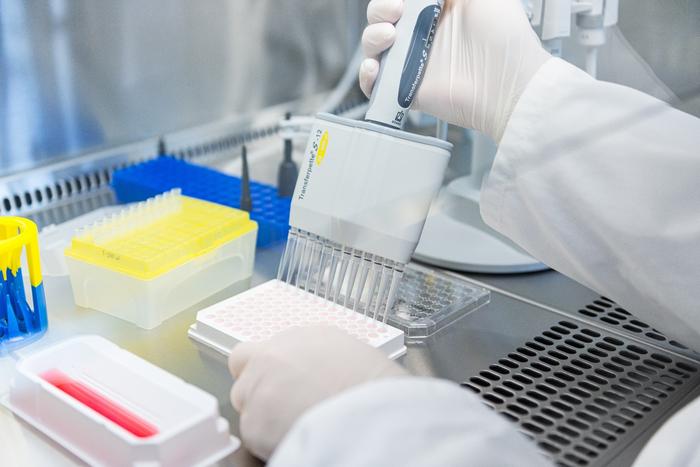
Geosmin is a volatile compound of microbial origin with a distinct “earthy” to “musty” odor that can affect the quality of water and food. A research team led by Dietmar Krautwurst from the Leibniz Institute for Food Systems Biology at the Technical University of Munich has now identified and characterized the human odorant receptor for geosmin for the first time.

Credit: C. Schranner / Leibniz-LSB@TUM
Geosmin is a volatile compound of microbial origin with a distinct “earthy” to “musty” odor that can affect the quality of water and food. A research team led by Dietmar Krautwurst from the Leibniz Institute for Food Systems Biology at the Technical University of Munich has now identified and characterized the human odorant receptor for geosmin for the first time.
Geosmin is responsible for the typical odor that occurs when rain falls on dry soil. This odorant is produced by microorganisms in the soil and is also found in plants such as cactus flowers and red beet.
Many creatures react very sensitively to geosmin, whereby the odorant can have a repellent or attractive effect. For example, it warns fruit flies of spoiled food. Camels, on the other hand, are attracted to water-rich areas. “This shows that geosmin acts as a chemical signaling substance in the animal kingdom and certainly also in humans,” explains first author Lena Ball from the Leibniz Institute.
Geosmin can impair food quality
“While the smell of geosmin suits red beet, its presence in foods such as fish, beans, cocoa, water, wine or grape juice is problematic. In these, it greatly impairs sensory quality and acceptance,” explains Stephanie Frank, food chemist at the Leibniz Institute. Even low concentrations of 4 to 10 ng/L are sufficient for a person to perceive the odor in water. This corresponds to about one teaspoon of geosmin in the water volume of 200 Olympic swimming pools.
Although geosmin has been known since 1965 and is important for food production, it was previously unknown which odorant receptor humans use to perceive geosmin. The team headed by principal investigator Dietmar Krautwurst has now carried out a bidirectional receptor screening and identified and functionally characterized the corresponding receptor for the first time.
Only one human odorant receptor for geosmin
Of 616 human olfactory receptor variants tested, only the OR11A1 receptor responded to physiologically relevant concentrations of the odorant. The team also investigated whether the identified receptor reacts to other food-relevant odorants. Of the 177 substances tested, only the earthy-smelling 2-ethylfenchol was able to significantly activate the receptor. This compound, is also of microbial origin.
“As geosmin is an important signaling substance in the animal kingdom, we also investigated how the odorant receptors of the kangaroo rat, mouse, rhesus monkey, Sumatran orangutan, polar bear and camel, which are genetically most closely related to the human receptor, react to geosmin. We wanted to find out whether the highly selective recognition of geosmin by the same receptor has been preserved over 100 million years of mammalian evolution,” reports doctoral student Lena Ball. As the team’s comparative studies show, the human receptor, together with the monkey receptors, is one of the less sensitive sensors. In the experiment, the kangaroo rat’s odorant receptor reacted around 100 times more sensitively to geosmin than the human receptor.
“The new findings on the highly sensitive odorant receptors of some animals once again emphasize the biological relevance of geosmin as a signaling substance. They could also help to develop novel detection systems that can be used to monitor food quality during production and storage or to control the water quality of freshwater reservoirs,” concludes Dietmar Krautwurst.
Publication: Ball, L., Frey, T., Haag, F., Frank, S., Hoffmann, S., Laska, M., Steinhaus, M., Neuhaus, K., and Krautwurst, D. (2024). Geosmin, a Food- and Water-Deteriorating Sesquiterpenoid and Ambivalent Semiochemical, Activates Evolutionary Conserved Receptor OR11A1. J Agric Food Chem. 10.1021/acs.jafc.4c01515. pubs.acs.org/doi/epdf/10.1021/acs.jafc.4c01515
More Information
Human odorant receptors
Humans possess a total of around 400 different odorant receptor genes, which in turn encode around 600 different allelic receptor variants in the nasal mucosa. The latter are responsible for the perception and differentiation of various odors. However, there is still a need for research to determine the exact number and function of all receptor variants. At present, it is only known for around 20 percent of human odorant receptors which odorants they can detect.
Test system used for screening
According to Dietmar Krautwurst, the cellular test system developed by the Leibniz researchers and used for receptor screening is unique in the world. He and his team have genetically modified the test cells so that they act like small biosensors for odorous substances. The researchers determine exactly which odorant receptor variant the test cells present on their surface. In this way, the researchers can specifically investigate which receptor reacts how strongly to which odorant. The Leibniz Institute has extensive collections of odorants and receptors, which it uses for its research work.
Contact:
Scientific Contact:
PD Dr. Dietmar Krautwurst
Leibniz Institute for Food Systems Biology
at the Technical University of Munich (Leibniz-LSB@TUM)
Research Group Taste & Odor Systems Reception
Lise-Meitner-Str. 34
85354 Freising
Phone: +49 8161 71-2634
E-mail: d.krautwurst.leibniz-lsb(at)tum.de
Dr. Stephanie Frank
Research Group Food Metabolome Chemistry
Leibniz-LSB@TUM
Tel.: +49 8161 71-2990
E-mail: s.frank.leibniz-lsb(at)tum.de
Press Contact at Leibniz-LSB@TUM:
Dr. Gisela Olias
Knowledge Transfer, Press and Public Relations
Phone: +49 8161 71-2980
E-mail: g.olias.leibniz-lsb(at)tum.de
www.leibniz-lsb.de
Information About the Institute:
The Leibniz Institute for Food Systems Biology at the Technical University of Munich (Leibniz-LSB@TUM) comprises a new, unique research profile at the interface of Food Chemistry & Biology, Chemosensors & Technology, and Bioinformatics & Machine Learning. As this profile has grown far beyond the previous core discipline of classical food chemistry, the institute spearheads the development of a food systems biology. Its aim is to develop new approaches for the sustainable production of sufficient quantities of food whose biologically active effector molecule profiles are geared to health and nutritional needs, but also to the sensory preferences of consumers. To do so, the institute explores the complex networks of sensorically relevant effector molecules along the entire food production chain with a focus on making their effects systemically understandable and predictable in the long term.
The Leibniz-LSB@TUM is a member of the Leibniz Association, which connects 96 independent research institutions. Their orientation ranges from the natural sciences, engineering and environmental sciences through economics, spatial and social sciences to the humanities. Leibniz Institutes address issues of social, economic and ecological relevance.They conduct basic and applied research, including in the interdisciplinary Leibniz Research Alliances, maintain scientific infrastructure, and provide research-based services. The Leibniz Association identifies focus areas for knowledge transfer, particularly with the Leibniz research museums. It advises and informs policymakers, science, industry and the general public.
Leibniz institutions collaborate intensively with universities – including in the form of Leibniz ScienceCampi – as well as with industry and other partners at home and abroad. They are subject to a transparent, independent evaluation procedure. Because of their importance for the country as a whole, the Leibniz Association Institutes are funded jointly by Germany’s central and regional governments. The Leibniz Institutes employ around 21,300 people, including 12,200 researchers. The financial volume amounts to 2,2 billion euros.
+++ Stay up to date via our X (Twitter) channel twitter.com/LeibnizLSB +++
Journal
Journal of Agricultural and Food Chemistry
Method of Research
Experimental study
Subject of Research
Cells
Article Title
Geosmin, a Food- and Water-Deteriorating Sesquiterpenoid and Ambivalent Semiochemical, Activates Evolutionary Conserved Receptor OR11A1
Article Publication Date
2-Jul-2024
COI Statement
The authors declare no competing financial interest
Cite Scienmag News
Drew Townsend. (August 1, 2024). Human odorant receptor for geosmin identified for the first time. Scienmag. https://scienmag.com/human-odorant-receptor-for-geosmin-identified-for-the-first-time/
Drew Townsend. "Human odorant receptor for geosmin identified for the first time." Scienmag, 1 August 2024, https://scienmag.com/human-odorant-receptor-for-geosmin-identified-for-the-first-time/. Accessed 4 September 2026.
Drew Townsend. "Human odorant receptor for geosmin identified for the first time." Scienmag. August 1, 2024. https://scienmag.com/human-odorant-receptor-for-geosmin-identified-for-the-first-time/

