


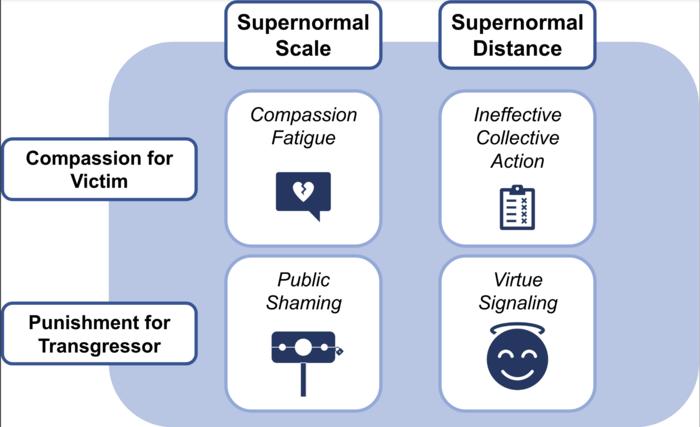
In a Review article, Claire Robertson and colleagues explore how human morality, which evolved in the context of small in-person groups, functions on the internet with over five billion users. Evolved human responses, such as compassion for victims and urges to punish transgressors, operate differently online, the authors argue. The internet exposes users to large quantities of extreme morally relevant stimuli in the form of 24-hour news and intentionally outrageous content from sometimes physically distant locations. Subjecting human brains to this new morally oversaturated environment has caused compassion fatigue, public shaming, ineffective collective action and virtue signaling, according to the authors. Compassion fatigue arises because empathy is a costly cognitive resource, easily overtaxed by the demands of round-the-clock information about suffering. Public shaming arises because the internet makes it all too easy for very large numbers of people to indulge in the universal human desire to punish wrongdoers, thought to be an evolved adaptation to living in groups—but small groups. As posting a condemnation is nearly costless, it becomes a tempting way to signal moral virtue and group membership. Real aid may in some cases be replaced by non-costly forms of compassion, such as “liking” or “sharing” a post, which does little to help but makes people feel they have fulfilled their moral responsibilities. In addition, the ease of organizing online leads to massive—but ephemeral—social movements with shallow roots and little staying power. The authors call for research into platform design features that sustain attention or engagement without inducing negative externalities on individuals and society, and for greater public access to platform algorithms so that research can proceed.

Credit: Robertson et al.
In a Review article, Claire Robertson and colleagues explore how human morality, which evolved in the context of small in-person groups, functions on the internet with over five billion users. Evolved human responses, such as compassion for victims and urges to punish transgressors, operate differently online, the authors argue. The internet exposes users to large quantities of extreme morally relevant stimuli in the form of 24-hour news and intentionally outrageous content from sometimes physically distant locations. Subjecting human brains to this new morally oversaturated environment has caused compassion fatigue, public shaming, ineffective collective action and virtue signaling, according to the authors. Compassion fatigue arises because empathy is a costly cognitive resource, easily overtaxed by the demands of round-the-clock information about suffering. Public shaming arises because the internet makes it all too easy for very large numbers of people to indulge in the universal human desire to punish wrongdoers, thought to be an evolved adaptation to living in groups—but small groups. As posting a condemnation is nearly costless, it becomes a tempting way to signal moral virtue and group membership. Real aid may in some cases be replaced by non-costly forms of compassion, such as “liking” or “sharing” a post, which does little to help but makes people feel they have fulfilled their moral responsibilities. In addition, the ease of organizing online leads to massive—but ephemeral—social movements with shallow roots and little staying power. The authors call for research into platform design features that sustain attention or engagement without inducing negative externalities on individuals and society, and for greater public access to platform algorithms so that research can proceed.
Journal
PNAS Nexus
Article Title
Morality in the anthropocene: The perversion of compassion and punishment in the online world
Article Publication Date
11-Jun-2024
Cite Scienmag News
Gavin Prescott. (June 11, 2024). Human evolution and online morality. Scienmag. https://scienmag.com/human-evolution-and-online-morality/
Gavin Prescott. "Human evolution and online morality." Scienmag, 11 June 2024, https://scienmag.com/human-evolution-and-online-morality/. Accessed 4 September 2026.
Gavin Prescott. "Human evolution and online morality." Scienmag. June 11, 2024. https://scienmag.com/human-evolution-and-online-morality/

