


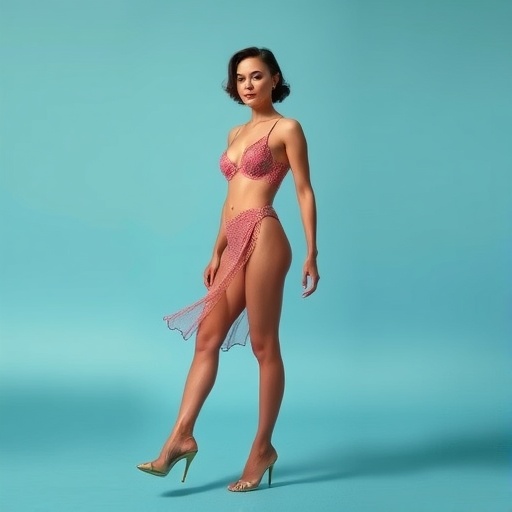
Over the past twenty-five years, the fashion industry has witnessed a conspicuous evolution in the portrayal of diversity within media and runway imagery. Despite the surface appearance of broader representation, recent groundbreaking research reveals a stubborn constancy in the industry’s ideal female body shape, challenging prevailing narratives about inclusion and change in fashion aesthetics. This comprehensive study, leveraging nearly 800,000 images spanning from 2000 to 2024, integrates advanced computer vision techniques, network analysis, and clinical health data to map the nuanced trajectories of body size depiction in female fashion models globally.
The researchers, led by Louis Boucherie of the Technical University of Denmark and collaborators from prominent institutions in the United States, Denmark, and Austria, deploy innovative analytical methodologies to scrupulously track shifts in model body size across multiple dimensions including geographic regions and industry segments. Their findings disrupt common assumptions: while the variety of body types publicly visible has indeed broadened, the statistical average model body size remains strikingly unchanged. This reveals that increased diversity stems primarily from the presence of outlier bodies at the extremes rather than a genuine recalibration of the normative ideal at the industry’s center.
This phenomenon articulates a cultural paradox within fashion—progress in inclusivity is often marginal rather than systemic. According to Boucherie, “On the mean, nothing happens. Everything is super stable.” This stability in central body norms persists even as the distribution of body sizes exhibits greater variance, meaning that the newfound visibility of plus-size or differently sized models does not significantly diverge the core aspirational body ideal, but rather exists around its periphery. Such findings suggest that token gestures of inclusivity may coexist alongside entrenched, immutable standards.
Benchmarking the fashion imagery against real-world population data underscores the dissonance between industry ideals and societal realities. The researchers compared US-based models with data from the National Health and Nutrition Examination Survey, revealing the striking fact that “plus-size” models are still systematically smaller than the average American woman. The degree of overlap between the body sizes exhibited in fashion media and those of the general population remains negligible. This sharp reality check exposes a persistent disconnection between fashion’s definitions of beauty and the embodied experiences of everyday people.
Compounding the complexity of representation, the study illuminates intersectional dynamics where ethnicity and body size intersect rather than diversify independently. The share of non-white models in fashion imagery surged from about 13% in 2011 to over 40% recently, a notable increase in racial diversity. However, the analysis identifies a disproportionate burden placed on non-white plus-size models, who are 4.5 times more likely to embody both markers of difference simultaneously. This pattern crystallizes the concept that diversity gains often aggregate on a relatively small subset of models who carry the responsibility of representing multiple dimensions of “otherness,” rather than permeating industry norms broadly.
Delving into intra-industry dynamics, the researchers constructed a data-driven hierarchy of brands and magazines by evaluating model booking networks, revealing stratified patterns of body size representation. Notably, top-tier, high-prestige fashion brands simultaneously showcase the thinnest models and a higher proportion of plus-size models relative to lesser-known competitors. This heterogeneous evolution complicates simplistic notions of progress; superficial aggregate statistics obscure profound variation within and between different segments of the fashion ecosystem.
The study also offers a rare comparative lens on regulatory interventions aimed at curbing extreme thinness in model selection. Contrasting two European approaches — a stringent numerical minimum body mass index (BMI) mandate at Milan Fashion Week versus a more flexible, certification-based system in France — the analysis suggests the efficacy of hard numerical thresholds. Milan’s policy correlated with a marked reduction in extremely thin models, whereas France’s softer, doctor-certification approach showed no comparable impact. While causality cannot be definitively claimed, these observations implicate regulatory architecture design as a crucial variable in shaping fashion’s visual standards.
Collectively, the research unveils a paradoxical cultural inertia within fashion industry norms. Representation and diversity, while visibly enhanced, do not translate into substantive transformation of the central body ideal. Token inclusion and intersectional concentration of diversity markers coexist with rigid aesthetic standards preserved at the core of fashion imagery. This suggests that genuine progress requires recalibrating the industry’s aspirational center rather than merely expanding its periphery.
Boucherie underscores the importance of quantifying these trends: “People already knew there was a problem, which has been debated repeatedly. What we’ve done is to quantify it.” By providing robust empirical evidence, the study arms stakeholders — advertisers, designers, editors, and policymakers — with the data necessary to critically evaluate the social implications of their creative and business decisions. The responsibility to act upon this knowledge, to challenge entrenched ideals and foster inclusive normativity, rests squarely on the shoulders of those who shape fashion culture.
While the primary focus rests on female models, the study also briefly examines male fashion imagery. In contrast to the subtle shifts detected among women, male body ideals demonstrate less variability and contestation across the examined period. The male fashion standard remains narrowly defined and relatively impervious to diversification. This gender asymmetry highlights the differential sociocultural pressures and market forces governing body representation and demands further research for comprehensive understanding.
This landmark study, titled “Cultural evolution of beauty standards,” published in the Proceedings of the National Academy of Sciences, stands as a clarion call for deeper systemic change in fashion’s cultural expressions. Despite the visual veneer of diversity, the entrenched body ideals underlying industry practices remain remarkably resistant. Through leveraging large-scale data and sophisticated analytics, the researchers illuminate the enduring challenges and complexities of evolving beauty standards in fashion, advocating for interventions that address not just marginal inclusion but transformation at the industry’s core.
News Publication Date: Not available from the provided content.
Web References:
– Cultural evolution of beauty standards in PNAS: https://www.pnas.org/doi/10.1073/pnas.2602380123
– Visual representation of data: https://louisboucherie.com/diversity/
References:
Boucherie, L., Kumar, S., Ledebur, K., Lohse, A., & Sliwa, K. (2026). Cultural evolution of beauty standards. Proceedings of the National Academy of Sciences.
Cite Scienmag News
Courtney Benton. (May 22, 2026). Body Diversity Rises in Fashion, Yet the Ideal Remains Unchanged. Scienmag. https://scienmag.com/body-diversity-rises-in-fashion-yet-the-ideal-remains-unchanged/
Courtney Benton. "Body Diversity Rises in Fashion, Yet the Ideal Remains Unchanged." Scienmag, 22 May 2026, https://scienmag.com/body-diversity-rises-in-fashion-yet-the-ideal-remains-unchanged/. Accessed 3 September 2026.
Courtney Benton. "Body Diversity Rises in Fashion, Yet the Ideal Remains Unchanged." Scienmag. May 22, 2026. https://scienmag.com/body-diversity-rises-in-fashion-yet-the-ideal-remains-unchanged/


