


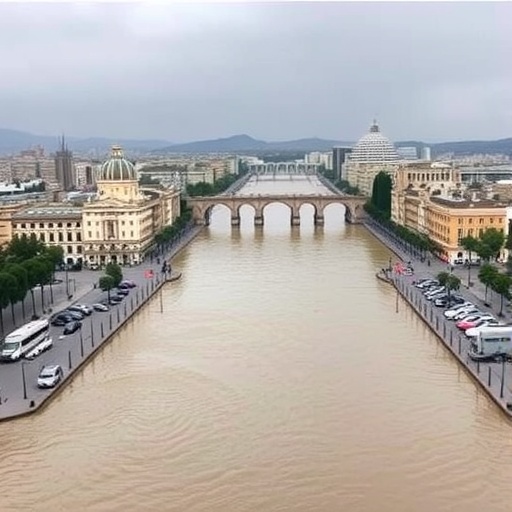
In 2024, Valencia faced a catastrophic flash flood that not only shocked the local population but also galvanized scientists worldwide to delve deeper into the intertwined effects of extreme weather events and climate change. A groundbreaking study recently published in Nature Communications sheds light on how human-induced climate change is amplifying storm dynamics, precipitating devastating rainfall and flooding events like the one experienced in Valencia. This research holds critical implications for forecasting, infrastructure planning, and climate mitigation strategies globally.
Traditionally, flash floods have been the result of intense but localized storms, with natural variability dictating their occurrence and severity. However, the 2024 Valencia flash flood distinguished itself not only by the sheer volume of rain but also by the complex dynamic behaviors of the storm system involved. Researchers Calvo-Sancho, Díaz-Fernández, González-Alemán, and their colleagues employed advanced climate models and observational data to dissect the storm’s evolution, revealing a stark amplification of rainfall intensity linked directly to anthropogenic climate influences.
Central to this study is the examination of how human-induced warming has altered atmospheric moisture content and storm dynamics. As global temperatures rise, the atmosphere can hold more water vapor—about 7% more per degree Celsius increase—resulting in heavier precipitation episodes. The Valencia flood event illustrated this principle dramatically, showing rainfall amounts far exceeding historical norms, which overwhelmed urban drainage systems and natural waterways.
Utilizing high-resolution climate simulations matched with radar and satellite data, the research team recreated the storm’s lifecycle. Their modeling revealed that the warmer sea surface temperatures in the Western Mediterranean Basin increased the storm’s convective energy, enhancing its vertical development and sustaining a prolonged period of torrential downpours. This feedback loop, energized by increasing greenhouse gas concentrations, created a storm of exceptional intensity and destructiveness.
Further complexity was uncovered in the storm’s dynamical structure. The scientists identified amplified mesoscale convective systems, which are clusters of thunderstorms that can sustain themselves longer and propagate over extended distances. These systems feed off the increased moisture and thermal gradients enhanced by climate change, generating a scenario where storm clusters become more organized and rainfall more spatially extensive and intense.
Another crucial finding relates to storm trajectories. The altered atmospheric circulation patterns influenced by global climate warming have shifted typical storm paths so that regions like Valencia are now more vulnerable to intense flash floods. These shifts correlate with changes in the jet stream and pressure systems, which the study explored using ensemble simulations, confirming statistical significance in changes compared to pre-industrial baselines.
Beyond meteorological insights, the study highlights the human and societal ramifications of these amplified storms. Valencia’s infrastructure, built around historical weather norms, was ill-equipped to handle the unprecedented flooding, leading to widespread urban damage, economic losses, and tragic human impacts. The research presents a dire warning that adapting urban planning and emergency response must account for climate change’s role in aggravating storm behavior.
To better project future risks, the authors advocate integrating climate change signal detection directly into operational weather forecasting. By factoring in anthropogenic warming’s proven amplification effects, meteorologists can provide critical early warnings with improved accuracy and lead time. This integration represents a paradigm shift from purely natural variability-based forecasts to climate-informed prediction frameworks.
The research also stresses the importance of preserving and restoring natural flood mitigation landscapes, such as wetlands and forested floodplains, which can buffer the impact of heightened rainfall. With intensified storm systems increasingly common due to climate change, nature-based solutions offer scalable, sustainable protection that complements engineered infrastructure enhancements.
The Valencia case study stands as a sentinel event demonstrating how localized extreme weather is symptomatic of broader planetary changes. It serves as a call to global communities and policymakers that greenhouse gas emissions not only drive gradual warming but also lead to abrupt, amplified disaster risks. The novel methodologies employed in this research set new standards for analyzing similar events worldwide, reinforcing the necessity of interdisciplinary approaches combining meteorology, climatology, hydrology, and urban planning.
In conclusion, the 2024 Valencia flash flood is no isolated anomaly but a manifestation of an accelerating trend fueled by human activities. The amplified storm dynamics uncovered by Calvo-Sancho and colleagues underscore the urgent need for global climate action and scientifically informed adaptation strategies. As the atmosphere continues to warm, understanding and preparing for such extreme weather events will be critical for safeguarding vulnerable communities around the globe.
This landmark study paves the way for future research exploring the nuances of climate-storm interactions. Through ongoing advancements in computational power and data availability, scientists will refine predictive models, unlocking deeper insights into how climate change reshapes the earth’s hydrological extremes. The lessons from Valencia thus resonate far beyond the Mediterranean, forming a cornerstone in our global response to climate-induced hazards.
As we witness the increasing frequency and impact of catastrophic floods, the scientific community’s ability to diagnose and forecast these events under new climate realities is essential. This study not only elucidates the mechanics of a specific event but also exemplifies how human-caused climate change is transforming weather extremes worldwide, demanding a coordinated, multidisciplinary approach to resilience and sustainability.
Cite Scienmag News
Violet Maxwell. (February 17, 2026). Human Climate Impact Amplifies Valencia’s 2024 Flood. Scienmag. https://scienmag.com/human-climate-impact-amplifies-valencias-2024-flood/
Violet Maxwell. "Human Climate Impact Amplifies Valencia’s 2024 Flood." Scienmag, 17 February 2026, https://scienmag.com/human-climate-impact-amplifies-valencias-2024-flood/. Accessed 4 September 2026.
Violet Maxwell. "Human Climate Impact Amplifies Valencia’s 2024 Flood." Scienmag. February 17, 2026. https://scienmag.com/human-climate-impact-amplifies-valencias-2024-flood/


