

Thursday, October 22, 2026
Science
No Result
View All Result
  • Login
  • HOME
  • SCIENCE NEWS
  • CONTACT US
  • HOME
  • SCIENCE NEWS
  • CONTACT US
No Result
View All Result
Scienmag
No Result
View All Result
Home Science News Earth Science

Human and social capital linked to lower provincial CO₂ emissions in Iran

October 22, 2026
in Earth Science
Sloane Callahan
By Sloane Callahan Scienmag Editorial Profile - Climate Mitigation
Reading Time: 2 mins read
0
Human and social capital linked to lower provincial CO₂ emissions in Iran

Human and social capital linked to lower provincial CO₂ emissions in Iran

65
SHARES
587
VIEWS
Share on FacebookShare on Twitter
ADVERTISEMENT

A dynamic spatial analysis of 28 Iranian provinces found that human capital, social capital, and their interaction were associated with lower carbon dioxide emissions from 2005 to 2020. Both forms of intangible capital had statistically significant negative relationships with emissions, with human capital showing the relatively stronger overall effect. The study also estimated that spatial spillovers were substantially larger than the direct provincial effects, indicating that the modeled relationships extended across provincial boundaries.

The researchers used a dynamic Spatial Durbin Model within an extended STIRPAT framework to distinguish direct effects from cross-provincial spillover effects and to estimate the combined influence of human and social capital. This approach accounts for temporal persistence, spatial interdependence, and the interaction between the two types of capital. The negative, significant interaction term suggested that the estimated relationships were complementary rather than independent, although the observational model does not by itself establish that increasing one form of capital would cause a reduction in emissions.

The study attributes the large spatial components of the results to possible processes such as knowledge diffusion, social norms, and institutional learning, but its reported evidence does not isolate which mechanism generated each spillover. Conditional marginal effects showed that the emissions-reducing relationships were consistently stronger in the long run than in the short run. Together, the findings suggest that the influence of human and social capital was neither confined to the province in which it was measured nor constant over time.

These results come from province-level observational data covering Iran’s 28 provinces over 16 years. The spatial model captures relationships among neighboring provincial units, persistent conditions, direct effects, and spillovers, but it cannot establish that the estimated factors caused the observed differences in emissions. The study therefore provides evidence of modeled associations rather than a tested intervention or a quantified forecast of how emissions would change under a specific education, trust, or regional-development program. Its central contribution is to show that human and social capital can be examined together within a dynamic spatial framework and decomposed into provincial and cross-provincial components.

Subject of Research: Spatial relationships among human capital, social capital, and provincial CO₂ emissions in Iran

Article Title: The spatial synergy of human and social capital mitigating CO2 emissions in Iranian provinces

Article References: Tabiee, M., Ghazali, S., & Dehghan Shabani, Z. (2026). The spatial synergy of human and social capital mitigating CO2 emissions in Iranian provinces. Discover Sustainability. https://doi.org/10.1007/s43621-026-05027-2

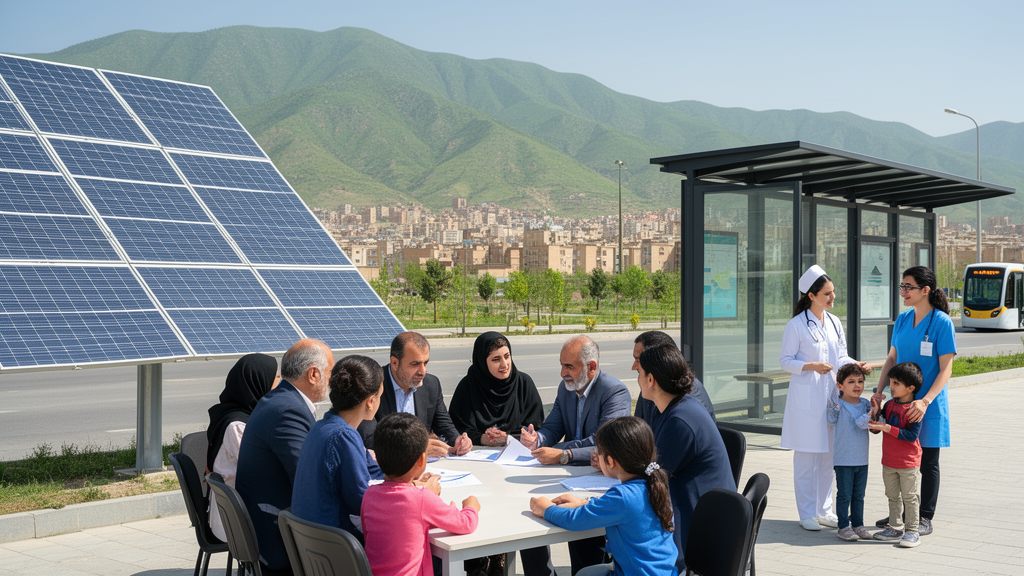
Image Credits: AI Generated

DOI: 10.1007/s43621-026-05027-2

Keywords: CO₂ emissions, Iranian provinces, human capital, social capital, spatial spillovers, Spatial Durbin Model, STIRPAT, regional development, complementarity, observational modeling, spatial, synergy

Cite Scienmag News

Sloane Callahan. (October 22, 2026). Human and social capital linked to lower provincial CO₂ emissions in Iran. Scienmag. https://scienmag.com/human-and-social-capital-linked-to-lower-provincial-co%e2%82%82-emissions-in-iran/


Sloane Callahan. "Human and social capital linked to lower provincial CO₂ emissions in Iran." Scienmag, 22 October 2026, https://scienmag.com/human-and-social-capital-linked-to-lower-provincial-co%e2%82%82-emissions-in-iran/. Accessed 22 October 2026.

Sloane Callahan. "Human and social capital linked to lower provincial CO₂ emissions in Iran." Scienmag. October 22, 2026. https://scienmag.com/human-and-social-capital-linked-to-lower-provincial-co%e2%82%82-emissions-in-iran/

Tags: CO2 emissionscomplementaritycross-provincial emission reduction strategiesdynamic spatial analysis of provincial emissionshuman capitalHuman capital and social capital in Iraninfluence of social norms and knowledge diffusion on emissionsintangible capital and climate change mitigationinteraction effects between human and social capital onIranian provincesobservational modelingprovince-level analysis of carbon emissions in Iranregional developmentrole of human and social capital in sustainable developmentsocial capitalSpatialSpatial Durbin Modelspatial Durbin model in environmental researchspatial interdependence in environmental studiesspatial spillover effects on CO₂ emissionsspatial spilloversSTIRPATSTIRPAT framework for environmental impactsynergy
Share26Tweet16
Previous Post

Suspended Silicon Metasurfaces Tune Mid-Infrared Light Rapidly

Next Post

Remimazolam lowers hypotension but does not prevent postoperative delirium in older adults

Related Posts

Washington field study links acidification, silicon loss and productivity decline
Earth Science

Washington field study links acidification, silicon loss and productivity decline

October 22, 2026
Research report: Editorial: Adaptive environmental policy for strengthening ecological resilience in socio-ecological systems
Earth Science

Research report: Editorial: Adaptive environmental policy for strengthening ecological resilience in socio-ecological systems

October 22, 2026
Fast avalanches may hit tall but not load tall
Climate

Fast avalanches may hit tall but not load tall

October 22, 2026
Flume study quantifies dam-break pressure on sloping wet beds
Earth Science

Flume study quantifies dam-break pressure on sloping wet beds

October 22, 2026
Long-term field study finds five pesticides near surface in conservation agriculture
Earth Science

Long-term field study finds five pesticides near surface in conservation agriculture

October 22, 2026
Large Puna evaporation ponds associated with domain-scale atmospheric changes
Earth Science

Large Puna evaporation ponds associated with domain-scale atmospheric changes

October 22, 2026
Next Post
Remimazolam lowers hypotension but does not prevent postoperative delirium in older adults

Remimazolam lowers hypotension but does not prevent postoperative delirium in older adults

  • Mothers who receive childcare support from maternal grandparents show more optimized

    Mothers who receive childcare support from maternal grandparents show more parental warmth, finds NTU Singapore study

    27656 shares
    Share 11059 Tweet 6912
  • University of Seville Breaks 120-Year-Old Mystery, Revises a Key Einstein Concept

    1061 shares
    Share 424 Tweet 265
  • Bee body mass, pathogens and local climate influence heat tolerance

    682 shares
    Share 273 Tweet 171
  • Researchers record first-ever images and data of a shark experiencing a boat strike

    546 shares
    Share 218 Tweet 137
  • Groundbreaking Clinical Trial Reveals Lubiprostone Enhances Kidney Function

    531 shares
    Share 212 Tweet 133
Science

Embark on a thrilling journey of discovery with Scienmag.com—your ultimate source for cutting-edge breakthroughs. Immerse yourself in a world where curiosity knows no limits and tomorrow’s possibilities become today’s reality!

RECENT NEWS

  • Remimazolam lowers hypotension but does not prevent postoperative delirium in older adults
  • Human and social capital linked to lower provincial CO₂ emissions in Iran
  • Suspended Silicon Metasurfaces Tune Mid-Infrared Light Rapidly
  • Integrated application of CBDP, iPBS, and SCoT markers with DNA barcoding enables effective classification of Chinese prickly ash (Huajiao)

Categories

  • Agriculture
  • Anthropology
  • Archaeology
  • Athmospheric
  • Biology
  • Biotechnology
  • Blog
  • Bussines
  • Cancer
  • Chemistry
  • Climate
  • Earth Science
  • Editorial Policy
  • Marine
  • Mathematics
  • Medicine
  • Pediatry
  • Policy
  • Psychology & Psychiatry
  • Science Education
  • Science News
  • Social Science
  • Space
  • Technology and Engineering

Subscribe to Blog via Email

Enter your email address to subscribe to this blog and receive notifications of new posts by email.

Join 5,151 other subscribers

© 2025 Scienmag - Science Magazine

Welcome Back!

Login to your account below

Forgotten Password?

Retrieve your password

Please enter your username or email address to reset your password.

Log In
No Result
View All Result
  • HOME
  • SCIENCE NEWS
  • CONTACT US

© 2025 Scienmag - Science Magazine

Discover more from Science

Subscribe now to keep reading and get access to the full archive.

Continue reading