


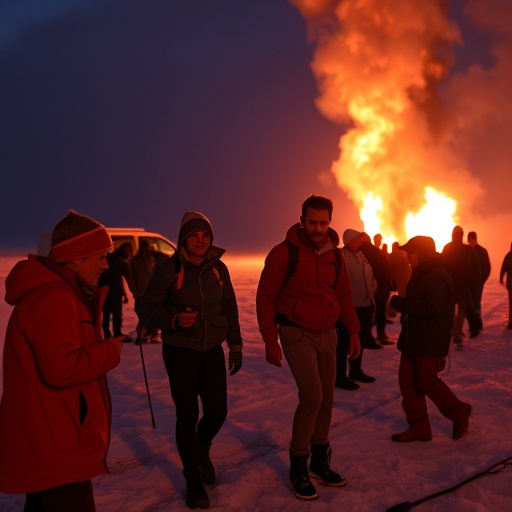
The Arctic is often portrayed as a land of lightning, frozen silence and fires driven almost entirely by a warming climate. A new study challenges that picture, reporting that human activity is playing a direct and measurable role in where Arctic fires occur. The research, published in Communications Earth & Environment, finds that fires are more common within and around areas illuminated by human settlements, infrastructure and other sources of artificial light.
The finding matters because the Arctic is changing at extraordinary speed. Rising temperatures are drying vegetation, thawing permafrost and lengthening the period during which wildfires can spread. Yet climate change alone does not explain every ignition. The study by C. Akandil, R.J. Heim, E. Plekhanova and colleagues focuses on a crucial additional factor: people are bringing more ignition opportunities into a region that was once relatively remote from concentrated human activity.
To investigate that relationship, the researchers examined the geographic overlap between Arctic fire occurrence and areas marked by artificial nighttime illumination. Satellite-based “night lights” are widely used as a proxy for human presence because they reveal settlements, roads, industrial sites, energy facilities and other developed locations even across vast, sparsely populated landscapes. By comparing fire locations with these illuminated zones and their surrounding areas, the team identified a pattern linking human activity to Arctic fire occurrence.
The result is not simply that fires appear in cities. The study indicates that elevated fire occurrence extends within and near lit areas, suggesting that the influence of people reaches beyond the precise footprint of buildings or infrastructure. Ignitions can begin near roads, camps, power installations, extraction sites and settlements, then spread into surrounding tundra, boreal forest or peat-rich ground. In the Arctic, where vegetation can be continuous and winds can rapidly transport flames, a small ignition may become a large landscape event under favorable weather conditions.
Artificial light itself does not cause vegetation to burn. Instead, it acts as a detectable signature of human access and activity. Machinery, vehicles, electrical equipment, industrial operations, campfires and accidental ignitions can all provide potential starting points. Once a fire begins, unusually warm and dry conditions may determine whether it dies out quickly or expands across the landscape. This distinction is scientifically important: human activity can increase the number of ignition opportunities, while climate and weather strongly influence the size, intensity and duration of the resulting fires.
The Arctic fire problem has consequences far beyond the immediate burn area. Many northern landscapes store vast quantities of carbon in soils, mosses, peat and permafrost. Fire can remove insulating vegetation and organic layers, exposing frozen ground to warmer air. That can accelerate permafrost thaw and release carbon dioxide and methane, greenhouse gases that further intensify global warming. Smoke from Arctic fires can also travel hundreds or thousands of kilometers, affecting air quality and depositing dark particles on snow and ice, where they reduce reflectivity and increase solar heat absorption.
The research also carries a warning for the future of northern development. As sea ice retreats and infrastructure expands, more of the Arctic is becoming accessible to transport, tourism, mining, energy production and settlement. Those changes may bring economic opportunities, but they can also increase the number of human-caused ignition points in ecosystems that are already under thermal stress. A warming climate and a growing human footprint may therefore reinforce one another, creating conditions in which fires become both more frequent and more difficult to manage.
The study does not suggest that every Arctic fire is caused by people, nor does it diminish the role of lightning and climate-driven extremes. Natural ignitions remain important, particularly during severe fire-weather events. Instead, the findings add human activity to the region’s fire equation. The key insight is that ignition pressure is not evenly distributed across the Arctic: it is concentrated around the places where people live, travel, work and build.
That insight could improve fire forecasting and prevention. Satellite night-light data can help authorities identify areas where rising human activity may create new ignition risks, even before detailed local records are available. Combining those maps with vegetation moisture, wind forecasts, drought indicators, permafrost conditions and historical fire data could support targeted patrols, public warnings and emergency planning. In remote regions where firefighting resources are limited, preventing a fire may be far more effective than attempting to control one after it has spread.
The Arctic is frequently described as a region too vast and wild for human actions to matter at the landscape scale. This study delivers a more complicated message. People may occupy only a small fraction of the far north, but their activities are leaving a detectable imprint on one of its most consequential disturbances. As the climate warms and the Arctic becomes more connected to the global economy, understanding where human ignition risk intersects with fragile ecosystems could become essential—not only for protecting northern communities, but also for slowing a feedback loop that reaches the entire planet.
Cite Scienmag News
Violet Maxwell. (July 31, 2026). Human Activity Raises Arctic Fire Risk Inside and Near Lighted Areas. Scienmag. https://scienmag.com/human-activity-raises-arctic-fire-risk-inside-and-near-lighted-areas/
Violet Maxwell. "Human Activity Raises Arctic Fire Risk Inside and Near Lighted Areas." Scienmag, 31 July 2026, https://scienmag.com/human-activity-raises-arctic-fire-risk-inside-and-near-lighted-areas/. Accessed 3 September 2026.
Violet Maxwell. "Human Activity Raises Arctic Fire Risk Inside and Near Lighted Areas." Scienmag. July 31, 2026. https://scienmag.com/human-activity-raises-arctic-fire-risk-inside-and-near-lighted-areas/


