


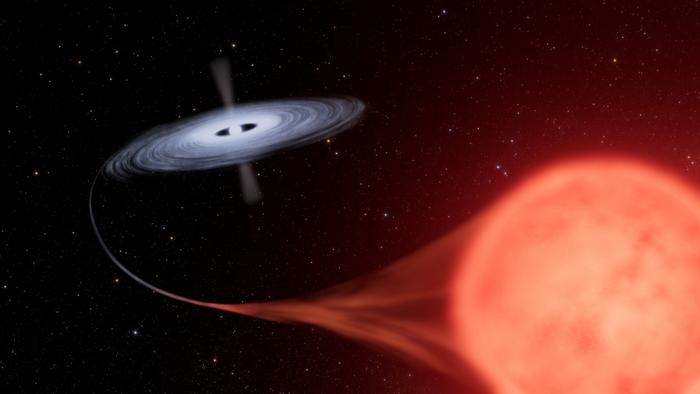
Astronomers have used new data from NASA’s Hubble Space Telescope and the retired SOFIA (Stratospheric Observatory for Infrared Astronomy) as well as archival data from other missions to revisit one of the strangest binary star systems in our galaxy – 40 years after it burst onto the scene as a bright and long-lived nova. A nova is a star that suddenly increases its brightness tremendously and then fades away to its former obscurity, usually in a few months or years.

Credit: NASA, ESA, Leah Hustak (STScI)
Astronomers have used new data from NASA’s Hubble Space Telescope and the retired SOFIA (Stratospheric Observatory for Infrared Astronomy) as well as archival data from other missions to revisit one of the strangest binary star systems in our galaxy – 40 years after it burst onto the scene as a bright and long-lived nova. A nova is a star that suddenly increases its brightness tremendously and then fades away to its former obscurity, usually in a few months or years.
Between April and September 1975, the binary system HM Sagittae (HM Sge) grew 250 times brighter. Even more unusual, it did not rapidly fade away as novae commonly do, but has maintained its luminosity for decades. Recently, observations show that the system has gotten hotter, but paradoxically faded a little.
HM Sge is a particular kind of symbiotic star where a white dwarf and a bloated, dust-producing giant companion star are in an eccentric orbit around each other, and the white dwarf ingests gas flowing from the giant star. That gas forms a blazing hot disk around the white dwarf, which can unpredictably undergo a spontaneous thermonuclear explosion as the infall of hydrogen from the giant grows denser on the surface until it reaches a tipping point. These fireworks between companion stars fascinate astronomers by yielding insights into the physics and dynamics of stellar evolution in binary systems.
“In 1975 HM Sge went from being a nondescript star to something all astronomers in the field were looking at, and at some point that flurry of activity slowed down,” said Ravi Sankrit of the Space Telescope Science Institute (STScI) in Baltimore. In 2021, Steven Goldman of STScI, Sankrit and collaborators used instruments on Hubble and SOFIA to see what had changed with HM Sge in the last 30 years at wavelengths of light from the infrared to the ultraviolet (UV).
The 2021 ultraviolet data from Hubble showed a strong emission line of highly ionized magnesium that was not present in earlier published spectra from 1990. Its presence shows that the estimated temperature of the white dwarf and accretion disk increased from less than 400,000 degrees Fahrenheit in 1989 to greater than 450,000 degrees Fahrenheit now. The highly ionized magnesium line is one of many seen in the UV spectrum, which analyzed together will reveal the energetics of the system, and how it has changed in the last three decades.
“When I first saw the new data,” Sankrit said, “I went – ‘wow this is what Hubble UV spectroscopy can do!’ – I mean it’s spectacular, really spectacular.”
With data from NASA’s flying telescope SOFIA, which retired in 2022, the team was able to detect the water, gas, and dust flowing in and around the system. Infrared spectral data shows that the giant star, which produces copious amounts of dust, returned to its normal behavior within only a couple years of the explosion, but also that it has dimmed in recent years, which is another puzzle to be explained.
With SOFIA astronomers were able to see water moving at around 18 miles per second, which they suspect is the speed of the sizzling accretion disk around the white dwarf. The bridge of gas connecting the giant star to the white dwarf must presently span about 2 billion miles.
The team has also been working with the AAVSO (American Association of Variable Star Observers), to collaborate with amateur astronomers from around the world who help keep telescopic eyes on HM Sge; their continued monitoring reveals changes that haven’t been seen since its outburst 40 years ago.
“Symbiotic stars like HM Sge are rare in our galaxy, and witnessing a nova-like explosion is even rarer. This unique event is a treasure for astrophysicists spanning decades,” said Goldman.
The initial results from the team’s research were published in the Astrophysical Journal, and Sankrit is presenting research focused on the UV spectroscopy at the 244th meeting of the American Astronomical Society in Madison, Wisconsin.
The Hubble Space Telescope has been operating for over three decades and continues to make ground-breaking discoveries that shape our fundamental understanding of the universe. Hubble is a project of international cooperation between NASA and ESA (European Space Agency). NASA’s Goddard Space Flight Center in Greenbelt, Maryland, manages the telescope and mission operations. Lockheed Martin Space, based in Denver, Colorado, also supports mission operations at Goddard. The Space Telescope Science Institute in Baltimore, Maryland, which is operated by the Association of Universities for Research in Astronomy, conducts Hubble science operations for NASA.
Explore More:
Three-Year Study of Young Stars with NASA’s Hubble Enters New Chapter
Hubble Views the Dawn of a Sun-like Star
Hubble Sees New Star Proclaiming Presence with Cosmic Lightshow
NASA’s Hubble Finds that Aging Brown Dwarfs Grow Lonely
Media Contacts:
Claire Andreoli
NASA’s Goddard Space Flight Center, Greenbelt, MD
claire.andreoli@nasa.gov
Ray Villard
Space Telescope Science Institute, Baltimore, MD
Science Contacts:
Ravi Sankrit
Space Telescope Science Institute, Baltimore, MD
Steven Goldman
Space Telescope Science Institute, Baltimore, MD
Journal
The Astrophysical Journal
Method of Research
Observational study
Subject of Research
Not applicable
Article Title
A Multiwavelength Study of the Symbiotic Mira HM Sge with SOFIA and HST
Article Publication Date
11-Jan-2024
Cite Scienmag News
Grant Pearson. (June 10, 2024). Hubble finds surprises around a star that erupted 40 years ago. Scienmag. https://scienmag.com/hubble-finds-surprises-around-a-star-that-erupted-40-years-ago/
Grant Pearson. "Hubble finds surprises around a star that erupted 40 years ago." Scienmag, 10 June 2024, https://scienmag.com/hubble-finds-surprises-around-a-star-that-erupted-40-years-ago/. Accessed 7 September 2026.
Grant Pearson. "Hubble finds surprises around a star that erupted 40 years ago." Scienmag. June 10, 2024. https://scienmag.com/hubble-finds-surprises-around-a-star-that-erupted-40-years-ago/

