


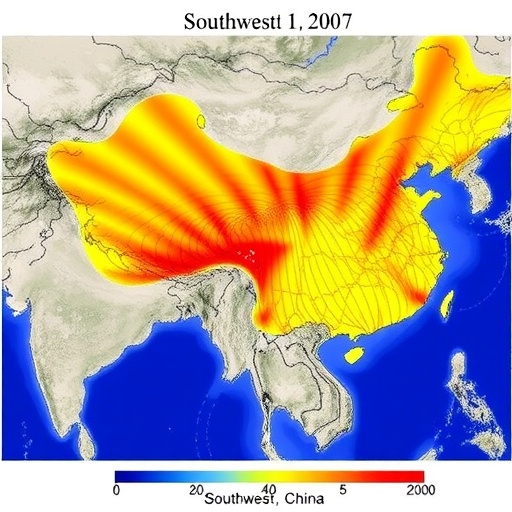
In the realm of earthquake science and engineering, the accurate prediction of strong ground motions following seismic events remains a critical yet challenging endeavor. This challenge is particularly pronounced in tectonically intricate zones like the Sichuan–Yunnan region of southwest China. The complexity of the Earth’s crust in such regions complicates efforts to reliably simulate expected ground shaking, a key factor in informing emergency responses and guiding seismic risk mitigation initiatives. A newly published study in Science China Earth Sciences delves into this problem by evaluating how varying three-dimensional crustal velocity models can influence the fidelity of ground motion simulations for the notable Mw 6.6 Luding earthquake that struck on September 5, 2022.
Ground motion simulations rely heavily on subsurface velocity models that describe how seismic waves propagate through the Earth’s crust. These models range from simplified one-dimensional (1D) profiles to sophisticated three-dimensional (3D) descriptions that incorporate intricate geological features. Yet, despite advances in crustal modeling, the extent to which these diverse velocity models affect practical, engineering-relevant ground shaking predictions has remained inadequately quantified. The research led by scientists from the Southern University of Science and Technology addresses this knowledge gap by systematically assessing the predictive performance of nine representative velocity models, each constructed using different data sources, resolutions, and modeling methodologies.
Distinct from many previous studies that focus mainly on waveform matching or travel-time accuracy, the team shifts attention onto peak ground velocity (PGV)—a crucial metric for earthquake engineering and damage appraisal. PGV evaluates the maximum speed reached by ground shaking during an earthquake and has a direct correlation with potential structural damage and human perception of shaking intensity. By prioritizing PGV, the study bridges the gap between seismological modeling and practical applications in post-earthquake scenarios, providing insights directly relevant to emergency responders and structural engineers.
The methodology centers on the Luding earthquake, a significant seismic event that offers a realistic testing ground. Researchers employed a finite-fault rupture model derived from detailed seismic observations of the event. Using advanced numerical simulations conducted up to 1 Hz frequency, they calculated PGV distributions based on the nine distinct 3D crustal velocity models. Each model embodies unique assumptions about the Earth’s crustal properties, capturing differences in shallow velocity structure, topographic inclusion, and overall modeling strategies.
Results reveal that while most 3D velocity models can satisfactorily replicate observed PGV values at frequencies below 0.3 Hz, their accuracy diminishes at higher frequencies. This frequency-dependent performance underscores inherent challenges in capturing fine-scale geological heterogeneities and complex wave propagation phenomena. Notably, these 3D models consistently outperform traditional 1D models in predicting both the magnitude and spatial distribution of ground shaking, underscoring the necessity of incorporating three-dimensional structural complexity for realistic simulations.
However, the study identifies persistent discrepancies among individual 3D models. Some models exhibit systematic overestimations of shaking intensity, while others lean toward underestimation. These divergences are attributed primarily to variations in the representation of near-surface velocity structures, the degree to which surface topography is integrated, and differing conceptual approaches to model construction. Such differences highlight the sensitivity of simulation outcomes to nuanced geological characterizations and modeling choices.
A striking insight from the investigation is the demonstrated value of employing a multi-model ensemble approach. By averaging PGV predictions across all nine velocity models, the researchers attained a significantly reduced systematic bias and improved consistency with recorded ground motion observations. This multi-model averaging technique emerges as a pragmatic and robust strategy for rapid post-earthquake assessments, especially in settings where uncertainties in subsurface composition and structure may preclude reliance on any single velocity model.
The implications of these findings extend well beyond the immediate case study. They provide a quantitative framework for selecting and applying crustal velocity models in strong ground motion simulations, with direct relevance to seismic hazard analysis, earthquake engineering design, and emergency management protocols. Furthermore, the multi-model strategy proposed offers a pathway toward enhancing the reliability of shaking intensity forecasts in seismically active regions characterized by complex geology.
An additional contribution of this work lies in its emphasis on practical metrics like PGV rather than purely theoretical waveform concordance, aligning seismological research more closely with engineering and emergency response needs. By evaluating PGV at individual seismic stations as well as aggregating regional shaking patterns, the study presents a comprehensive suite of validation tests that ground motion modelers can adopt to benchmark their own velocity models and simulation frameworks.
In conclusion, this pioneering assessment of diverse 3D crustal velocity models in the context of the 2022 Luding earthquake offers critical insights into the interplay between subsurface modeling choices and ground shaking predictions. It reveals that while no single model is flawless, combining multiple models yields more reliable and actionable information. Such multi-model approaches are poised to play an increasingly central role in earthquake risk mitigation strategies, especially in tectonically complicated regions where seismic hazards are compounded by geological heterogeneity.
This study underscores the necessity of integrating cross-disciplinary expertise in seismology, geophysics, and computational modeling to confront the challenges of earthquake ground motion prediction. The findings advocate for continuous refinement of crustal velocity models, enhanced data acquisition for model construction, and adoption of ensemble modeling strategies as a best practice standard. Ultimately, these advances have the potential to save lives and minimize economic losses by informing more effective earthquake preparedness and response plans.
Future research prompted by this work may explore the integration of machine learning techniques for velocity model optimization, the coupling of strong motion simulations with urban infrastructure models, and real-time applications of multi-model approaches for immediate post-earthquake ground shaking estimation. As seismic hazard modeling progresses towards greater precision, studies like this forge a path toward more resilient societies capable of confronting the unpredictable power of earthquakes.
News Publication Date: Not explicitly provided
Web References: http://dx.doi.org/10.1007/s11430-025-1743-3
References:
Li T, Zhang W. 2026. Assessment of the impact of different 3D crustal velocity models on strong ground motion simulations in the Sichuan-Yunnan region. Science China Earth Sciences, 69(1): 348–365.
Cite Scienmag News
Violet Maxwell. (March 25, 2026). How Updated Velocity Models Refine Earthquake Shaking Forecasts in Southwest China. Scienmag. https://scienmag.com/how-updated-velocity-models-refine-earthquake-shaking-forecasts-in-southwest-china/
Violet Maxwell. "How Updated Velocity Models Refine Earthquake Shaking Forecasts in Southwest China." Scienmag, 25 March 2026, https://scienmag.com/how-updated-velocity-models-refine-earthquake-shaking-forecasts-in-southwest-china/. Accessed 5 September 2026.
Violet Maxwell. "How Updated Velocity Models Refine Earthquake Shaking Forecasts in Southwest China." Scienmag. March 25, 2026. https://scienmag.com/how-updated-velocity-models-refine-earthquake-shaking-forecasts-in-southwest-china/


