


A groundbreaking discovery by a dedicated team of researchers led by Professor XIAO Jun at the Institute of Genetics and Developmental Biology (IGDB) of the Chinese Academy of Sciences illuminates a novel mechanism through which ambient temperature intricately orchestrates plant cell fate via epigenetic regulation. Published in the prestigious journal Developmental Cell, this study reveals how subtle shifts in environmental temperature translate into profound modifications of the plant’s epigenetic landscape, thereby influencing gene activity and ultimately controlling cell identity transitions during development.
Plants, unlike animals, are immobile and therefore have evolved sophisticated systems to respond to their surroundings, using molecular signals to fine-tune gene expression. Central to this adaptive capacity is the role of epigenetic modifications—chemical tags added to histone proteins around which DNA is wound. These tags act as signposts, directing cellular machinery to either activate or repress specific genomic regions, thus determining which sets of genes are expressed at any given stage. In Arabidopsis thaliana, a model organism for plant biology, the transition from embryonic seed to germinated seedling relies heavily on the repression of embryonic genes that are only beneficial during early development.
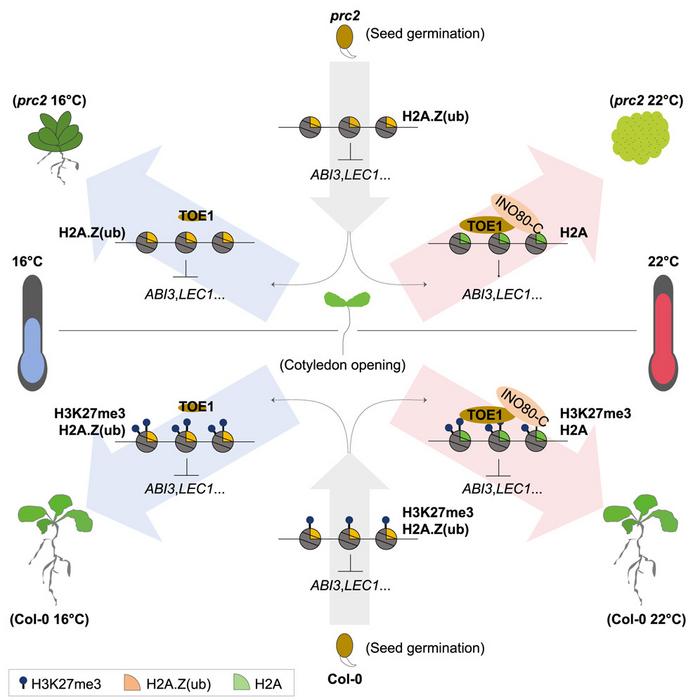
Key to this repression are two groups of protein complexes: Polycomb Repressive Complex 1 (PRC1) and Polycomb Repressive Complex 2 (PRC2). These complexes collaborate to establish a repressive chromatin environment by depositing distinct chemical marks on histone proteins, effectively locking down embryonic genes to prevent their premature or inappropriate activation. PRC2 deposits trimethyl groups on histone H3 at lysine 27 (H3K27me3), a widely conserved repressive mark in eukaryotes, whereas PRC1 ubiquitinates histone H2A and its variant H2A.Z to form H2Aub and H2A.Zub, respectively. Together, these modifications create a multi-layered epigenetic barrier crucial for stable gene silencing.
When either PRC1 or PRC2 function is compromised, this silencing mechanism collapses, lifting repression on embryonic regulators such as LEC1 and ABI3. Consequently, the plant cells begin to revert to a more embryonic, undifferentiated state characterized by callus formation—a phenomenon that resonates with Conrad Waddington’s concept of developmental plasticity. This reactivation underscores the delicacy of epigenetic controls in maintaining the developmental trajectory of cells.
Remarkably, this study uncovers an unexpected twist: lowering the ambient temperature to 16℃ partially ameliorates the developmental defects associated with loss of PRC2. Employing a combination of transcriptome profiling, epigenomic mapping, and genetic manipulations, the researchers identified the transcription factor TOE1 as a pivotal node bridging temperature cues and chromatin modifications. TOE1 normally interacts with the INO80-C chromatin remodeling complex to evict H2A.Z from nucleosomes at embryonic gene loci, facilitating their silencing during normal germination.
At lower temperatures, however, TOE1 expression is markedly decreased. This downregulation impairs the removal of H2A.Z, causing its accumulation along the embryonic gene regions. Intriguingly, PRC1 capitalizes on this accumulation by ubiquitinating H2A.Z to form H2A.Zub, introducing a new form of repressive mark that compensates for the absence of PRC2-mediated H3K27me3 deposition. This cross-talk between temperature-modulated transcriptional regulators and chromatin remodelers redefines the capacity for environmental factors to substitute or complement canonical epigenetic pathways, thus safeguarding developmental fidelity under stress.
The interplay between temperature, transcription factors like TOE1, and chromatin remodelers paints a dynamic portrait of epigenetic plasticity that is far from rigid. It highlights how external environmental variables can recalibrate the epigenetic landscape in real-time to maintain cellular identity, expand developmental robustness, and even promote regenerative potential. This nuanced understanding challenges the long-held notion of the genome as a static blueprint, instead proposing it as a responsive, negotiable system finely attuned to extrinsic and intrinsic signals.
Beyond plant biology, these findings have broader biological implications. The highly conserved nature of the H3K27me3 mark across eukaryotes places it at the core of multicellular differentiation processes, balancing the demand for developmental stability with the flexibility to respond to environmental inputs. In animals, dysregulation of this epigenetic mark is implicated in diseases such as cancer, where aberrant loss of repressive silencing can reawaken stem-like cellular programs. The parallels between plant callus formation and tumorigenesis open intriguing avenues for translational research, suggesting that insights from plant epigenetics might inform novel therapeutic strategies in oncology.
Practically, this work offers a promising avenue for agricultural biotechnology. By manipulating culture temperatures, it may be possible to optimize callus differentiation and improve crop regeneration efficiencies, addressing key bottlenecks in plant breeding and genetic engineering. Understanding the molecular circuitry that ties ambient temperature to epigenetic regulation thus becomes crucial for designing next-generation climate-resilient crops and biotechnological applications.
The study also underscores the essential roles played by protein complexes such as PRC1, PRC2, and chromatin remodelers like INO80-C in maintaining epigenomic integrity. The discovery of H2A.Zub as a novel repressive entity not only enriches our comprehension of chromatin dynamics but also challenges researchers to revisit the functional diversity of histone variants and their modified forms. Future research will undoubtedly explore how widespread this temperature-dependent epigenetic switch is among other plant species and beyond.
Moreover, the methodological approach adopted by Professor XIAO Jun’s team—integrating transcriptomic and epigenomic datasets with targeted genetic disruptions—demonstrates the power of systems biology to unravel complex regulatory networks. Their findings contribute to a paradigm shift that situates epigenetic modifications at the interface between environment and development, forging a richer understanding of plant adaptation and morphogenesis.
This research, supported by multiple national funding agencies including the Beijing Natural Science Foundation Outstanding Youth Project and the National Key Research and Development Program of China, exemplifies cutting-edge bioscience at the intersection of genetics, epigenetics, and environmental biology. It elegantly deciphers how a seemingly mundane factor like temperature can evoke intricate molecular choreography, revealing fresh layers in the regulation of cell fate.
Ultimately, the revelations about ambient temperature’s role in controlling histone modifications and thereby gene silencing deepen our grasp of developmental biology and epigenetic flexibility. They highlight nature’s capacity to seamlessly integrate external cues into the internal genome regulatory grammar, ensuring survival and continuity of life forms amidst fluctuating environments. As epigenetics continues to reshape our understanding of biology, this study stands out as a transformative contribution promising to inspire new research directions across multiple disciplines.
News Publication Date: 22-Apr-2025
Web References: https://doi.org/10.1016/j.devcel.2025.04.002
Cite Scienmag News
Juliet Wilcox. (April 28, 2025). How Temperature Directs Plant Cell Fate via Epigenetic Reprogramming. Scienmag. https://scienmag.com/how-temperature-directs-plant-cell-fate-via-epigenetic-reprogramming/
Juliet Wilcox. "How Temperature Directs Plant Cell Fate via Epigenetic Reprogramming." Scienmag, 28 April 2025, https://scienmag.com/how-temperature-directs-plant-cell-fate-via-epigenetic-reprogramming/. Accessed 7 September 2026.
Juliet Wilcox. "How Temperature Directs Plant Cell Fate via Epigenetic Reprogramming." Scienmag. April 28, 2025. https://scienmag.com/how-temperature-directs-plant-cell-fate-via-epigenetic-reprogramming/


