


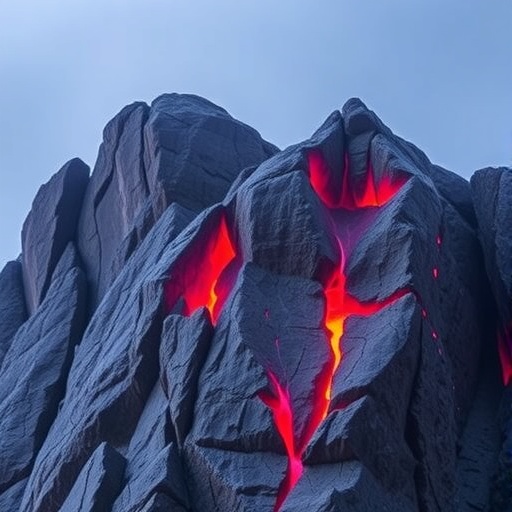
As the Earth’s crust endures relentless stresses, rocks silently communicate their structural distress through subtle chemical whispers long overlooked. A pioneering study by an international consortium of geoscientists has decoded these cryptic signals, establishing for the first time a quantitative framework linking the fluctuating emissions of naturally occurring nuclides to the progressive deformation and ultimate failure of rocks. These revelations herald a transformative advance toward forecasting catastrophic geological events such as landslides, earthquakes, and volcanic eruptions.
The research, spearheaded by Xin Luo of Hong Kong University, Yifeng Chen of Wuhan University, and Michael Manga of the University of California, Berkeley, bridges a critical gap that has challenged earth scientists for decades: parsing the relationship between transient geochemical anomalies—alpha and beta-emitting nuclides like radon, helium, and thoron—and the underlying mechanical processes that precipitate rock rupture. Prior empirical observations of nuclide fluctuations lacked an integrative theoretical underpinning to reliably interpret the signals in the context of rock mechanics. The new computational model offers a robust quantitative method to analyze these signals, thus allowing for real-time inferences about subsurface structural integrity.
At its core, the model characterizes rock failure as a four-stage process—crack initiation, crack opening, crack dilation, and crack propagation—each producing distinct patterns in nuclide signal intensity and variability. Until now, deciphering these phases remotely was virtually impossible. As microscopic fractures nucleate and evolve, trapped nuclide-rich gases accumulate and diffuse through an increasingly interconnected pore network, leading to characteristic pulses and anomalies detectable even on the surface. By simulating this coupled physicochemical system, the team demonstrated how incremental mineral lattice disruptions translate into measurable geochemical emissions, a breakthrough that promises early detection of catastrophic rock failure.
Laboratory experiments provided vital calibration for the model. Data from long-term radon monitoring of a stressing granite cylinder revealed consistent signal trends mirroring progressive rock deformation under controlled mechanical loading. Complementary field measurements from a three-year radon emission study on a bedrock hillside in the French Alps—an area influenced by seasonal reservoir water level changes—validated the model in a complex natural setting. Despite inherent environmental noise and hydrological variability, the model precisely captured the evolving anomalies corresponding to the dynamic stress regime of the rock mass.
This synthesis of theoretical modeling and empirical observation underscores significant practical implications. Rock instability adjacent to critical infrastructure, such as hydropower stations and urban reservoirs, can now be surveilled via geochemical precursors, enabling proactive hazard mitigation. The Three Gorges Reservoir Region in China exemplifies this, where radon monitoring installations housed within tunnels excavated directly inside landslide masses provide unprecedented in situ data reflecting subsurface dynamics with fine temporal resolution.
Moreover, the study elucidates how auxiliary factors, including the presence of deep-seated thermal fluids or saline brines, modulate nuclide release profiles. Such fluids enhance both the generation and transmission of radiogenic gases, confounding signal interpretation without accounting for geochemical fluid-rock interactions. Future research aims to refine the model by integrating hydrodynamic and thermochemical coupling effects to better distinguish structural versus fluid-driven signal components.
Another avenue the authors emphasize is enhancing the temporal fidelity of nuclide signal interpretation. While the current framework faithfully reproduces stages of rock degradation, accurately constraining the time lags associated with nuclide generation, migration, and surface detection remains an open challenge. Attaining higher temporal resolution is pivotal for transitioning this technique from a research tool to a reliable, operational early warning system, capable of alerting to imminent rock failure with actionable lead times.
The multidisciplinary collaboration underpinning this breakthrough seamlessly marries expertise spanning geochemistry, rock mechanics, computational modeling, and field geophysics. The confluence of analytical rigor and innovative observation strategies signals a new era in earth hazard science, wherein chemical signals beneath our feet shed light on the ominous transformations presaging geological disasters. The authors’ deployment of radon monitoring stations across multiple Chinese sites—such as the Huangtupo landslide near Three Gorges and slopes near Xiluodu Hydropower Station—unfolds a thrilling chapter in continuous geohazard surveillance.
Ultimately, this research opens compelling prospects for revolutionizing risk assessment methodologies in rock engineering and natural hazard management. By harnessing naturally emitted nuclides as silent sentinels of internal rock health, scientists envision the integration of geochemical diagnostics into comprehensive monitoring networks. Such systems could inform infrastructure design, emergency preparedness, and resilience planning, mitigating the devastating human and economic toll of rock-induced disasters worldwide.
Published in the prestigious journal Proceedings of the National Academy of Sciences on April 9, 2026, this seminal work embodies a leap forward in applied geoscience. As the team refines their innovative model and expands observational arrays, the vision of reliably predicting rock rupture via natural chemical signals moves ever closer to reality. Their journey heralds an era where earth’s restless interior no longer remains inscrutable but instead offers invaluable warnings through the subtle language of nuclides.
News Publication Date: 9-Apr-2026
Web References: http://dx.doi.org/10.1073/pnas.2602434123
References:
- PNAS Article
- Prior radon emission studies referenced from Earth and Planetary Science Letters and Nature
Cite Scienmag News
Violet Maxwell. (April 22, 2026). How Rock “Sighs” Reveal Stress and Could Predict Geohazards. Scienmag. https://scienmag.com/how-rock-sighs-reveal-stress-and-could-predict-geohazards/
Violet Maxwell. "How Rock “Sighs” Reveal Stress and Could Predict Geohazards." Scienmag, 22 April 2026, https://scienmag.com/how-rock-sighs-reveal-stress-and-could-predict-geohazards/. Accessed 5 September 2026.
Violet Maxwell. "How Rock “Sighs” Reveal Stress and Could Predict Geohazards." Scienmag. April 22, 2026. https://scienmag.com/how-rock-sighs-reveal-stress-and-could-predict-geohazards/


