


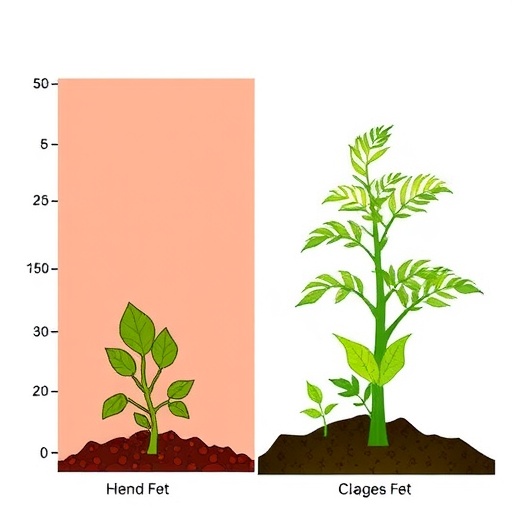
As global temperatures steadily climb and unpredictable heat waves become an ever-more common threat, the imperative to understand how plants endure and adapt to extreme heat stress has never been greater. Recent advancements highlight the remarkable capacity of plants to perceive and respond to elevated temperatures not only at the cellular level but also throughout whole organisms, enabling survival under conditions that would otherwise be detrimental. This emerging field unravels a sophisticated network of molecular sensors, signaling pathways, transcriptional regulators, and genomic reprogramming tailored to mitigate the negative impacts of heat stress, crucially informing strategies to protect global agriculture.
At the forefront of plant heat stress research is the discovery of the molecular mechanisms plants employ to detect increased temperatures. Unlike animals, plants cannot escape adverse conditions, compelling them to develop intricately sensitive systems to gauge thermal changes. This thermosensation involves specialized protein complexes and membrane components that respond to temperature fluctuations. Upon sensing heat stress, these sensors initiate a cascade of intracellular signaling events, leading to a robust reconfiguration of gene expression tailored to protect cellular integrity and function.
A pivotal component in this transcriptional reprogramming is the family of heat shock factor (HSF) transcription factors found across eukaryotes. These transcription factors act as master regulators, orchestrating the activation of heat-responsive genes that encode for molecular chaperones and other protective proteins. The regulation of HSFs is remarkably nuanced: their activity is fine-tuned through post-translational modifications, oligomerization states, and interactions with other cellular factors, enabling plants to calibrate the magnitude and duration of the heat stress response according to the severity and persistence of the stimulus.
Remarkably, the cellular response to heat shock transcends straightforward transcription activation and integrates complex chromatin remodeling events. Recent evidence has uncovered that heat stress triggers dynamic changes in chromatin architecture, making certain genomic loci more accessible to transcription machinery. This remodeling not only facilitates rapid gene expression changes during stress but also contributes to the establishment of a form of “molecular memory,” allowing plants to recall prior heat exposure and mount a faster, heightened response upon subsequent heat events.
This chromatin-based memory mechanism is interpreted as an epigenetic phenomenon involving histone modifications and nucleosome repositioning. Such epigenetic marks can persist beyond the acute stress episode, influencing gene expression in progeny cells and even across generations. This transgenerational inheritance of heat stress tolerance highlights an evolutionary advantage whereby plants can pre-adapt offspring to increasingly hostile environments, emphasizing the plasticity and resilience embedded in plant genomes.
Adding further complexity to heat stress signaling is the formation of biomolecular condensates—phase-separated intracellular compartments that dynamically assemble in response to heat. These condensates serve as hubs concentrating specific proteins and nucleic acids, facilitating efficient signaling, RNA metabolism, and protein homeostasis under thermal stress. The condensation of HSFs and other factors into these membraneless organelles represents a novel regulatory layer that modulates plant responses with spatial and temporal precision, an exciting area of current investigation.
Moreover, heat stress responses intertwine with a plant’s hormonal balance and environmental cues beyond temperature, such as light intensity, water availability, and nutrient status. This integration ensures that plants tailor their acclimation strategies holistically, optimizing survival and growth under fluctuating conditions. Cross-talk between heat signaling pathways and those governing developmental processes or biotic stress responses exemplifies the interconnectedness underlying plant adaptability.
Fundamental to these processes is the ability of plants to allocate metabolic resources efficiently during heat stress. The production of heat shock proteins (HSPs), antioxidants, and osmoprotectants consumes significant energy, necessitating tight regulation to balance stress responses with growth and reproduction. Plants achieve this balance by modulating cellular energy sensors and altering metabolic fluxes, a fine equilibrium critical for maintaining fitness under constant environmental pressures.
The implications of this expanding knowledge base extend far beyond academic curiosity; they present transformative opportunities for agriculture in the face of climate change. By elucidating the pivotal molecular players and regulatory networks that facilitate heat tolerance, researchers can harness these insights to engineer or breed crop varieties with enhanced resilience. Such innovations could safeguard yields and contribute to global food security in an era defined by climatic volatility.
Technological advances in genomics, transcriptomics, and live-cell imaging have fueled this burgeoning field, offering unprecedented resolution of heat stress dynamics at multiple biological scales. Single-cell approaches reveal heterogeneity in heat sensing and responses even within tissues, positioning researchers to identify key cell types and regulatory nodes most pivotal for acclimation. Likewise, the integration of synthetic biology tools permits the design of precise gene circuits that modulate heat stress pathways on demand.
Looking ahead, unraveling the interplay between heat stress responses and other abiotic stresses—including drought and salinity—remains a major frontier. Many stress pathways converge or intersect, suggesting that multifaceted breeding approaches targeting shared signaling hubs could yield crops with broad-spectrum tolerance. Additionally, understanding how natural variation in heat stress acclimation arises among diverse plant species and populations can inform strategies for utilizing wild relatives and landraces in crop improvement.
In conclusion, the molecular dance orchestrating plant acclimation to heat stress exemplifies nature’s ingenuity and resilience. As biochemical sensors detect rising temperatures, a sophisticated signaling web mobilizes transcription factors, restructures chromatin landscapes, and forms dynamic biomolecular condensates to reprogram gene expression and cellular states. This adaptive plasticity is further enhanced by epigenetic memory and intricate hormonal and metabolic coordination, empowering plants to not only survive but thrive amid thermal challenges.
Harnessing these principles through biotechnology and breeding holds promise to secure agricultural productivity as global climates continue to warm. The convergence of molecular biology, genomics, and environmental science thus lays a critical foundation for developing next-generation crops capable of meeting humanity’s mounting food demands in a hotter world. With each discovery, the blueprint of plant resilience becomes clearer, illuminating paths toward sustainable and climate-resilient agriculture.
By decoding the fundamental mechanisms of heat sensing, signal transduction, and transcriptional regulation, scientists are redefining our ability to intervene and enhance natural stress tolerance pathways. Novel insights into phase separation and chromatin memory shift longstanding paradigms and open avenues for innovative interventions. The future of heat stress research stands at a thrilling intersection of basic discovery and applied solutions, offering tools that could redefine the relationship between plants and their increasingly challenging environments.
This comprehensive understanding not only underscores the urgency of climate action but also celebrates plant biology’s adaptive brilliance. As we peer into plant cells under heat duress, the elegant choreography of molecular actors unfolds—each movement finely tuned by millions of years of evolution. In this unfolding narrative, plants emerge as dynamic, responsive organisms with immense potential to adapt and persist, a beacon of hope in a warming planet.
Cite Scienmag News
Juliet Wilcox. (May 22, 2026). How Plants Adapt: Heat Stress Acclimation Explained. Scienmag. https://scienmag.com/how-plants-adapt-heat-stress-acclimation-explained/
Juliet Wilcox. "How Plants Adapt: Heat Stress Acclimation Explained." Scienmag, 22 May 2026, https://scienmag.com/how-plants-adapt-heat-stress-acclimation-explained/. Accessed 3 September 2026.
Juliet Wilcox. "How Plants Adapt: Heat Stress Acclimation Explained." Scienmag. May 22, 2026. https://scienmag.com/how-plants-adapt-heat-stress-acclimation-explained/


