


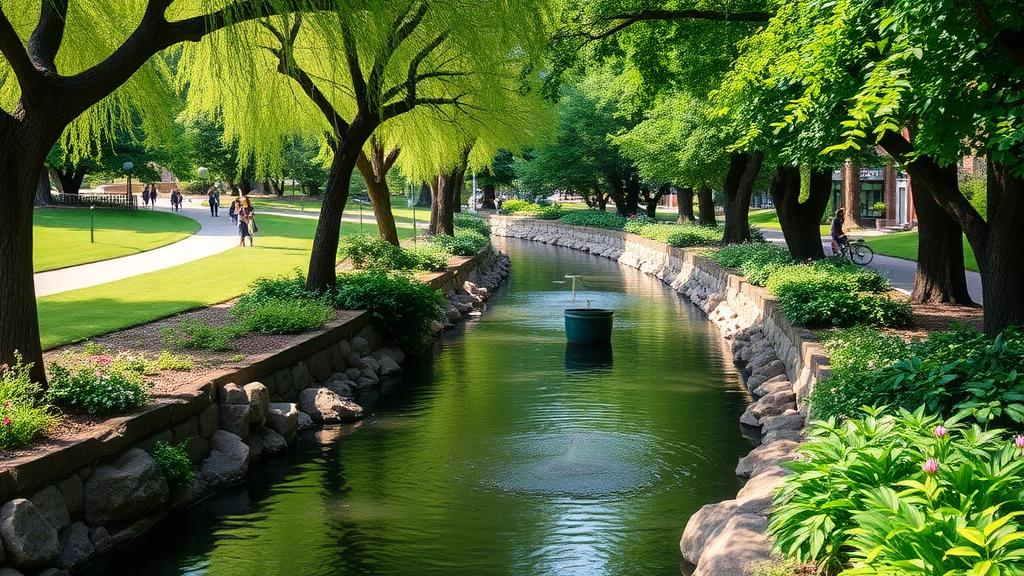
There is a reason a walk along a tree-lined river feels different from a stroll down a busy commercial street, and a new synthesis published in Current Psychology argues that the difference is far more than aesthetic preference. In a narrative review integrating environmental psychology, public health and urban studies, Zhe Jiang of Jiangsu Normal University and Yanjie Wu of the Xuzhou Literary and Art Development Center propose a unified framework of landscape-mediated well-being, one that traces how the physical structure of public spaces translates into measurable psychological and physical health outcomes. Their central claim is deceptively simple but consequential for city planners: the health effects of landscapes do not emerge from beauty alone, but from the interaction between environmental stimuli, psychological processes and human behaviour.
The review organises the sprawling literature on green and blue spaces into three interconnected domains. The first concerns environmental structural qualities, the objective features of a landscape such as biodiversity richness, vegetation complexity, spatial connectivity, the presence of water, and multisensory characteristics that engage sight, sound, smell and even touch. The second domain covers psychological mediation processes, the internal mechanisms through which these features are converted into restorative effects, including attentional recovery, stress reduction and emotional regulation. The third and, in the authors’ framing, most underappreciated domain comprises socio-behavioural pathways: the ways landscapes actively shape what people do, from walking and exercising to socialising and volunteering. It is the dynamic coupling of all three domains, rather than any single ingredient, that the model treats as the true engine of well-being.
The theoretical backbone of the synthesis draws on three complementary perspectives that have dominated restorative-environments research for decades. Attention Restoration Theory, developed originally by Rachel and Stephen Kaplan, holds that natural settings engage our involuntary attention in an effortless way, allowing the depleted directed-attention system that we rely on for work and concentration to recover. Stress Reduction Theory, advanced by Roger Ulrich, emphasises a faster, more primal psychophysiological response: exposure to certain natural scenes triggers an almost immediate decline in negative affect and physiological arousal. The Stimulus–Organism–Response framework, borrowed from environmental psychology’s broader tradition, supplies the connective tissue, describing how environmental stimuli act on an organism’s internal cognitive and affective states, which in turn drive approach or avoidance behaviour. Jiang and Wu’s contribution is to slot behavioural responses into this chain not as an endpoint but as a mediating mechanism in its own right.
That conceptual move matters because a growing body of empirical work shows that what a landscape makes people do may matter as much as how it makes them feel. Physical activity is the clearest example. Greenways, parks and waterfronts provide settings that invite walking, cycling and play, and systematic reviews of urban green and blue infrastructure consistently identify increased physical activity as a major pathway linking these spaces to better cardiovascular and mental health. A park that is beautiful but inaccessible, poorly connected to pedestrian networks, or perceived as unsafe will fail to generate the very behaviours through which its restorative potential is realised. Spatial connectivity, in this framework, is not a design nicety; it is a precondition for the health benefit to materialise.
Social interaction forms a second behavioural channel with its own evidence base. Studies across four European cities have examined how neighbourhood green space shapes the social environment and, through it, mental health, while sensitivity analyses of green-space characteristics in European cities have linked specific qualities of these spaces to social cohesion and psychological outcomes. Place attachment, the emotional bond people form with particular settings, and community participation in the stewardship of parks and gardens extend this pathway further, connecting environmental design to social capital and collective efficacy. In Jiang and Wu’s model, these behavioural and social responses amplify the direct psychological effects of greenery and water, creating a feedback loop in which well-used public spaces become more valued, better maintained and more restorative over time.
The review also underscores that not all green space is created equal, a conclusion supported by experimental and observational studies alike. Research on urban green space has shown that biodiversity predicts the psychological restorative benefits people derive from a site, suggesting that ecologically richer environments deliver measurably greater gains in well-being than simplified mown grass. Vegetation complexity, the layering of trees, shrubs and ground cover, appears to matter for both perceived naturalness and restorative potential, and studies of green-space naturalness have linked it to public well-being in ways relevant to designing healthier cities. Field experiments on urban blue spaces, including within-subject designs comparing physiological and psychological responses across settings, indicate that water features confer restoration benefits that are partly distinct from those of vegetation, while meta-analytic work on blue space has catalogued the mechanisms, from physical activity to psychological restoration, through which rivers, lakes and coasts affect health.
Multisensory design emerges as another frontier. A systematic review of public urban space found that combined multisensory effects, the orchestrated interplay of visual, auditory, olfactory and tactile stimuli, can enhance restoration beyond what visual quality alone achieves, and studies in Edinburgh’s diverse urban environments have explored multi-sensory approaches to psychological well-being in green space. This has practical implications: the sound of running water, the scent of flowering plants and the texture of natural materials are not decorative afterthoughts but active components of a restorative environment. Even small interventions, such as pocket parks in densely populated areas, have been shown to influence perception, preference and psychological well-being, offering a scalable strategy for cities where large parks are impractical.
The public health stakes of this literature are considerable. The World Health Organization has formally recognised green and blue spaces as determinants of mental health, and researchers publishing in The Lancet Public Health have called for advancing the contribution of urban green and blue space to population health. Reviews of cognitive function have begun mapping mechanistic pathways from green and blue exposure to improved cognition, and studies of stress resilience in real-world settings have assessed how blue-green infrastructure buffers the physiological toll of urban life. Equity is a recurring theme in this literature: because access to high-quality green space is unevenly distributed, the health benefits documented in these studies risk accruing disproportionately to wealthier neighbourhoods, making landscape design a matter of environmental justice as well as aesthetics.
Jiang and Wu are candid about the limitations of the current evidence base, and their prescriptions for future research are among the most useful parts of the synthesis. Much of the literature remains cross-sectional, relying on self-reported well-being and correlational designs that cannot cleanly separate cause from effect. The authors argue that the field should move toward longitudinal, experimental and cross-cultural studies that incorporate objective physiological and behavioural measures, such as wearable sensors, biomarkers of stress and direct observation of park use, in order to quantify causal relationships more precisely. Cross-cultural validation is particularly important given that preferences for landscape types, perceptions of safety and patterns of park use vary substantially across societies, meaning that design principles validated in one region may not transfer unexamined to another.
For urban planners and landscape architects, the framework offers a practical checklist grounded in evidence rather than intuition. Design for ecological richness and structural complexity, not just greenery coverage. Connect green and blue spaces into continuous, walkable networks. Engage multiple senses deliberately. And, crucially, design for behaviour: provide the affordances, safety, shade, seating, water access and programming that turn a passive landscape into a stage for physical activity, social encounter and community life. The health of a city’s population, this synthesis suggests, is written into the geometry of its streets and the ecology of its parks, and the most effective prescriptions are those that treat people not as passive viewers of scenery but as active participants in the environments that heal them.
Subject of Research: Environmental psychology of how urban green and blue landscapes influence human health through psychological and behavioural pathways
Article Title: Environmental psychology and behavioral response for creating public spaces and landscapes impacting human health
Article References: Jiang, Z., & Wu, Y. (2026). Environmental psychology and behavioral response for creating public spaces and landscapes impacting human health. Current Psychology, 45(19), Article 1557. https://doi.org/10.1007/s12144-026-10111-x
Image Credits: AI Generated
DOI: 10.1007/s12144-026-10111-x
Keywords: environmental psychology, urban green space, blue space, restorative environments, attention restoration theory, stress reduction theory, physical activity, social cohesion, biodiversity, urban planning, public health, well-being
Cite Scienmag News
Glenn Wilkins. (October 1, 2026). How Parks, Rivers and Green Streets Quietly Rewire Our Brains and Bodies. Scienmag. https://scienmag.com/how-parks-rivers-and-green-streets-quietly-rewire-our-brains-and-bodies/
Glenn Wilkins. "How Parks, Rivers and Green Streets Quietly Rewire Our Brains and Bodies." Scienmag, 1 October 2026, https://scienmag.com/how-parks-rivers-and-green-streets-quietly-rewire-our-brains-and-bodies/. Accessed 4 October 2026.
Glenn Wilkins. "How Parks, Rivers and Green Streets Quietly Rewire Our Brains and Bodies." Scienmag. October 1, 2026. https://scienmag.com/how-parks-rivers-and-green-streets-quietly-rewire-our-brains-and-bodies/


