


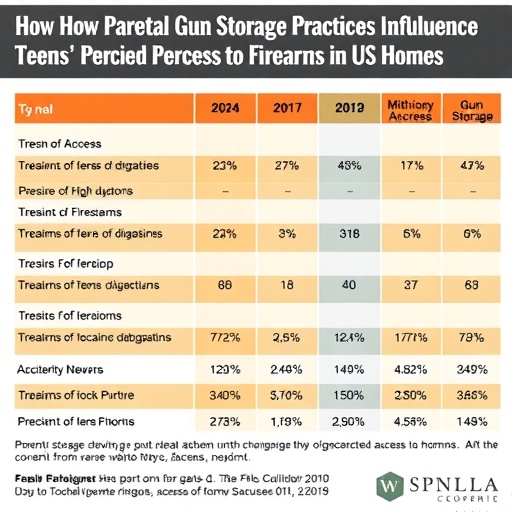
A groundbreaking new study published in JAMA Network Open challenges conventional assumptions about firearm safety in American households, highlighting critical discrepancies between parental reports of firearm storage and teenagers’ perceptions of access. The research, led by Katherine G. Hastings, MPH, exposes the complexity underlying adolescent access to guns and raises important questions about the effectiveness of standard safety interventions aimed at preventing youth firearm exposure and potential injury.
For decades, public health efforts around firearm injury prevention have emphasized the importance of securely storing firearms—keeping them locked, unloaded, and inaccessible to minors. This study, however, reveals that such strategies might not reliably translate into teenagers’ actual sense of access to firearms within their own homes. Investigating multiple variables including adolescent gender, parental education levels, and urban versus rural residency, researchers found that young people often believe they can obtain and load household guns even when parents report strict safety storage practices.
The implications of this research are profound. It suggests that the presence of a single unlocked firearm in a home can negate the perceived safety of secure storage practices surrounding other guns. This undermines the effectiveness of partial compliance with safe storage recommendations and emphasizes the need to revisit current messaging protocols. Parents who believe they have mitigated risk by locking away some firearms may unintentionally underestimate their teen’s perceived ability to access unsecured ones, potentially contributing to a preventable public health hazard.
Methodologically, the study tapped into parent-teen dyads, collecting data on reported firearm storage behaviors from caregivers alongside direct assessments of adolescents’ perceived ease of accessing household firearms. By meticulously parsing these dual perspectives, the researchers were able to identify significant inconsistencies that have remained largely unexplored in prior firearm safety research. This approach sheds new light on the behavioral and psychological dimensions of teen firearm access—domains traditionally overlooked in favor of more mechanical storage interventions.
Further detailed analyses considered the sociological variables that might modulate these perceptions, such as gender differences in teenagers and varying educational backgrounds of parents. Results demonstrated that the mismatch between reported storage and adolescent perception was consistent across these demographics, indicating that the phenomenon is widespread and not confined to specific subpopulations. This universality magnifies the urgency of addressing the issue through improved educational and policy frameworks.
Urbanicity—whether a family resides in a metropolitan area or a more rural setting—also did not significantly influence the disconnect between reported storage practices and teen firearm access perceptions. This finding challenges assumptions that urban versus rural cultural differences notably affect firearm safety attitudes or behaviors, instead suggesting common gaps in risk communication and perception across the country.
The scientific community should take particular note of this study’s implication that secure storage of firearms, while necessary, is insufficient alone to mitigate adolescent access risk. Safety interventions must evolve beyond hardware solutions like locks and safes, incorporating educational programs that directly target teens and parents alike to realistically assess and reduce perceived and actual access. These could include family-based counseling, community outreach, and school-based firearm safety curricula attuned to adolescent psychology.
Moreover, the study suggests the potential benefits of comprehensive household firearm safety audits, whereby families systematically identify and secure every firearm, minimizing even a single unsecured weapon’s impact. Such practices require policy support and culturally sensitive public health messaging that resonate with diverse American populations. Bridging the gap between parental intentions and adolescent perceptions is critical to crafting effective prevention strategies that save lives.
In terms of public health implications, reducing accidental firearm injuries and deaths among teenagers remains a pressing challenge in the United States, where firearm-related fatalities are a leading cause of adolescent mortality. This new evidence illuminates a heretofore underrecognized mechanism by which teenagers continue to access guns in supposedly secure environments, underscoring a latent threat under current safety paradigms.
The study’s senior author, Katherine G. Hastings, MPH, stresses the necessity of reevaluating firearm storage recommendations in light of these findings. “Security measures are paramount, but our data reveal that locking up some guns while leaving others unsecured still leaves teens feeling able to access firearms,” Hastings notes. “This realization should drive a more comprehensive approach that integrates both physical storage and family communication about firearm risks.”
Taken together, these insights prompt a reconsideration of policy approaches at both state and federal levels, including the potential for legislation mandating universal secure storage of all household firearms. Additionally, the findings advocate for enhanced funding and prioritization of adolescent-focused firearm injury prevention research, aiming to develop nuanced, multilayered strategies addressing psychological, social, and environmental influences on teen firearm access.
In conclusion, this study fundamentally challenges the notion that parental reports of locked and unloaded firearms reliably predict adolescent firearm access perceptions. It calls for an urgent expansion of safety efforts to encompass complete firearm security and transparent family dialogues about the real risks posed by household firearms. Adoption of such evidence-based, multidimensional strategies is essential for meaningful progress in reducing youth firearm injuries and fatalities in the United States.
News Publication Date: Not provided
Web References: Not provided
References: (doi:10.1001/jamanetworkopen.2025.14443)
Cite Scienmag News
Courtney Benton. (June 10, 2025). How Parental Gun Storage Practices Influence Teens’ Perceived Access to Firearms in US Homes. Scienmag. https://scienmag.com/how-parental-gun-storage-practices-influence-teens-perceived-access-to-firearms-in-us-homes/
Courtney Benton. "How Parental Gun Storage Practices Influence Teens’ Perceived Access to Firearms in US Homes." Scienmag, 10 June 2025, https://scienmag.com/how-parental-gun-storage-practices-influence-teens-perceived-access-to-firearms-in-us-homes/. Accessed 3 September 2026.
Courtney Benton. "How Parental Gun Storage Practices Influence Teens’ Perceived Access to Firearms in US Homes." Scienmag. June 10, 2025. https://scienmag.com/how-parental-gun-storage-practices-influence-teens-perceived-access-to-firearms-in-us-homes/


