


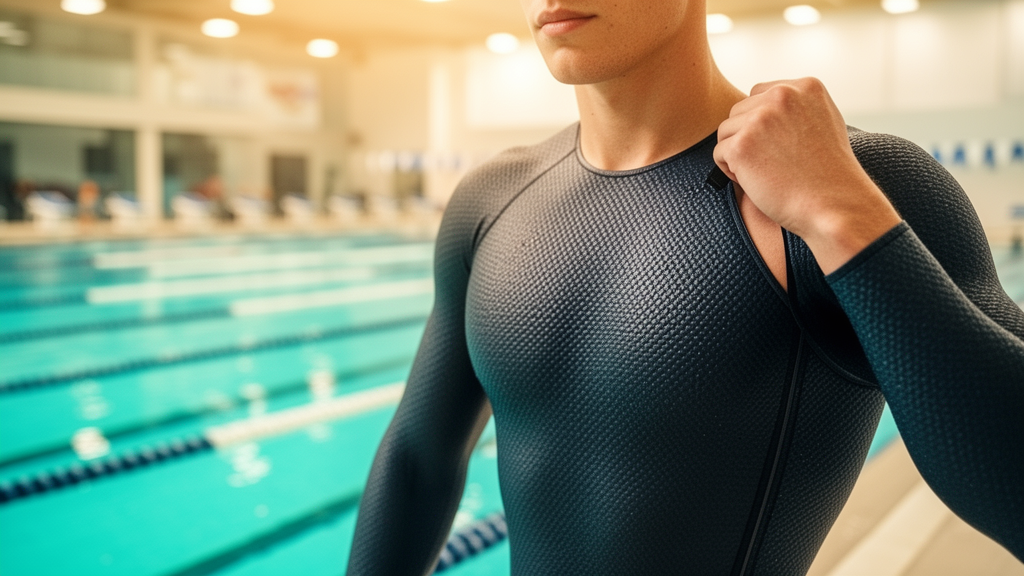
At the 2008 Beijing Olympics, swimmers wearing the Speedo LZR Racer were associated with 23 new world records out of 25 events and won 94 percent of the races, according to an industry review. The suits, made from woven elastane-nylon and polyurethane, provided artificial buoyancy that World Aquatics, then known as FINA, banned in 2009. Yet the story did not end there. A new review published in Frontiers in Sports and Active Living by Shengxuan Yuan of Beijing 21st Century School synthesizes the materials science and engineering principles behind the post-2010 generation of high-performance competitive swimsuits, showing how modern suits now pursue speed through surface engineering and body compression rather than material-driven buoyancy.
The review examines the current long-course world records as ratified by World Aquatics in August 2026 and finds an uneven pattern: 34 of the 40 current records have been reset since 2010, but six set during the 2008-09 non-textile-suit era still stand. That the sport has moved on in most events, yet not in these six, indicates that the swimwear of that period conferred an advantage large enough to outlast more than 15 years of subsequent advances in training, biomechanics, and nutrition. Those suits are no longer permitted, and no comparable margin should be expected from a textile garment. The question is therefore which factors can still contribute to performance under current regulations, where the scope for improvement lies primarily in surface engineering and body compression rather than in material buoyancy.
Yuan’s analysis begins with the physics of drag. In competitive swimming, race outcomes are largely decided by velocity, which depends on the swimmer’s power output, propelling efficiency, and a drag constant. The active drag force opposing forward motion increases with the square of swimming velocity, and the same biomechanical analysis divides this drag into three components. Friction drag arises from the friction between the wetted body or suit surface and the water. Pressure drag, which dominates at the high Reynolds numbers prevailing in competitive swimming, is governed mainly by the body’s frontal cross-sectional area. Wave-making drag results from the water surface deforming into a bow wave and grows steeply as speed increases. High-performance competitive swimsuits act chiefly on the first two components: surface engineering of the fabric reduces friction drag, and body compression reduces pressure drag by streamlining the body’s form. Wave-making drag is governed largely by swimming velocity, body height, and body position, and is therefore little affected by suit materials.
The review then turns to fiber composition. Nylon, a polyamide polymer, offers high tensile strength, good abrasion resistance, and superior moisture resistance, but it lacks the ability to resist chlorine or UV radiation. Polyester is extremely durable and highly resistant to common pool chemicals, though it is usually too stiff or less comfortable against the skin. Elastane, a synthetic linear macromolecule composed of no less than 85 percent polyurethane segments, is lightweight, fast-drying, and highly elastic, stretching up to five times its length and returning to its original shape. Because no single fiber is optimal for every requirement, scientists blend several kinds to synthesize hybrid fiber composites. A general consensus in the industry regarding the proportions of the constituent fibers points to blends of 80 percent nylon plus 20 percent elastane or 80 percent polyester plus 20 percent elastane, providing better elasticity and durability. However, for elite-level sprinting where maximized compression is the primary goal, leading producers like Speedo, Arena, and TYR have pushed the boundary to around 65:35 or 70:30 ratios of nylon to elastane.
Knitting techniques also matter. Warp knitting, in which each warp yarn forms loops oriented along the length of the fabric, is the most common and best choice for swimwear fabrics according to an industrial report cited in the review. Composite materials produced using warp knitting show better tensile resistance than those produced using weft knitting, meaning warp-knitted swimsuits can form a stronger compression structure for athletes. Industrial reports further suggest that warp knitting offers improved durability, stronger structural integrity, exceptional stretch recovery, and high fabric stability compared with weft knitting. Manufacturers also adopt microfibers with fineness typically below 1 denier. Such a minute diameter results in a high aspect ratio, which provides higher packing density. High packing density reduces textile porosity and therefore lowers water permeability, helping maintain the hydrophobic behavior of the textile and leading to drag reduction underwater. Carbon fiber reinforcement, as in Arena’s Powerskin series, can reduce muscle oscillation and improve body streamlining without sacrificing flexibility or range of motion.
Surface engineering is the review’s most technically detailed section. A two-step surface modification approach has been developed to enhance the hydrophobicity of polyester fabrics. First, the fabrics are activated, either by chemical saponification using 1 M NaOH at 80 degrees Celsius for 40 minutes or by an atmospheric air-plasma treatment, to create reactive carboxyl and hydroxyl groups on the fiber surface. The activated fabrics are then treated with a 7 percent on-weight-of-fabric amino-silicon micro-emulsion at pH 5, padded to 80 percent wet pick-up, dried at 80 degrees Celsius, and cured at 150 degrees Celsius for 4 minutes. This optimal condition resulted in a significantly increased water contact angle and wettability time of up to 80 minutes, compared to seconds for untreated fabric, along with a dramatic reduction in both wicking distance and percentage. A stable hydrophobic barrier layer was formed without sacrificing the mechanical or chemical properties of the fabric, and treated fabrics demonstrate excellent durability after 20 washing cycles.
For nylon, the dominant base material in most elite-level suits, a three-step chemical modification process has been developed. The fabric is pretreated with 1,2,3,4-butanetetracarboxylic acid to increase the number of reactive carboxyl groups on the surface. Tetrabutyltitanate is then applied to generate nanoscale Ti-O-Ti particles, which significantly increase surface roughness, as confirmed by SEM images showing numerous small particles on the treated fabric. Finally, octadecylamine is used to reduce surface energy through its long alkyl chain. The synergistic treatment resulted in a water contact angle of 134 degrees, compared to approximately 90 degrees with octadecylamine treatment only. The treated fabric also exhibited strong water repellency, rated 85 out of 100, and hydrostatic pressure resistance of 27.64 millibar, with only a slight reduction in tensile strength because of acid hydrolysis. Beyond laboratory methods, commercialized coating techniques such as Lamoral coatings have been applied in Fastskin products, with the latest generation providing water repellency reported to be six times more durable than that of the previous LZR generation.
Biomimetic structures inspired by aquatic animals offer another avenue. Fine rib-like surface geometries with sharp surface ridges, known as riblets and inspired by sharks’ dermal denticles, might reduce drag when aligned either parallel or perpendicular to the flow direction. Surfaces with riblet materials show an increase of approximately 7 percent in their self-propelled swimming speed, as riblets can efficiently delay the occurrence of turbulent vortices, resulting in less momentum transfer and shear stress when aligned in the direction of fluid flow. A second biomimetic structure is inspired by the pit-shaped microstructures found on the aquatic beetle Cybister, which improve hydrodynamic performance by regulating near-wall flow dynamics. In drag measurements on fabric specimens, the hydrophobic small-pit fabric designated as 4# achieved an 84 percent drag reduction at 400 millimeters per second. However, the current long-course world records correspond to average swimming speeds of about 1.4 to 2.4 meters per second, so the measurement was made at well under a third of racing speed. This reduction arises mainly from the Cassie state on the hydrophobic surface, which markedly decreases viscous drag, and from the microvortices generated by the pit structures, which delay flow separation and thereby minimize pressure drag.
Compression systems form the other major pillar. Compression sportswear has been shown in land-based studies to significantly improve speed, endurance, and functional motor performance, possibly by modulating soft tissue movements and restraining muscle oscillations. In competitive swimming, compression can reduce total passive drag by creating an idealized streamlined shape and a smaller frontal area in the water. To obtain such an ideal compression system, manufacturers either incorporate carbon fibers or vary fiber ratios across different areas. The manufacturer of the Speedo Fastskin LZR Pure Intent specifies three fabrics of differing composition for different regions of the same garment: a 65:35 nylon-elastane fabric over the torso in women’s suits or the waist region in men’s suits, and a 75:25 fabric in the leg sections. In six elite female swimmers, the suits producing greater compression ranked highest in performance tests, leading the authors to conclude that compression reduces drag, though the differences were not always statistically significant. It has also been proposed that compressive swimsuits may restrict blood flow, reducing aerobic respiration and prompting the glycolytic system to produce ATP more rapidly, but that proposal is advanced without supporting measurements.
Thermal considerations, sensory comfort, and manufacturing techniques round out the framework. High-performance competitive swimsuits usually do not contain insulating fabrics or coatings, because World Aquatics regulations require the material to be textile fabric with a maximum total thickness of 0.8 millimeters and a permeability of more than 80 liters per square meter per second. A garment that is this thin and permeable offers little scope for thermal insulation, and the water temperature of top swimming competitions must be 25 to 28 degrees Celsius, with even the longest individual pool event completed in about fifteen minutes. The exposure in competition is therefore far warmer and far shorter than the conditions in which cooling impairs performance. On the sensory side, sportswear comfort encompasses physiological, ergonomic, skin sensorial, and psychological aspects, and a systematic review of 32 studies and 1,513 participants reported a mean effect size of d equals 0.47 for mechanical ergogenic aids, effects described as small to moderate. Ultrasonic welding, which uses mechanical vibrations at a frequency of 20 to 40 kilohertz to soften or melt a thermoplastic material at the joint line, creates an impermeable seam without stitch holes, and an industry source reports that adopting ultrasonic welding helps to reduce drag by up to 6 percent. Advanced garment design methods such as 3D body scanning and cutting can improve the fit of the swimsuit to the swimmer’s body and thereby maximize functional performance.
Yuan’s discussion emphasizes that these factors do not operate in isolation but rather function as interdependent and coupled mechanisms. The adoption of microfibers can reduce porosity, support hydrophobic behavior, and thereby reduce underwater drag, while also enhancing comfort through a softer texture. The compression structure can be achieved using carbon fiber, warp knitting, multilayer structures, or a high proportion of elastane, and the use of elastane and warp knitting is also associated with enhanced comfort due to the resulting elasticity. By contrast, very few of the factors impose constraints on one another. Microfibers reduce porosity, which limits heat exchange by lowering water permeability, but due to the importance of microfibers and the fact that thermal regulation plays a relatively less important role in affecting swimmers’ performance, this negative impact could be negligible. The most dominant factors that produce significant enhancement to swimmers’ performance may still be those related to drag exerted on swimmers, such as swimmers’ body shape and the hydrophobicity of swimsuits.
The review also acknowledges limitations. Much of the supporting evidence was obtained under controlled laboratory conditions that differ from actual competition, so the reported effects may not transfer directly to race settings. The 84 percent drag reduction reported for pit-shaped biomimetic microstructures was measured at 400 millimeters per second, well below race speed, and the benefits of hydrophobic surface treatments rest largely on laboratory measures such as water contact angle and a limited number of wash cycles. Scalability is a practical constraint, as translating laboratory-scale surface treatments and biomimetic microstructures into durable, regulation-compliant, mass-produced garments is challenging. Regulatory limits and the absence of a consistent speed benefit for certain surface-modified fabrics further restrict how far these techniques can be realized in practice. Future research directions include nanoparticle and nanostructured coatings, responsive smart textiles such as shape-memory polymers that recover a programmed shape in response to stimuli like body heat, and computational approaches including AI-assisted design and digital-twin modeling of the swimmer-suit interaction. All such directions will require validation under authentic competition conditions, including realistic speeds, motions, and stroke-specific flow environments.
Subject of Research: Materials science and engineering principles behind high-performance competitive swimsuits
Article Title: Factors contributing to high-performance competitive swimsuits: a review from materials science and engineering principles
Article References: Yuan, S. (2026). Factors contributing to high-performance competitive swimsuits: a review from materials science and engineering principles. Frontiers in Sports and Active Living, 8, Article 1902117. https://doi.org/10.3389/fspor.2026.1902117
Image Credits: AI Generated
DOI: 10.3389/fspor.2026.1902117
Keywords: competitive swimsuits, drag reduction, hydrophobic coatings, biomimetic structures, compression garments, warp knitting, surface engineering, World Aquatics regulations, Factors, contributing, high-performance, competitive
Cite Scienmag News
Neil Sanderson. (October 17, 2026). How Materials Science Builds the World’s Fastest Competitive Swimsuits. Scienmag. https://scienmag.com/how-materials-science-builds-the-worlds-fastest-competitive-swimsuits/
Neil Sanderson. "How Materials Science Builds the World’s Fastest Competitive Swimsuits." Scienmag, 17 October 2026, https://scienmag.com/how-materials-science-builds-the-worlds-fastest-competitive-swimsuits/. Accessed 17 October 2026.
Neil Sanderson. "How Materials Science Builds the World’s Fastest Competitive Swimsuits." Scienmag. October 17, 2026. https://scienmag.com/how-materials-science-builds-the-worlds-fastest-competitive-swimsuits/


