


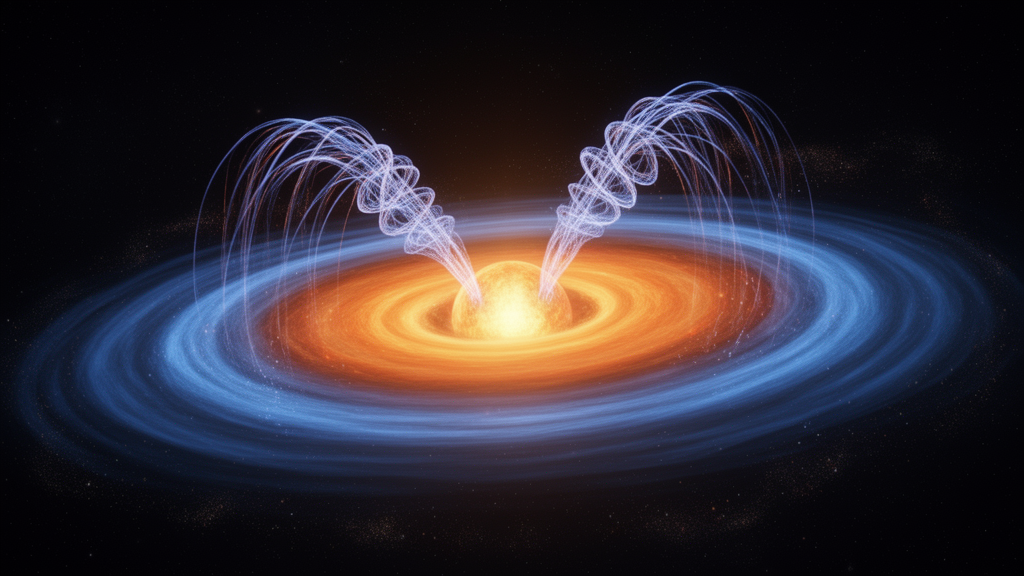
Deep inside star-forming regions, infant stars like our Sun once were are slowly devouring the disks of gas and dust that surround them. Yet these disks cannot simply fall inward. If nothing removed their angular momentum, the material would orbit forever and no planets would ever form. A new review published in Frontiers in Astronomy and Space Sciences by Ana I. Gómez de Castro of the Universidad Complutense de Madrid argues that the answer lies in magnetically driven disk winds — outflows launched by magnetic fields threading the disk — and that decades-old analytical models remain the essential framework for decoding what modern telescopes actually see.
The review traces the intellectual lineage of disk-wind theory back to the Weber–Davis model of 1967, which described a rotating magnetized stellar wind. Its central insight was the magnetic lever arm: because plasma stays frozen to field lines anchored in the rotating star, magnetic stresses enforce co-rotation far out into the wind, up to the Alfvén radius. Each unit of mass escaping the star therefore carries away angular momentum as if it had been removed from a much larger distance than the stellar surface. Even a tenuous breeze can brake a rapidly spinning star, provided the field maintains its grip. The same principle, the review emphasizes, applies to disk winds, with the stellar radius replaced by the footpoint radius of a field line anchored in the accretion disk.
The decisive leap came in 1982, when Roger Blandford and David Payne showed that a large-scale magnetic field threading a Keplerian disk can centrifugally fling material off the disk surface while simultaneously extracting the angular momentum that allows the remaining gas to accrete. Their famous launching criterion states that the poloidal field must be inclined more than 30 degrees from the rotation axis — or less than 60 degrees from the disk plane — for the effective potential along the field line to become unstable. Steeper field lines fail to overcome the component of gravity pulling gas back down; more inclined ones let centrifugal force win. The criterion, the review cautions, applies strictly to cold, stationary, ideal-MHD winds, and thermal pressure, magnetic-pressure gradients, and non-ideal effects can all modify the picture in real disks.
Once launched, the wind becomes a precision machine for angular-momentum transport. Close to the disk, most of the angular momentum is carried electromagnetically by the twisted, toroidal magnetic field. As the gas accelerates past the Alfvén surface, magnetic stresses progressively hand that angular momentum over to the matter itself. The dimensionless magnetic lever arm — the ratio of the cylindrical Alfvén radius to the launching radius — determines both how efficiently the wind brakes the disk and how fast the flow ultimately travels. For a cold, steady Keplerian wind, the terminal poloidal velocity scales with the Keplerian speed at the footpoint multiplied by the lever arm, so observations of wind velocity constrain a combination of launching radius and lever arm rather than either quantity alone.
Mass loading ties the whole solution together. The amount of material injected into the wind, set in the partially ionized disk atmosphere, controls the inertia the magnetic field must accelerate. Lightly loaded field lines remain magnetically dominated over large distances and develop long lever arms, ejecting little mass while still sustaining substantial accretion. Heavily loaded lines reach the Alfvén surface close to the disk, shorten the lever arm, and demand higher mass-loss rates for the same torque. In radially self-similar solutions, this coupling is captured by the ejection index, which for cold, wind-dominated accretion relates directly to the lever arm. The review stresses that mass loading and lever arm are dynamically linked properties of a single MHD solution, not independent parameters that can be compared freely across different models.
Real protoplanetary disks, however, are only weakly ionized, and the review devotes careful attention to the non-ideal MHD processes that govern the transition from disk to wind. Ohmic resistivity dominates in the dense, poorly ionized midplane, allowing magnetic flux to diffuse through the gas and confining efficient magnetic torques to the surface layers. Ambipolar diffusion rules the low-density surface layers where winds originate, regulating how neutrals drift across field lines and thus setting the mass loading. The Hall effect, which is non-dissipative and depends on the polarity of the magnetic field relative to the disk’s rotation axis, operates at intermediate heights and can either strengthen or weaken the magnetic torque. This vertical stratification of conductivities provides a natural framework for understanding how the disk couples to its outflow.
Magnetic winds are not the only way disks shed gas. Photoevaporative winds, driven by extreme-ultraviolet, far-ultraviolet, and X-ray radiation from the young star, launch thermally heated gas once its thermal energy exceeds gravitational binding. These flows reach only a few to roughly ten kilometers per second, comparable to the sound speed of the heated gas, and remove relatively little angular momentum. MHD winds, by contrast, tap the disk’s rotational energy and can reach hundreds of kilometers per second while actively driving accretion. The two mechanisms likely coexist, with magnetic torques dominating angular-momentum removal and photoevaporation contributing to final disk dispersal as accretion declines. Distinguishing them observationally remains difficult, since the low-velocity components of optical forbidden lines can be produced by either mechanism.
The review’s observational core shows how analytical models become predictive tools. Ultraviolet spectroscopy of classical T Tauri stars revealed hot, dense plasma at the wind base that cold magnetocentrifugal solutions could not reproduce, motivating warm wind models in which thermal pressure contributes to the dynamics. Synthetic spectra computed from these solutions predict broad, asymmetric profiles from resonance lines such as SiIII], CIII], and CIV, with inclination-dependent shifts that constrain the launching geometry. Optical forbidden lines like [OI] and [SII] trace the acceleration and magnetic collimation of microjets over tens to hundreds of astronomical units, and models that self-consistently calculate excitation and ionization reproduce observed opening angles, velocity gradients, and line ratios.
Perhaps the most striking test is jet rotation. Because each streamline conserves its specific angular momentum beyond the Alfvén surface, a magnetocentrifugal wind should show a systematic transverse velocity gradient across the jet axis. Hubble Space Telescope spectroscopy first detected such asymmetries in the DG Tau jet, and subsequent observations extended the measurements to larger samples, yielding launching radii and angular-momentum fluxes broadly consistent with disk-wind models. The review urges caution, however: asymmetric shocks, precession, and finite resolution can mimic rotation, and synthetic ALMA channel maps show that line-of-sight integration and beam convolution can make apparent rotation differ significantly from the intrinsic wind rotation. Forward modelling is essential before inferred launching radii can be trusted.
Analytical theory even explains why molecules survive in winds bathed in stellar ultraviolet radiation. Material launched from sufficiently large disk radii remains shielded from photodissociation, allowing molecular gas to persist throughout much of the outflow, and ambipolar diffusion acts as a natural thermostat, heating cooler gas through ion–neutral drift while backing off in hotter, better-coupled regions. Numerical simulations now extend this framework with non-ideal MHD, radiative transfer, chemistry, and dust evolution, confirming that magnetocentrifugal winds can dominate angular-momentum transport in weakly ionized disks. With the Extremely Large Telescopes, a future ultraviolet observatory, and the Square Kilometre Array poised to probe the launching region directly, the review concludes that the classical analytical models will remain the conceptual bridge between what simulations compute and what telescopes actually measure.
Subject of Research: Magnetically driven disk winds from T Tauri stars and their observable signatures
Article Title: Disk winds from T Tauri stars – physics and observables
Article References: Gómez de Castro, A. I. (2026). Disk winds from T Tauri stars – physics and observables. Frontiers in Astronomy and Space Sciences, 13, Article 1943483. https://doi.org/10.3389/fspas.2026.1943483
Image Credits: AI Generated
DOI: 10.3389/fspas.2026.1943483
Keywords: protoplanetary disks, T Tauri stars, disk winds, magnetohydrodynamics, angular momentum transport, magnetocentrifugal acceleration, Blandford–Payne model, non-ideal MHD, photoevaporation, jet rotation, ALMA, star formation
Cite Scienmag News
Grant Pearson. (October 16, 2026). How Magnetic Levers Spin Up the Winds That Shape Young Planetary Systems. Scienmag. https://scienmag.com/how-magnetic-levers-spin-up-the-winds-that-shape-young-planetary-systems/
Grant Pearson. "How Magnetic Levers Spin Up the Winds That Shape Young Planetary Systems." Scienmag, 16 October 2026, https://scienmag.com/how-magnetic-levers-spin-up-the-winds-that-shape-young-planetary-systems/. Accessed 16 October 2026.
Grant Pearson. "How Magnetic Levers Spin Up the Winds That Shape Young Planetary Systems." Scienmag. October 16, 2026. https://scienmag.com/how-magnetic-levers-spin-up-the-winds-that-shape-young-planetary-systems/


