


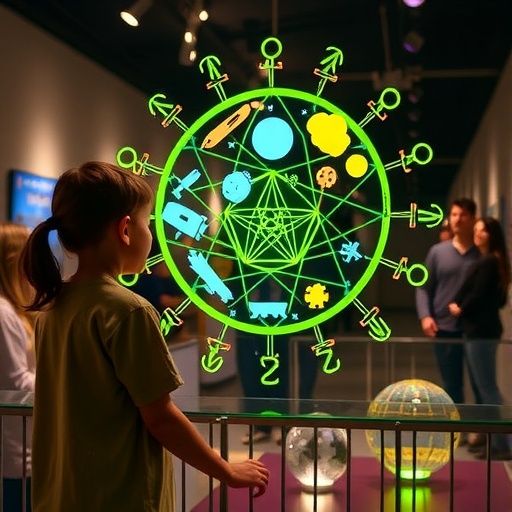
In the evolving landscape of STEM education, informal learning environments such as museums have emerged as pivotal venues for cultivating scientific curiosity and competence. An insightful recent study delves into the dynamics of self-regulated STEM learning within museum settings, highlighting how individual learner characteristics and specific visit-related activities intertwine to influence educational outcomes. This research sheds light on the nuanced mechanisms through which museums can transcend their traditional role as passive repositories of knowledge and become active incubators of self-directed exploration and learning in science, technology, engineering, and mathematics.
At the core of this investigation is the concept of self-regulated learning—a process in which learners proactively control and direct their own educational experiences, setting goals, monitoring progress, and reflecting on outcomes. In a museum context, this autonomy is facilitated by the spatial freedom to explore diverse exhibits, the availability of interactive technology, and the presence of facilitators who can scaffold understanding without dictating it. The study systematically examines how learners’ intrinsic motivation, prior knowledge, and cognitive styles modulate their engagement and learning efficacy during museum visits.
The researchers employed a robust methodological framework, combining quantitative assessments with qualitative observations to capture the multifaceted nature of STEM learning in museums. Visitor behaviors were meticulously tracked, while pre- and post-visit surveys measured shifts in learners’ attitudes and understanding of STEM concepts. Special attention was given to delineating how different activities within the museum—ranging from hands-on experiments and multimedia presentations to guided tours and peer discussions—affected the depth and retention of learning.
One of the pivotal findings underscores the significant variability in outcomes based on individual learner profiles. Students exhibiting higher initial interest in STEM fields demonstrated greater initiative in seeking challenging tasks and persisted longer in complex explorations. Conversely, those with lower baseline engagement benefited notably from structured visit components that provided explicit goals and feedback, suggesting that tailoring museum experiences to diverse learner needs can optimize educational impact.
This differentiation calls for a reevaluation of exhibit design, where adaptive learning technologies and personalized learning paths could be integrated to cater to heterogeneous audiences. The study advocates for museums to move beyond the one-size-fits-all model, embracing data-driven customization that responds to visitors’ real-time interactions and cognitive readiness. Such an approach aligns with contemporary pedagogical theories emphasizing the learner’s agency and the contextualization of knowledge.
Furthermore, the research highlights the integral role of social interactions during museum visits. Collaborative activities and peer discussions not only enhance engagement but also promote deeper conceptual understanding by enabling learners to articulate their thinking and negotiate meanings. The social dimension acts as both a motivator and a cognitive catalyst, reinforcing the importance of interactive programming and group-based challenges within informal science education frameworks.
In addressing the practical implications for educational institutions, this work encourages schools to integrate museum visits more systematically within the STEM curriculum. Pre-visit preparation and post-visit reflection are identified as critical phases that amplify the benefits of experiential learning, helping students consolidate new knowledge and connect it to classroom content. This cyclical pedagogical strategy fosters sustained interest and supports the transfer of skills across contexts.
Technological advancements serve as another promising vector for enhancing museum-based self-regulated learning. Augmented reality (AR), virtual reality (VR), and mobile applications offer dynamic platforms for immersive and personalized learning experiences. The study calls attention to ongoing innovations in these areas, emphasizing their potential to bridge gaps between abstract STEM concepts and tangible, engaging representations that resonate with diverse learner groups.
Importantly, this research also confronts challenges inherent in measuring informal science learning outcomes. Unlike formal education, museum learning often lacks standardized assessment metrics, complicating the evaluation of knowledge acquisition and skill development. By proposing a combination of behavioral analytics, learner self-reports, and cognitive assessments, the study contributes valuable methodologies for capturing the complexity of informal STEM education.
An intriguing aspect of the findings pertains to the motivational factors influencing self-regulation. The study documents how intrinsic curiosity, goal orientation, self-efficacy, and prior STEM identity shape learners’ navigation through museum exhibits. These psychological variables interact with environmental affordances to create personalized learning trajectories, underscoring the interplay between internal dispositions and external stimuli.
The implications of this research extend beyond the museum walls, offering insights relevant to digital and hybrid learning environments that have gained prominence amid global shifts in education. Strategies derived from this study can inform the design of virtual museum tours and online interactive science platforms, ensuring that principles of self-regulated learning are embedded across modalities to sustain engagement and meaning-making.
Policy makers and educators alike are urged to recognize informal STEM learning environments as critical complements to formal education systems. Investment in museum infrastructure, educators’ professional development, and collaborative partnerships between schools and cultural institutions are identified as key levers for maximizing educational equity and fostering lifelong STEM learning habits.
This study’s contributions resonate with broader discussions about STEM literacy and public engagement with science in an increasingly complex world. By illuminating how personalized, self-regulated learning unfolds in informal settings, it charts a pathway for empowering learners of all backgrounds to become confident, knowledgeable participants in scientific and technological domains.
As museums embrace these insights, they are poised to transform into vibrant hubs where curiosity meets rigor, exploration leads to mastery, and informal education catalyzes formal achievement. The synergy between learner characteristics and visit-related activities forms the crux of this transformation, offering a replicable model for effective STEM education that bridges theory, practice, and community engagement in innovative ways.
Ultimately, this research not only advances academic understanding of museum-based STEM learning but also offers a compelling vision for reimagining how science is communicated and experienced outside conventional classrooms. It underscores the untapped potential within informal learning environments to cultivate the next generation of STEM innovators through self-directed, immersive, and socially enriched educational encounters.
The study heralds a future in which museums no longer serve merely as repositories of artifacts but as active, adaptive learning ecosystems responsive to the needs and aspirations of diverse learners. By fostering environments that promote autonomy, motivation, and collaboration, museums can significantly contribute to developing a scientifically literate society prepared for the challenges and opportunities of the 21st century.
In conclusion, the research encapsulates a forward-thinking approach to STEM education—one that integrates psychological insights, technological innovation, and pedagogical best practices to harness the full educational potential of museums. As the boundaries between formal and informal learning continue to blur, such studies are invaluable for shaping policies and practices that ensure accessible, engaging, and effective STEM education for all.
Cite Scienmag News
Courtney Benton. (November 26, 2025). How Learner Traits Drive STEM Learning in Museums. Scienmag. https://scienmag.com/how-learner-traits-drive-stem-learning-in-museums/
Courtney Benton. "How Learner Traits Drive STEM Learning in Museums." Scienmag, 26 November 2025, https://scienmag.com/how-learner-traits-drive-stem-learning-in-museums/. Accessed 5 September 2026.
Courtney Benton. "How Learner Traits Drive STEM Learning in Museums." Scienmag. November 26, 2025. https://scienmag.com/how-learner-traits-drive-stem-learning-in-museums/


