


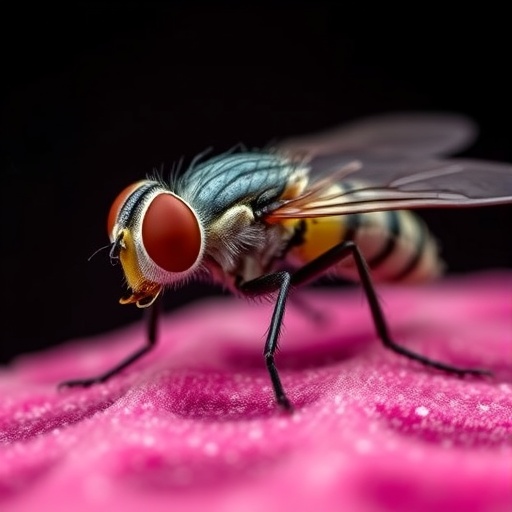
A tiny algorithm inspired by the fruit fly’s brain could bring artificial noses closer to reality—and help machines learn new smells without forgetting the old ones. Developed by researchers at the Okinawa Institute of Science and Technology (OIST), Spi-Fly is a brain-inspired computing system designed for scent classification under conditions that challenge conventional artificial intelligence: limited training data, continuously changing information, and strict energy constraints. In tests using experimental odor datasets, the system performed particularly well when it was asked to recognize scents from only a handful of examples, a capability known as few-shot learning. It also demonstrated continual learning, allowing it to acquire knowledge about new odors while retaining previously learned categories. These abilities are central to the development of practical, low-power artificial noses that could operate outside data centers and cloud-connected laboratories.
The research, published in Neuromorphic Computing and Engineering, addresses a persistent problem in machine learning. Many modern algorithms achieve impressive accuracy by relying on large datasets, extensive training, and powerful hardware. Those requirements become a major obstacle when data arrive gradually, computing resources are limited, or a device must operate independently in the field. Conventional neural networks can also suffer from catastrophic forgetting: when they are trained on new information, their performance on older information may deteriorate sharply. The researchers behind Spi-Fly sought a different approach by examining how biological nervous systems process sensory information efficiently. Rather than treating the brain as a conventional computer, they adapted key principles of the fruit fly’s olfactory system into a compact, event-driven network intended to work with neuromorphic hardware.
The fruit fly, despite having a brain smaller than a poppy seed, contains approximately 140,000 neurons and can perform sophisticated sensory tasks. Its olfactory system is especially attractive to computational scientists because it uses sparse coding. In sparse coding, an incoming signal does not activate every neuron in a network. Instead, it stimulates a relatively small and selective group, creating a compact representation of the original input. Different smells therefore produce distinct patterns of activity, much like neural bar codes. Because only a fraction of the available neurons are active at any moment, sparse coding can reduce energy consumption and limit the overlap between sensory representations. This makes it easier for a system to distinguish similar inputs while avoiding the need for extensive training.
Spi-Fly translates this biological strategy into a three-layer computational architecture. Odor signals first enter an input layer and are then projected randomly and sparsely onto a hidden layer containing 1,000 neurons. The random connections are not a flaw but a deliberate feature: they transform the incoming sensory pattern into a high-dimensional representation in which only a few hidden neurons become active for any given scent. The resulting activity pattern acts as a distinctive code. An output layer interprets that code and assigns it to an odor category. Instead of repeatedly adjusting millions of parameters through lengthy training, Spi-Fly relies on an associative learning rule that links the sparse hidden-layer patterns to their corresponding outputs. This structure allows the system to learn quickly while keeping its memory demands relatively low.
To evaluate the algorithm, the researchers tested it on two separate scent databases and compared its performance with several other classification methods. The strongest results emerged in few-shot learning, where an algorithm must classify a category after seeing only a small number of examples. Spi-Fly was able to form useful odor representations rapidly, allowing it to recognize scents without the extensive sample collections normally required by machine-learning systems. The result is significant because real-world chemical sensing rarely produces perfectly balanced, massive datasets. An artificial nose deployed in a factory, hospital, airport, or agricultural setting may encounter a new substance only a few times before it must make a decision. A system that can learn from scarce evidence could therefore be more practical than one that depends on a complete catalogue of every possible smell.
The algorithm also showed an advantage in continual learning. In a conventional model, adding new odor classes can disrupt the internal representations associated with earlier classes. Spi-Fly’s sparse activity patterns help reduce this interference by allocating distinct neural codes to different inputs. When new information arrives, the system can associate fresh patterns with new categories without extensively rewriting the connections that encode previous knowledge. In testing, it learned to classify new odors while maintaining its ability to identify earlier ones. This is particularly important for autonomous sensing devices, which cannot always be taken offline for retraining. A compact detector monitoring air quality, industrial emissions, or food storage could gradually update its knowledge as conditions change instead of repeatedly starting the learning process from scratch.
The researchers emphasize that Spi-Fly is not yet a complete artificial nose, and its performance does not surpass every traditional machine-learning classifier. More work is needed to determine how reliably it can identify odors in environments filled with mixtures and background smells. Real-world scent signals are rarely clean: chemicals overlap, concentrations fluctuate, humidity changes, and unrelated odors can mask the target substance. These factors may make classification far more difficult than recognizing samples in a controlled dataset. The team also plans to explore how the system behaves when several odor sources are present simultaneously. Even with these limitations, the algorithm provides a promising blueprint because it was developed with energy-efficient, neuromorphic hardware in mind rather than being designed solely for conventional computers.
That hardware connection could be crucial. Neuromorphic systems use electronic circuits that imitate aspects of biological neurons and synapses, often processing information through brief, event-like signals called spikes. Unlike conventional processors that continuously move large volumes of numerical data between memory and computation units, neuromorphic devices can perform operations only when relevant events occur. This can significantly reduce power consumption and latency. Researchers at TU Eindhoven and Kiel University are developing odor-sensing hardware intended to detect chemical signals and are working toward integrating Spi-Fly with such platforms. The combination could produce an artificial nose capable of processing odors locally, without sending raw sensor data to a remote server. Potential applications include detecting explosives, monitoring allergens, checking food freshness and safety, identifying drugs, and tracking hazardous chemicals.
The significance of Spi-Fly extends beyond smell. Although the system was built around olfactory classification, its underlying principles—sparse representations, rapid association, low memory use, and resistance to catastrophic forgetting—could be adapted to other classification problems. A device that learns continuously from small amounts of data could be useful wherever conditions evolve and energy is scarce, including wearable sensors, autonomous robots, environmental monitors, and edge-AI systems. The researchers’ broader goal is not simply to copy the fruit fly, but to understand which biological strategies can be translated into efficient machines. By turning a miniature insect brain into a design for hardware-compatible artificial intelligence, Spi-Fly offers a striking example of how nature’s compact solutions may help overcome some of the biggest challenges facing modern computing.
News Publication Date: 24-Aug-2026
Web References: https://doi.org/10.1088/2634-4386/ae9177; https://doi.org/10.1088/2634-4386/aded2d
References: Neuromorphic Computing and Engineering, DOI: 10.1088/2634-4386/ae9177
Cite Scienmag News
Reid Dalton. (August 24, 2026). How Fruit Flies Decode Smells. Scienmag. https://scienmag.com/how-fruit-flies-decode-smells/
Reid Dalton. "How Fruit Flies Decode Smells." Scienmag, 24 August 2026, https://scienmag.com/how-fruit-flies-decode-smells/. Accessed 3 September 2026.
Reid Dalton. "How Fruit Flies Decode Smells." Scienmag. August 24, 2026. https://scienmag.com/how-fruit-flies-decode-smells/


