


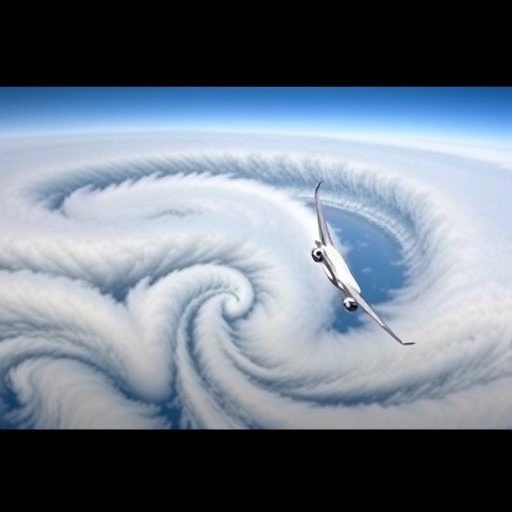
In the realm of high-speed aerospace travel, even the most minute adjustments in an aircraft’s orientation can yield profound aerodynamic consequences. Recent research from the FAMU-FSU College of Engineering sheds critical light on the complex vortex dynamics that manifest when aircraft forebodies are subjected to steep angles of incidence, revealing mechanisms that could revolutionize the stability and control of future high-speed flight vehicles.
When an aircraft pitches sharply relative to its oncoming airflow—a condition quantified by its angle of incidence—the air does not simply glide smoothly over its surfaces. Instead, the airflow transitions into turbulent, spiraling currents known as vortices. These vortices emerge predominantly around the conical forebody of the aircraft, particularly as it slices through the air at supersonic speeds. While vortices are common in aerodynamics, their behavior grows increasingly unpredictable and destabilizing as the angle of incidence increases, potentially compromising flight safety and control.
The investigative team, helmed by Dr. Rajan Kumar, Chair of Mechanical and Aerospace Engineering and Director of the Florida Center for Advanced Aero-Propulsion, sought to decode the nature of these vortical structures using a fusion of experimental data and high-fidelity computational fluid dynamics (CFD) simulations. Their focus centered on how airflow patterns evolve over a conical shape flying at Mach 1.1—just above the speed of sound—and how these patterns morph at incidence angles of 15, 25, and 30 degrees.
At the lower bound of the studied angles, around 15 degrees, the airflow forms intricate patterns composed of dual intertwined spirals, which progressively unravel into fine, tangled strands of vortex filaments. This complexity indicates the onset of vortex breakdown but retains a degree of symmetry and relative stability. Contrastingly, at 25 and 30 degrees, the airflow exhibits a distinctly different signature: a singular, dominant spiral pattern indicative of pronounced asymmetry and a higher degree of flow instability.
This shift from symmetric to asymmetric vortex breakdown is not merely an academic curiosity but a phenomenon with direct and potentially catastrophic implications for flight dynamics. As vortices become asymmetric, they impose uneven lateral and rotational forces on the aircraft’s structure. Such forces can cause the vehicle to yaw or roll uncontrollably, deviating from its intended trajectory. In military and aerospace contexts where precision is paramount, these unpredictable forces can jeopardize mission success and aircraft integrity.
One of the profound insights of this research lies in its elucidation of the vortex breakdown mechanism. The study reveals that minute secondary vortices, initially smaller-scale and separate, interact and progressively coalesce into more substantial, asymmetric vortex systems enveloping the forebody. This cascading effect amplifies instabilities, eventually manifesting as significant disturbances in the aircraft’s aerodynamic equilibrium.
Moreover, the interaction of vortex size, orientation, and breakdown behavior emerged as critical factors explaining why vortex asymmetry arises and accentuates. The interplay of these factors dictates the distribution and magnitude of aerodynamic forces, thereby influencing control challenges faced by pilots and flight control systems during high-angle maneuvers.
Understanding these vortex dynamics is pivotal for advancing next-generation aerospace vehicle design. The ability to predict when vortices remain stable or transition into disruptive configurations enables engineers to establish operational envelopes that enhance aircraft safety and maneuverability. Additionally, insights from this research open pathways toward developing adaptive control surfaces and flow control technologies capable of dynamically countering vortex-induced instabilities in flight.
Looking ahead, Dr. Kumar’s team is advancing their studies into transonic and hypersonic regimes, where vortex behavior is even more complex and influential. They are also investigating real-time control methodologies, potentially leveraging artificial intelligence and autonomous flight systems to detect and mitigate vortex-induced perturbations before they escalate into dangerous instabilities.
Beyond immediate aerospace applications, the research serves as a critical educational platform. Graduate students participating in this work gain hands-on experience with cutting-edge aerodynamic analysis and high-performance simulation tools, equipping a new generation of engineers with the expertise essential for pushing the boundaries of flight technology.
The implications of these findings are profound. By untangling the intricacies of vortex asymmetry and breakdown on conical forebodies, this research informs the design of more reliable, efficient, and agile aircraft and missile systems. These advances promise not only enhanced safety and mission effectiveness but also the potential expansion of aircraft operational envelopes into regimes previously considered volatile or prohibitive.
In summary, the FAMU-FSU College of Engineering’s pioneering work dissects the multifaceted vortex behaviors induced by varying angles of incidence on conical aerospace vehicles flying at supersonic speeds. This deepened understanding paves the way for innovative design strategies and intelligent control mechanisms, marking a significant leap toward mastering the complex aerodynamics that underpin modern and future high-velocity flight.
News Publication Date: 26-Mar-2026
Web References:
https://eng.famu.fsu.edu/
https://arc.aiaa.org/doi/10.2514/1.C038725
References:
Kumar, R., Wilkerson, J., & Sasidharan Nair, U. (2026). Investigation of Vortex Asymmetry of a Conical Forebody at Angles of Incidence. Journal of Aircraft. DOI: 10.2514/1.C038725
Keywords
Vortices, Aerospace Engineering, Supersonic Flight, Fluid Dynamics, Vortex Breakdown, Aerodynamic Stability, Conical Forebody, Angle of Incidence, Computational Fluid Dynamics, Flight Control, High-Speed Aerodynamics, Airflow Instabilities
Cite Scienmag News
Audrey Campbell. (May 5, 2026). How Flight Angles Influence Turbulence and Vortex Formation: Insights from FAMU-FSU Researchers. Scienmag. https://scienmag.com/how-flight-angles-influence-turbulence-and-vortex-formation-insights-from-famu-fsu-researchers/
Audrey Campbell. "How Flight Angles Influence Turbulence and Vortex Formation: Insights from FAMU-FSU Researchers." Scienmag, 5 May 2026, https://scienmag.com/how-flight-angles-influence-turbulence-and-vortex-formation-insights-from-famu-fsu-researchers/. Accessed 4 September 2026.
Audrey Campbell. "How Flight Angles Influence Turbulence and Vortex Formation: Insights from FAMU-FSU Researchers." Scienmag. May 5, 2026. https://scienmag.com/how-flight-angles-influence-turbulence-and-vortex-formation-insights-from-famu-fsu-researchers/


