


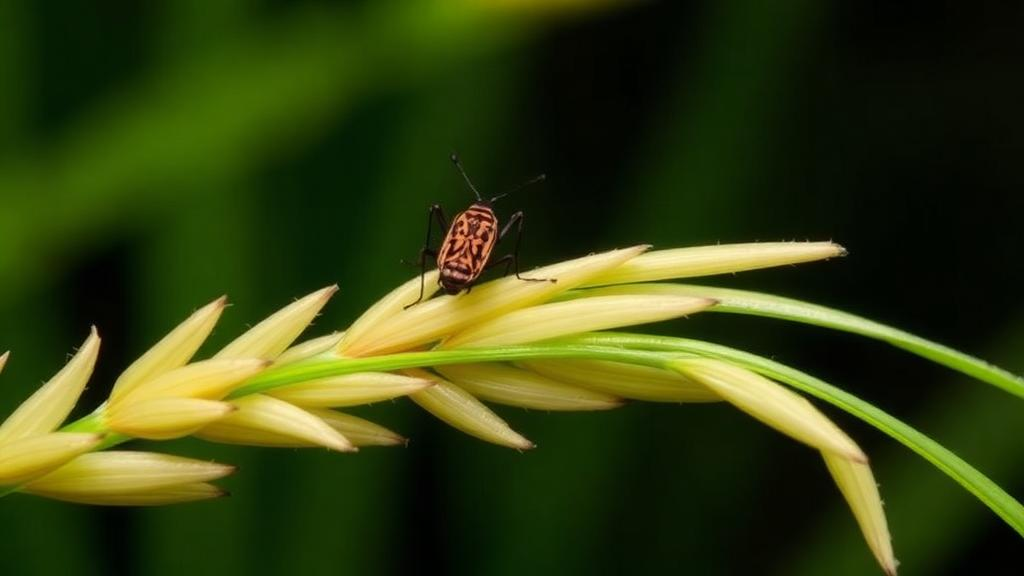
A microscopic bacterium that lives inside the cells of some of the world’s most destructive rice pests may hold the key to controlling them. A new review published in the journal Crop Health by researchers at Nanjing Agricultural University brings together decades of evidence on how Wolbachia, an intracellular symbiont found in a large share of the world’s insects, manipulates the reproduction of three devastating rice planthoppers: the brown planthopper Nilaparvata lugens, the small brown planthopper Laodelphax striatellus, and the white-backed planthopper Sogatella furcifera. These insects pierce and suck the sap of rice stems, lay eggs inside plant tissue, and transmit serious viral diseases, making them among the most consequential agricultural pests in Asia. Understanding how a bacterial passenger bends their reproductive biology to its own ends is now revealing both the mechanics of pest outbreaks and a potential route to sustainable control.
Wolbachia is famous among biologists for its extraordinary reproductive tricks. Because it is transmitted only from mothers to offspring through the egg cytoplasm, the bacterium has evolved an arsenal of strategies to favor infected females at the expense of males and uninfected individuals. It can kill infected males outright, convert genetically male embryos into females, induce females to reproduce without mating, and, most famously, trigger cytoplasmic incompatibility, or CI. In CI, when a Wolbachia-infected male mates with an uninfected female, or with a female carrying a different Wolbachia strain, the fertilized eggs die during embryonic development. If, however, the female carries the same strain, her eggs can rescue the paternal chromosomes and development proceeds normally. The net effect is that infected females enjoy a reproductive advantage, and the bacterium sweeps through populations on the back of this manipulation.
The review’s central insight is that the three rice planthopper species host strikingly different Wolbachia strains with very different effects. In the brown planthopper, the native strain wLug infects fewer than half of individuals in the field, and rather than inducing CI it appears to boost the fecundity of its host. In the small brown planthopper, by contrast, the strain wStri infects roughly ninety-nine percent of wild populations and induces complete cytoplasmic incompatibility while simultaneously enhancing reproduction. The white-backed planthopper’s strain, wSfur, infects about ninety percent of individuals but shows weak or no CI and only minimal effects on fecundity. These strain-specific differences matter enormously for population dynamics, because the reproductive effects of the bacterium directly alter the base population size of the insects and therefore influence the scale of planthopper infestations in the field.
One of the most intriguing findings concerns what happens when a Wolbachia strain is moved into a new host species. Researchers successfully transfected wStri from the small brown planthopper into the brown planthopper, where the bacterium adopted a tissue distribution similar to that in its native host but reached significantly higher densities than the native wLug strain. Although wStri still induced cytoplasmic incompatibility in its new home, the intensity of the effect was notably reduced. This observation carries an important message: the strength of CI is shaped not only by the symbiont itself but also by the genetic background of the host. The transfection also had a practical payoff, because the introduced wStri inhibited infection and transmission of rice ragged stunt virus in the brown planthopper, hinting at significant pest control potential.
At the molecular level, the mechanism of cytoplasmic incompatibility has only recently come into focus. Because Wolbachia cannot be cultured outside living cells, identifying the bacterial factors behind CI long remained a stubborn challenge. The breakthrough came with the discovery of two adjacent genes, cifA and cifB, encoding proteins that appear to be the key effectors. In transgenic experiments in fruit flies, expressing CifB and CifA in uninfected males was sufficient to reproduce the CI phenotype, with embryos dying after mating with uninfected females. Conversely, expressing CifA alone in uninfected females rescued embryos from Wolbachia-infected males. Mutations in the PD-(D/E)XK nuclease, deubiquitinase, and peptidase domains of CifB impair the function of these factors, and the three-dimensional structures of the two proteins have now been resolved, revealing that their interaction depends on charge attraction across three interfacial regions.
Two competing models attempt to explain how these proteins work. The toxin-antidote model proposes that CifB is delivered to the embryo, where it acts as a toxin, while Wolbachia in the egg synthesizes CifA, which binds CifB and neutralizes it, allowing normal development. The host modification model instead holds that Cif proteins modify targets within the gametes themselves: modifications to sperm induce CI, while modifications to female gametes reverse the damage and rescue embryos. Recent functional studies lend weight to the modification model. CifA has been detected in sperm nuclei during spermatogenesis, where it causes retention of histones and deficiency of protamines in mature sperm, and both CifA and CifB have been shown to act as nucleases that degrade long non-coding RNAs and damage DNA during late sperm formation. Notably, the rules differ across strains: in some systems CifB alone suffices to induce CI, while in others both proteins must be expressed together, underscoring how diverse these mechanisms remain.
The wStri genome adds another layer of complexity. It contains three copies of the cifA-cifB gene pair, and phylogenetic analysis shows that the known CI factor groups have expanded from five to ten, with the wStri factors belonging to newly identified groups VI and VIII whose functions remain unknown. On the host side, proteomic and RNA interference studies in the small brown planthopper have identified candidate host factors. The cytoplasmic aminopeptidase-like protein, or CAL, appears to be associated with CI lethality, while the gene iLvE, involved in branched-chain amino acid biosynthesis, was the most significantly downregulated gene in infected insects, and knocking it down in uninfected males reduced fertility in a way that could be restored by mating with infected females. Another candidate, NDUFA8, which encodes a subunit of a mitochondrial enzyme complex, was upregulated in infected females, and suppressing it reproduced CI-like embryo mortality, suggesting a role in the rescue phenotype.
Beyond incompatibility, Wolbachia acts as a reproductive booster for its planthopper hosts. Removing the bacterium from brown planthoppers significantly shortens oviposition and reduces female fecundity, and wStri similarly promotes egg production in the small brown planthopper. Comparative genomics and metabolomics show that both wStri and wLug carry complete pathways for synthesizing B vitamins, including biotin and riboflavin, nutrients that play crucial roles in host reproduction and that the insects apparently cannot fully supply themselves. At the physiological level, the bacterium upregulates vitellogenin, the yolk precursor protein essential for egg formation, increases mitotic division of germ cells, and accelerates the breakdown of nurse cells during peak oviposition, thereby channeling more nutrients into egg production. Wolbachia also alters microRNA expression in its host, reshaping the expression of fecundity-related genes, and preliminary evidence suggests changes in mitochondrial energy metabolism may contribute as well.
The picture is further complicated by interactions with other symbionts. In the white-backed planthopper, Wolbachia coexists with another intracellular bacterium, Cardinium, and lines carrying both symbionts show distinct microbiomes and metabolite profiles. Remarkably, double-infected lines exhibit lower fecundity than uninfected ones, indicating that combined symbiont effects can be more consequential than either bacterium alone. For pest management, the implications are considerable. The CI principle underlies incompatible insect technique programs already deployed against mosquitoes, in which males carrying specific Wolbachia strains are released to mate with wild females, causing their fertilized eggs to die and suppressing target populations. Whether similar strategies can be scaled up for rice planthoppers remains an open question, and the review’s authors caution that field deployment would require careful risk assessment, including the possibility of resistance evolution, ecological side effects, and horizontal transmission of Wolbachia to non-target species. Still, as planthopper outbreaks intensify and pesticide resistance grows, a bacterium that can both sabotage and supercharge insect reproduction may prove to be one of the most valuable allies rice farmers have.
Subject of Research: Wolbachia-mediated reproductive manipulation, including cytoplasmic incompatibility and fecundity enhancement, in three rice planthopper pest species
Article Title: Wolbachia-mediated reproductive manipulation in rice planthoppers
Article References: Niu, Y.-D., Wang, M.-K., Yan, Z.-C., Bing, X.-L., & Hong, X.-Y. (2025). Wolbachia-mediated reproductive manipulation in rice planthoppers. Crop Health, 3(1), Article 20. https://doi.org/10.1007/s44297-025-00059-y
Image Credits: AI Generated
DOI: 10.1007/s44297-025-00059-y
Keywords: Wolbachia, rice planthoppers, cytoplasmic incompatibility, endosymbiont, Nilaparvata lugens, Laodelphax striatellus, Sogatella furcifera, cif genes, fecundity, pest control, symbiosis, B vitamins
Cite Scienmag News
Alan Morgan. (September 30, 2026). How a Sneaky Bacterium Hijacks the Sex Lives of Rice’s Worst Pests. Scienmag. https://scienmag.com/how-a-sneaky-bacterium-hijacks-the-sex-lives-of-rices-worst-pests/
Alan Morgan. "How a Sneaky Bacterium Hijacks the Sex Lives of Rice’s Worst Pests." Scienmag, 30 September 2026, https://scienmag.com/how-a-sneaky-bacterium-hijacks-the-sex-lives-of-rices-worst-pests/. Accessed 4 October 2026.
Alan Morgan. "How a Sneaky Bacterium Hijacks the Sex Lives of Rice’s Worst Pests." Scienmag. September 30, 2026. https://scienmag.com/how-a-sneaky-bacterium-hijacks-the-sex-lives-of-rices-worst-pests/


