


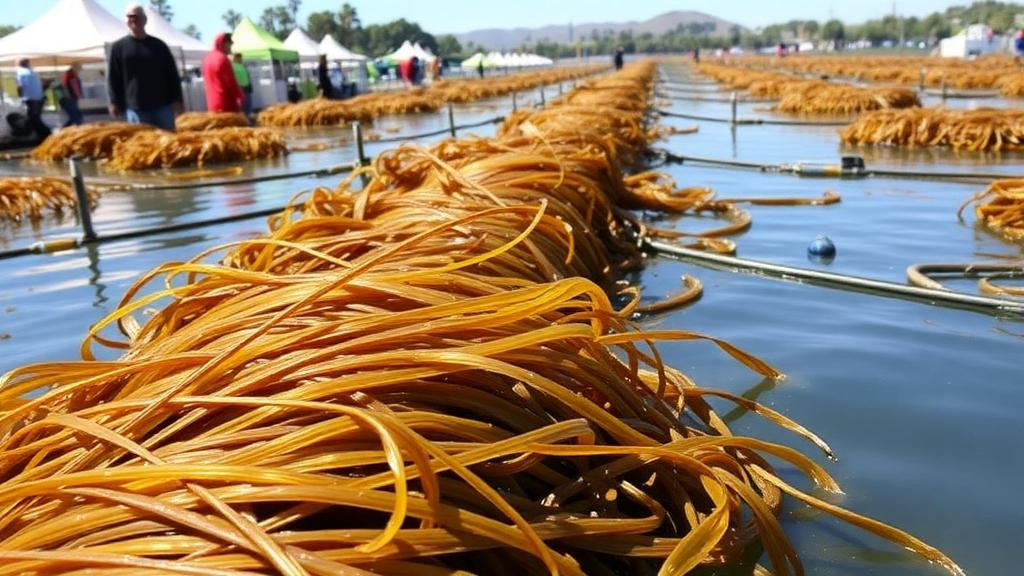
Seaweed has long been touted as a climate-friendly crop of the future, capable of feeding people, cleaning water, and replacing fossil-based materials. But in North America, the industry faces a stubborn paradox: scientists and entrepreneurs can grow the algae, yet the market barely exists and the public remains wary. A new case study published in Frontiers in Aquaculture argues that the missing ingredient is not technology but community, and it offers the California Seaweed Festival as a working model for how informal public education can simultaneously build consumer demand and secure the social acceptance that seaweed farms need to operate.
The study, led by phycologist Simona Augyte of California Sea Grant and Scripps Institution of Oceanography together with colleagues at California State University Northridge, Cal Poly Humboldt, and other institutions, documents six years of the festival’s evolution from 2020 to 2025. The team combined interviews with seven seaweed aquaculture professionals across the west coast of North America with a survey of 121 attendees at the 2025 festival in San Pedro. Their findings suggest that experiential community events can measurably shift attitudes toward seaweed food products, food packaging, ocean ecology, and climate change, addressing both the environmental and social challenges facing the nascent industry.
The California Seaweed Festival was founded by two phycologists as an annual outreach program and is now entering its seventh year. Its first iteration in 2020 was a weeklong online webinar series forced by COVID restrictions, reaching an estimated 450 viewers worldwide. As restrictions lifted, the festival rotated between Central, Northern, and Southern California, with coastal locations chosen in or near regional population centers. Attendance grew from 550 in Santa Barbara in 2021 to 728 in Tiburon in 2022, then jumped to 2,775 in San Diego in 2023, 1,200 in Eureka in 2024, and 3,612 in Los Angeles in 2025. The number of ways to try seaweed food or drink at each event grew in parallel, from zero in the virtual year to 29 distinct offerings in 2025.
That culinary component has become one of the festival’s most powerful market-development tools. Chefs and culinary professionals have showcased sugar kelp meatballs, popcorn seasoned with wakame or sea lettuce flakes, sunomono salad with winged kelp, salted kelp scallops, and a Gose-style beer brewed with Pacific dulse. The authors note that this expanding assortment marks seaweed’s move beyond traditional Asian cuisine applications into Western beverages and novel dishes, a strategy the literature identifies as key to leveraging seaweed’s flavor, texture, nutrition, and sustainability for unfamiliar consumers.
The festival’s structure has also evolved deliberately. In its first three years it relied on a single primary donor, first California Sea Grant and then California State University COAST. It then shifted to building a portfolio of local support around each host region’s Blue Economy interests and incorporated as a 501(c)(3) nonprofit in 2022. The event integrates academia, industry, Tribal organizations, and the arts, featuring remotely operated vehicles used in kelp farm monitoring, marine-themed murals, immersive sculptures at port facilities, bilingual educational materials and a regional field guide identifying the 24 most common seaweed species in Southern California produced with the Ellen Browning Scripps Herbarium.
The interviews reveal why such engagement matters. Nearly all interviewees named market development and consumer demand as the industry’s greatest challenge, particularly for seaweeds native to the west coast that lack the established demand of Asian cuisine species. Low demand combined with high production costs has squeezed profit margins. One interviewee recalled a moment several years ago when venture capital firms flooded in expecting the market to figure itself out, only for many companies to collapse virtually overnight. Another noted that most companies remain vertically integrated, still doing everything themselves because there is not enough market pull to build a business on.
Social license emerged as the second major theme. Interviewees described contending with negative public perceptions of aquaculture shaped by finfish farming, with one noting that the word aquaculture carries a bad connotation in California and that offshore development is a sensitive topic. At a state Ocean Protection Council hearing for a new Marine Aquaculture Action Plan, nearly all negative public comments demanded that finfish aquaculture be excluded, while people were fine with bivalves and seaweed. Interviewees proposed transparent communication of environmental benefits, engagement through local festivals and community events, education of local youth, and integration of Indigenous history and science as interventions, with one emphasizing that people need to see seaweed has been utilized for thousands of years, not just in Asian cuisine.
The survey data quantifies the festival’s impact. Of 121 respondents aged 18 to 74, 85.1 percent were first-time attendees, suggesting the rotating locations successfully engage new audiences across the state. Nearly 92 percent visited the vendor and exhibitor area, 71.7 percent visited seaweed touch tanks, and over 60 percent visited the arts and crafts area. Approximately 81 percent attended three or more activities. Nearly 80 percent said environmental change was now a more important issue to them, and 80.8 percent said the same about ocean ecology, with no participants reporting either issue as less important. A Wilcoxon signed-rank test showed a statistically significant shift in likelihood of seeking information on oceans or coastal ecology, with extremely likely responses rising from 52.1 to 68.6 percent and a large standardized effect size.
Behavioral intentions showed similar momentum. 89.3 percent of respondents reported an intent to change one or more of four behavior categories: food choices, food packaging choices, daily energy consumption, and time spent volunteering. The 108 respondents collectively reported 220 intended changes, averaging 1.8 per person. Food choices showed the greatest impact, which the authors link to the variety of seaweed food and drink available at the event. Notably, when respondents did not intend to change a behavior, a majority said it was already their current practice, and affordability was the least commonly chosen reason for not consuming seaweed products, suggesting that familiarity and preparation knowledge, not price, are the key barriers.
The authors argue that the California Seaweed Festival and events like it serve as critical players in shifting public perception, securing social license, and developing seaweed markets in California. The festival has already inspired similar events nationally and internationally, from Alaska to New Zealand. As the industry seeks to scale toward a circular bioeconomy with adaptive governance and community and Indigenous engagement, the case study offers seaweed producers a proven, replicable strategy: build the community first, and the market and social acceptance will follow.
Subject of Research: Seaweed aquaculture market development through community festivals
Article Title: Community as a driver in macroalgae market development: the California Seaweed Festival case study
Article References: Augyte, S., Hernandez, P., Cuevas-Uribe, R., Appelrouth, S. A., Ainsworth, A., Dudgeon, S. R., & Kübler, J. E. (2026). Community as a driver in macroalgae market development: the California Seaweed Festival case study. Frontiers in Aquaculture, 5, Article 1984525. https://doi.org/10.3389/faquc.2026.1984525
Image Credits: AI Generated
DOI: 10.3389/faquc.2026.1984525
Keywords: seaweed aquaculture, macroalgae, California Seaweed Festival, social license, market development, kelp, Blue Economy, science festivals, consumer behavior, ocean ecology, climate change, community engagement
Cite Scienmag News
Gavin Prescott. (October 19, 2026). How a Community Festival Is Fueling California’s Seaweed Aquaculture Boom. Scienmag. https://scienmag.com/how-a-community-festival-is-fueling-californias-seaweed-aquaculture-boom/
Gavin Prescott. "How a Community Festival Is Fueling California’s Seaweed Aquaculture Boom." Scienmag, 19 October 2026, https://scienmag.com/how-a-community-festival-is-fueling-californias-seaweed-aquaculture-boom/. Accessed 19 October 2026.
Gavin Prescott. "How a Community Festival Is Fueling California’s Seaweed Aquaculture Boom." Scienmag. October 19, 2026. https://scienmag.com/how-a-community-festival-is-fueling-californias-seaweed-aquaculture-boom/


