


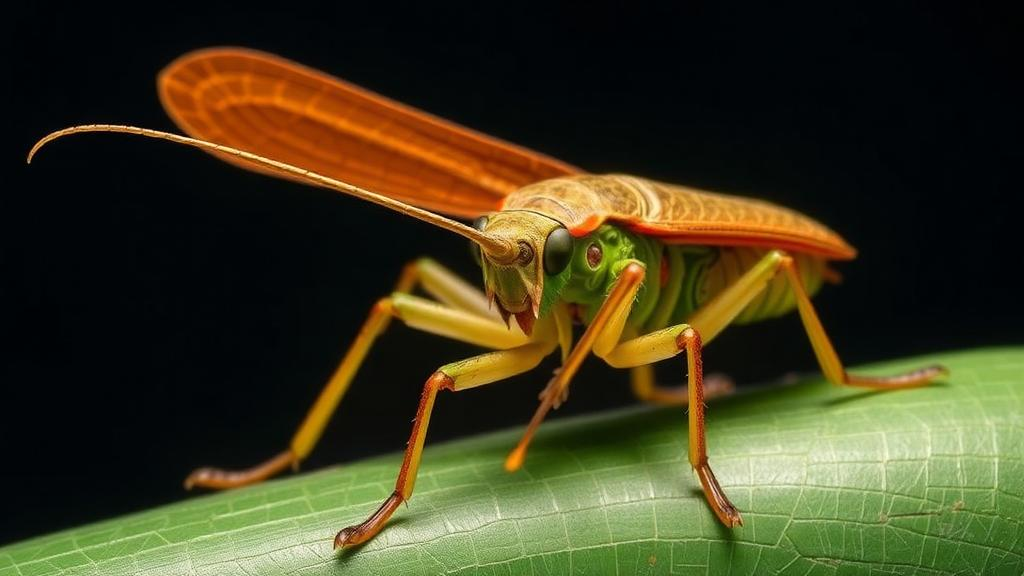
On Tsushima Island, a remote Japanese archipelago lying between Kyushu and the Korean Peninsula, the migratory locust Locusta migratoria grows to sizes that astonish entomologists. While solitarious females of this species typically measure between 6.6 and 8.5 millimeters across the head in populations around the world, certain females on Tsushima exceed 10.5 millimeters, and some males surpass 8.0 millimeters. These exceptional insects, colloquially known as giant locusts, have been documented by Japanese researchers since at least the 1970s, and museum specimens confirm that they have prowled the island’s grasslands for nearly a century. A new study published in the Journal of Orthoptera Research now provides the most detailed investigation yet into how large these locusts become, how their enormous bodies develop, and what genetic and environmental forces might sustain—or diminish—such giants within an ordinary population.
The research team, led by Seiji Tanaka, conducted fieldwork on Tsushima Island during October of 2008 and 2012, supplemented by specimens collected by Hironori Sakamoto in 2018 and 2022. Across nine collection sites, they captured hundreds of adults, the overwhelming majority of which were fully grown. Back in the laboratory at Tsukuba, each insect was measured with digital calipers for head width, hind femur length, and forewing length, following standard morphometric protocols. The data revealed that the Tsushima populations possess the largest mean adult body size of any Locusta migratoria population examined across diverse climatic regions, from temperate Japan and continental China to subtropical islands, Australia, and Ethiopia. In a worldwide comparison of male and female head widths, the Tsushima measurements stood out as the most extreme data point.
The giants themselves are genuinely startling. The heaviest giant female recorded weighed 8.9 grams, nearly double the maximum of 5.5 grams seen among other examined females, whose average maximum weight hovered around 4.5 grams. One giant female measured 80 millimeters in total body length with a head width of 11.7 millimeters, dwarfing an average-sized island female at 65 millimeters and 8.8 millimeters. Historical material makes the phenomenon even more striking: dry specimens collected in 1930 and 1933 and preserved at Kyushu University Museum averaged 10.8 millimeters in head width for females, with the largest reaching 11.9 millimeters. Estimates derived from body lengths reported by the entomologist Hiura for specimens from 1967 to 1975 suggest similarly enormous averages, with the largest historical female estimated at 11.9 millimeters and one male at 9.9 millimeters.
Bigness, it turns out, pays reproductive dividends. Larger females deposited wider egg pods and produced significantly more eggs per pod, with giant females averaging 113.4 eggs per pod compared with 87.6 for their smaller neighbors—a difference that pushed the giants beyond the previously reported range of 66 to 116 eggs for solitarious populations worldwide. Egg mortality did not differ between giant and normal-sized females, meaning the extra offspring were not bought at the cost of quality. The anatomical basis for this fecundity lies in the ovarioles, the egg-producing tubes within the female reproductive system. Females collected at seven sites carried between 100 and 160 ovarioles, and larger females consistently possessed more of them. Since roughly 62 percent of ovarioles are typically deployed in egg production in this species, the correlation between body size and reproductive capacity is functionally direct.
To understand how such giants are built, the researchers reared offspring of a field-collected giant female in isolation at 30 degrees Celsius under two photoperiods: 12 hours of light and 12 of darkness, approximating autumn days, and 16 hours of light, approximating summer. Solitarious migratory locusts usually pass through five to seven nymphal molts, but the Tsushima giants never exceeded six stadia. The crucial insight was that individuals passing through six molts—predominantly females—tended to emerge as the largest adults, despite taking longer to develop. Intriguingly, within each molting group, larger adults actually grew faster than smaller ones, and at the long-day photoperiod, smaller hatchlings were the ones more likely to take the six-molt route to gigantism. Females with six stadia were far more common than males with six, explaining why giant females outnumber giant males on the island.
The developmental story is one of trade-offs and maternal influence. Hatchling weight correlated positively with the mother’s head width, so larger females laid the foundations for larger offspring. When nymphs from different mothers were reared in groups, the average adult head width of the first laboratory generation tracked the mother’s size, and this maternal effect persisted into the second generation of purebred descendants. In every instance observed, field-collected giant females produced larger offspring than their normal-sized counterparts. Reciprocal crossing experiments between a giant family line and ordinary families from two island localities showed that hatchling body weight in the second generation was either intermediate between the two parental lines or closer to the maternal mean, pointing to a complex genetic architecture in which the female parent contributes disproportionately to offspring size.
Selection experiments added another layer of nuance. When the researchers bred the largest and smallest adults of a giant family line over two generations, selecting for small size produced a significant reduction in head width in both sexes under the short-day photoperiod, but selecting for large size produced no further increase—suggesting the giant line may already have approached its physiological ceiling. Under long-day conditions, the effect of selection was not evident at all. The authors caution that these results could reflect either a genuine genetic limit or simply the overriding influence of maternal body size on the next generation, and they note that longer-term selection experiments separating the sexes would be needed to disentangle the two possibilities.
Perhaps the most tantalizing question is where the giants came from. Mitochondrial DNA analysis of Tsushima locusts revealed a genetically mixed population: of eight sampled individuals, two belonged to the species’ southern phylogeographic clade and six to the northern clade, with one giant’s haplotype sitting near sequences from Tianjin, China. Crucially, the analysis provided no evidence of genetic differentiation between the giants and the other locusts on the island, or indeed between the island population and those on Honshu, Kyushu, and much of continental China. The giants appear to be extreme individuals drawn from the same gene pool rather than a cryptic species or distinct lineage, though the authors emphasize that nuclear genes, which the mitochondrial study did not examine, may yet hold secrets about the trait’s origins.
The study also raises a sobering possibility: the giants may be fading. Specimens collected before 1976 were consistently larger than those gathered in recent decades, and the island’s climate has changed markedly over the same period. Mean annual air temperature on Tsushima rose by 1.5 degrees Celsius, from 14.7 degrees in 1930 to 16.2 degrees in 2022, with virtually all of that warming concentrated after 1975. The migratory locust follows a well-known latitudinal pattern in body size tied to the number of generations it produces each year, and Tsushima sits at the southern edge of the bivoltine zone where locusts are at their largest. Southward, where warming allows a third annual generation, body size shrinks. The researchers speculate that recent warming may be pushing some Tsushima locusts toward a trivoltine life cycle, reducing the frequency of giants—though they acknowledge that small historical sample sizes and possible sampling error could also explain the apparent decline. Whether these magnificent insects are relics of a cooler era or a persistent quirk of island ecology, the Tsushima giants remain one of the most remarkable examples of body-size extremes within a single wild population, and a vivid reminder that even familiar species can harbor astonishing variability waiting to be measured.
Subject of Research: Giant body-size variants of the migratory locust Locusta migratoria on Tsushima Island, Japan
Article Title: Occurrence of giant migratory locust Locusta migratoria ( Acrididae ) on Tsushima Island, Japan
Article References: Tanaka, S., & Tokuda, M. (2024). Occurrence of giant migratory locust Locusta migratoria (Acrididae) on Tsushima Island, Japan. Journal of Orthoptera Research, 33(1), 113-126. https://doi.org/10.3897/jor.33.112789
Image Credits: AI Generated
Keywords: migratory locust, Locusta migratoria, Tsushima Island, gigantism, orthoptera, body size, ovarioles, nymphal molting, maternal effects, climate change, Japan, entomology
Cite Scienmag News
Juliet Wilcox. (October 19, 2026). Giant Locusts of Tsushima: Japan’s Island of Extraordinarily Large Migratory Grasshoppers. Scienmag. https://scienmag.com/giant-locusts-of-tsushima-japans-island-of-extraordinarily-large-migratory-grasshoppers/
Juliet Wilcox. "Giant Locusts of Tsushima: Japan’s Island of Extraordinarily Large Migratory Grasshoppers." Scienmag, 19 October 2026, https://scienmag.com/giant-locusts-of-tsushima-japans-island-of-extraordinarily-large-migratory-grasshoppers/. Accessed 19 October 2026.
Juliet Wilcox. "Giant Locusts of Tsushima: Japan’s Island of Extraordinarily Large Migratory Grasshoppers." Scienmag. October 19, 2026. https://scienmag.com/giant-locusts-of-tsushima-japans-island-of-extraordinarily-large-migratory-grasshoppers/


