


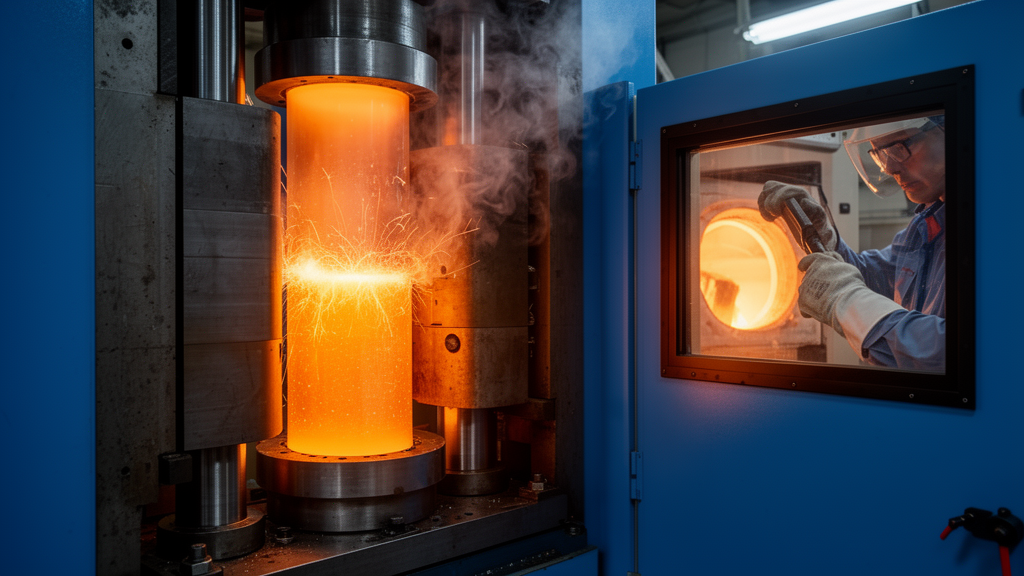
An experimental hot-compression study of a Mg–Gd–Y–Zn–Mn alloy identified a predicted optimum hot-working window of 420–500 °C at a strain rate of approximately 0.01 s−1. The study also found that the dominant recrystallization mechanism changed with deformation conditions, while second phases influenced grain-boundary movement and the resulting microstructure. These findings are summarized in the article’s published abstract; the available evidence does not include the full study for assessment.
For the analysis, the researchers established a strain-compensated hyperbolic-sine Arrhenius constitutive model and constructed hot-processing maps. The model showed a correlation coefficient of R = 0.992, a root mean square error of 8.992 MPa, and an average absolute relative error of 7.283%. The reported processing maps were used to divide the deformation conditions into instability, instability-edge, and stable regions. The work examined dynamic recrystallization mechanisms and assessed the roles of second phases under the different deformation conditions.
Microstructural analysis indicated that deformation in the instability region was dominated by prismatic <a> slip. The dynamic recrystallization fraction there was below 10%, and discontinuous dynamic recrystallization was the primary mechanism, while continuous dynamic recrystallization was suppressed by lamellar long-period stacking-ordered phases. At the instability edge, prismatic <a> slip remained dominant, with limited basal and pyramidal slip; discontinuous dynamic recrystallization also dominated this region. In the stable region, several slip systems were active simultaneously, and distinct Orowan looping was observed.
At high temperatures, most lamellar long-period stacking-ordered phases dissolved. The phases that remained undissolved, together with α–Mn particles, inhibited grain-boundary migration and were associated with a bimodal grain structure. The study therefore connects the alloy’s hot-processing conditions, deformation mechanisms and recrystallization behavior with the influence of its second phases. Because the supplied source is an abstract and subscription preview, details such as specimen dimensions, deformation conditions beyond those reported, replicate numbers and the limits of the processing map cannot be independently evaluated from the available evidence.
Subject of Research: Hot-deformation mechanisms and dynamic recrystallization in a Mg–Gd–Y–Zn–Mn alloy
Article Title: Investigation on deformation mechanism and recrystallization behavior of a Mg–Gd–Y–Zn–Mn alloy by hot compression
Article References: Zhang, M., Jiang, J., Luo, H., Ye, Y., & Chen, X. (2026). Investigation on deformation mechanism and recrystallization behavior of a Mg–Gd–Y–Zn–Mn alloy by hot compression. Journal of Materials Science, 61(43), 34124-34146. https://doi.org/10.1007/s10853-026-13758-w
Image Credits: AI Generated
DOI: 10.1007/s10853-026-13758-w
Keywords: Mg–Gd–Y–Zn–Mn alloy, hot compression, dynamic recrystallization, constitutive modeling, processing maps, deformation mechanisms, LPSO phases, microstructure, Orowan looping, grain boundaries, Investigation, deformation
Cite Scienmag News
Neil Sanderson. (October 20, 2026). Hot compression study maps recrystallization in Mg–Gd–Y–Zn–Mn alloy. Scienmag. https://scienmag.com/hot-compression-study-maps-recrystallization-in-mg-gd-y-zn-mn-alloy/
Neil Sanderson. "Hot compression study maps recrystallization in Mg–Gd–Y–Zn–Mn alloy." Scienmag, 20 October 2026, https://scienmag.com/hot-compression-study-maps-recrystallization-in-mg-gd-y-zn-mn-alloy/. Accessed 20 October 2026.
Neil Sanderson. "Hot compression study maps recrystallization in Mg–Gd–Y–Zn–Mn alloy." Scienmag. October 20, 2026. https://scienmag.com/hot-compression-study-maps-recrystallization-in-mg-gd-y-zn-mn-alloy/


