


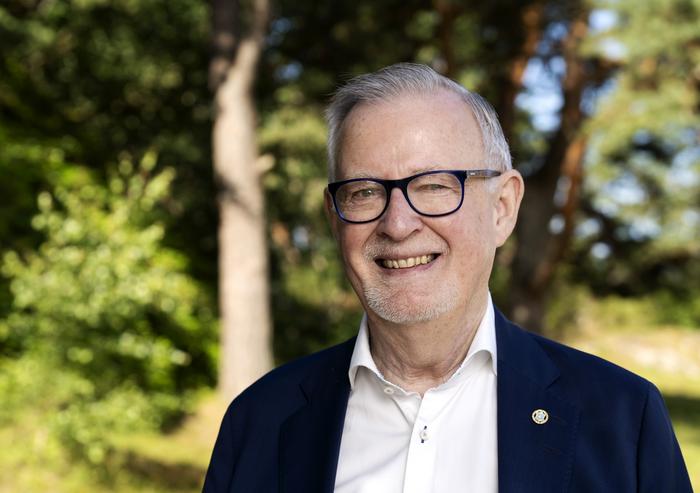
Anders Olauson, initiator of the Ågrenska Foundation, has been awarded an honorary doctorate in medicine at Sahlgrenska Academy at the University of Gothenburg. He has been recognized for his many years of far-sighted commitment to rare diseases.

Credit: Photo by Johan Wingborg
Anders Olauson, initiator of the Ågrenska Foundation, has been awarded an honorary doctorate in medicine at Sahlgrenska Academy at the University of Gothenburg. He has been recognized for his many years of far-sighted commitment to rare diseases.
Anders Olauson, born in 1950, has had a significant impact on Sahlgrenska Academy’s research and education on rare diseases. He has inspired and enabled researchers to come together in connection with many of these health conditions.
The Faculty Board at Sahlgrenska Academy appointed Anders Olauson as an honorary doctor of medicine, and highlights his achievements within the faculty’s areas of interest in terms of pediatrics, pediatric surgery, and clinical genetics.
“Anders Olauson’s work as the driving force behind the Ågrenska Foundation, with all that it involves – both for patients and for research and education within the field of rare diagnoses, in Sweden and around the world – cannot be overemphasized,” says Professor Jenny Nyström, Dean and Chair of the Faculty Board at Sahlgrenska Academy. “I am therefore proud and delighted that he has now been awarded an honorary doctorate in medicine at Sahlgrenska Academy.”
A beautiful location on Lilla Amundön
We met Anders Olauson for a photo shoot at Ågrenska, a non-profit national competence center with a beautiful location on the island of Lilla Amundön, south of Gothenburg.
Anders Olauson initiated the Ågrenska Foundation in 1985, bringing together five key players within the field of rare diseases among children: healthcare providers, schools, social services, the Swedish Social Insurance Agency, and patient representatives.
Operations began a few years later, in partnership with Sahlgrenska Academy and the Queen Silvia Children’s Hospital at Sahlgrenska University Hospital. At Ågrenska, visitors encounter a holistic world where educational teams and healthcare professionals arrange family stays.
Children from all around Sweden come here with their families for weeks at a time, with a focus on their child’s health condition. Here, parents and guardians can listen to experienced medical teams and researchers sharing the latest scientific findings.
Resident physicians from the Queen Silvia Children’s Hospital also come to Ågrenska to gain a better understanding of patients, relatives, and communicating research findings. The public dental service’s Mun-H-Center specialist clinic is also represented and carries out research together with Ågrenska on the dental status and oral motor skills of the patients, who often have nutritional problems.
An international ripple effect
In addition to his tireless commitment to Ågrenska, Anders Olauson was a member of the National Board of Health and Welfare’s Advisory Council for several years. Thanks to its excellent reputation under Anders Olausons’ leadership, Ågrenska is responsible for the scientific texts on rare diseases in the agency’s knowledge database.
Operations stepped up a gear with the formation of the Ågrenska Academy, in a new building nearby with lecture halls and group rooms. The initiative has resulted in several theses at the University of Gothenburg, including on siblings’ experiences of the situation.
The work carried out by Ågrenska and Anders Olauson has attracted considerable attention, and has had an international ripple effect. Similar operations have been established in other countries, including Estonia and Portugal, and his expertise has been acknowledged by the European Organisation for Rare Diseases, the European Patients’ Forum, the EU’s Horizon 2020 program, the European Commission, and the UN. Anders Olauson contributed to member states’ unanimous approval of the 2021 UN Resolution on Rare Diseases.
Anders Olauson has previously been awarded HM The King’s Medal in silver, 8th size with the ribbon of the Order of the Seraphim, and the City of Gothenburg’s Medal of Merit.
Cite Scienmag News
Courtney Benton. (July 3, 2024). Honorary doctor with a focus on rare diseases. Scienmag. https://scienmag.com/honorary-doctor-with-a-focus-on-rare-diseases/
Courtney Benton. "Honorary doctor with a focus on rare diseases." Scienmag, 3 July 2024, https://scienmag.com/honorary-doctor-with-a-focus-on-rare-diseases/. Accessed 5 September 2026.
Courtney Benton. "Honorary doctor with a focus on rare diseases." Scienmag. July 3, 2024. https://scienmag.com/honorary-doctor-with-a-focus-on-rare-diseases/

